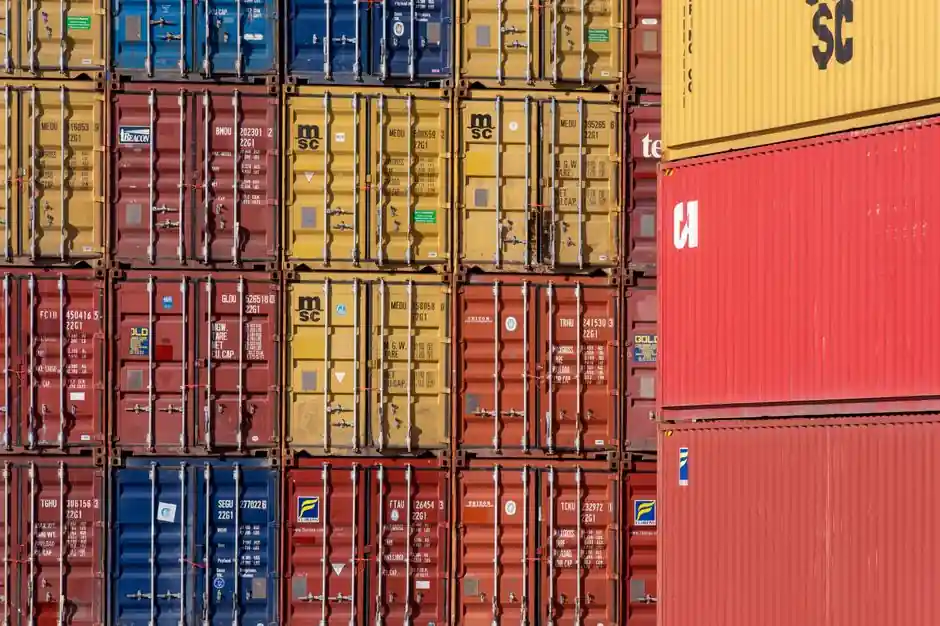
An automated stacking crane (ASC) is a rail-mounted gantry crane that runs without a human driver, placing ISO standard 20, 40, and 45 ft containers to within +/- 50 mm using laser-based guidance while the gantry itself can travel at up to 5 m/s along the rails [S1][S4].
Two ASCs typically share a pair of rails per yard section, span roughly 33.5 m (110 ft) wide, stand about 24 m (80 ft) tall, and stack up to 10 rows of containers five high, a footprint that defines the modern automated container block [S1][S4].
Fixed rails and a separated yard are the physical prerequisites
ASCs are deployed in dedicated stack lanes that are physically separated from any area where manned vehicles operate, a layout decision the gantry crane architecture makes mandatory rather than optional [S3]. Containers arrive at a handover point at the seaside or landside end of the lane, where the ASC picks them up and stores them under instructions from the terminal operating system; the reverse path handles retrieval for vessel or truck loading [S3].
Because the rails are fixed, the crane's motion is fully programmable, which is the precondition for unmanned operation: the gantry, trolley, and hoist axes move on deterministic paths with no steering or driver input [S1][S4].
Positioning stack: laser rangefinders, transponders, and encoders
Each ASC carries more than 20 three-phase 460 V motors, each driven by its own variable frequency drive, split across four functional groups: 2 main hoist motors, 4 trolley motors for across-stack travel, 12 gantry motors for along-rail travel, and 4 motors for spreader skew and sway control [S1][S4].
Positioning is a three-layer stack of sensors. Automatic position indication uses laser rangefinders to measure gantry, trolley, and hoist position directly, which compensates for rope stretch and wheel slippage rather than inferring position from motor counts [S1][S4]. The automatic landing system then uses laser scanners on the trolley to measure spreader position relative to the container below during the final approach [S1][S4].
Along-rail position is fixed by an antenna on the crane reading transponders embedded in the rail surface, giving an absolute reference independent of wheel slip [S1][S4]. A second optical axis scanner picks up container ends, while the primary optical positioning system measures distance and angle to the container, the spreader, and the target slot before every pick or place [S1][S4].
Control system replaces the operator, with a defined manual fallback
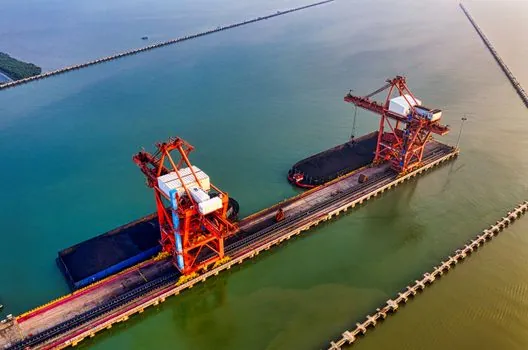
The control system chooses every container move instead of a human operator, exchanging the move instructions and status data with the terminal operating system through a defined interface [S2]. Above the operator station, a digital twin of the entire container yard provides a real-time virtual representation used for monitoring and exception handling [S5].
Manual intervention is reserved for a narrow case: if the spreader cannot latch to the container anchor points within a defined margin, the operator takes control from the station; outside that exception the system runs itself [S5]. This is why an ASC yard is best understood as a control loop between the terminal operating system, the crane's PLC layer, and the optical positioning stack, rather than a remote-controlled machine [S1][S4].
Throughput reality: continuous hours, slower automated interchange
Because ASCs have no shift changes or meal breaks in the same way manned equipment does, they can sustain longer operating windows, which is the dominant economic argument for brownfield conversion from RTG or straddle carrier operations [S3]. Brownfield transitions benefit from a phased ramp-up, often starting with a 40-container discharge flow to verify system interaction before scaling to the full yard [S3].
The flip side is that automated interchange, the hand-off between external transport and the ASC, is typically slower than manual interchange because of the positioning time the automation stack requires, so business cases that assume a 1:1 throughput match with manned equipment tend to overstate early-phase performance [S3].
Hardware envelope and sensing limits to budget for
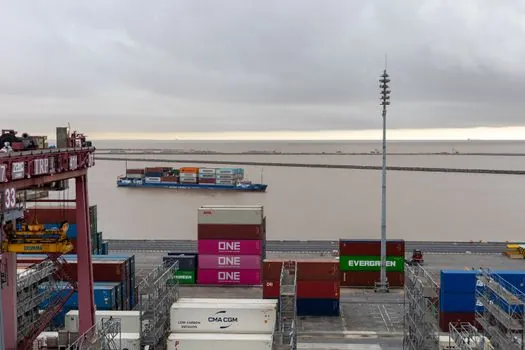
A 40 ft container can weigh up to 40 t while the gantry is moving at 5 m/s, which sets the dynamic loading that the positioning stack and the anti-sway control have to handle during every move [S1][S4]. With a stack section stretching up to 400 m, the transponder array under the rails and the laser scanner field of view are sized for that full travel length, not a single block [S1][S4].
For comparison with neighbouring yard equipment, an AGV robot under the quay cranes handles horizontal transport on the apron with a different guidance and traffic model, while a truck-mounted crane is a flexible but un-automatable option for terminals that have not committed to fixed infrastructure. Process engineers planning a new build typically compare the three on storage density, peak throughput, and civil works cost, which is where ASCs win at the cost of the higher initial rail and power infrastructure.
Standards and sizing hooks the spec writer needs
Container dimensional compliance is to ISO 1496/ISO 668 family 20, 40, and 45 ft units, which the spreader and twist-lock geometry must match; the ASCs covered in the technical literature handle all three sizes on a single machine [S1][S4]. Crane electrical architecture, with more than 20 VFD-driven 460 V three-phase motors per machine, points spec writers to IEC 61800 series drives and IEC 60204-1 machine electrical safety as the baseline control-panel reference [S1][S4].
For yard-level design, the fixed-rail and traffic-separation model means the safety case should treat the ASC lane as a guarded zone with restricted human access, much like a truck-mounted concrete pump deployment zone, but enforced by the control system rather than by exclusion tape. Where the optical positioning system cannot resolve the target, the defined latch margin before manual takeover is the line between autonomous and attended operation [S5].
For spec sheets, the verifiable next nodes are: the transponder spacing and count along a 400 m lane, the refresh rate of the optical positioning system, and the PLC-to-TOS message cycle, all of which set the practical upper bound on moves per hour per crane. Trackable signals for 2026 are the second-edition publication of the Port Economics, Management and Policy reference, which now standardises the control-station and digital-twin description in its container terminal automation chapter [S5].
Related analysis: Industrial Solvent Selection by Evaporation Rate and Flash Point.