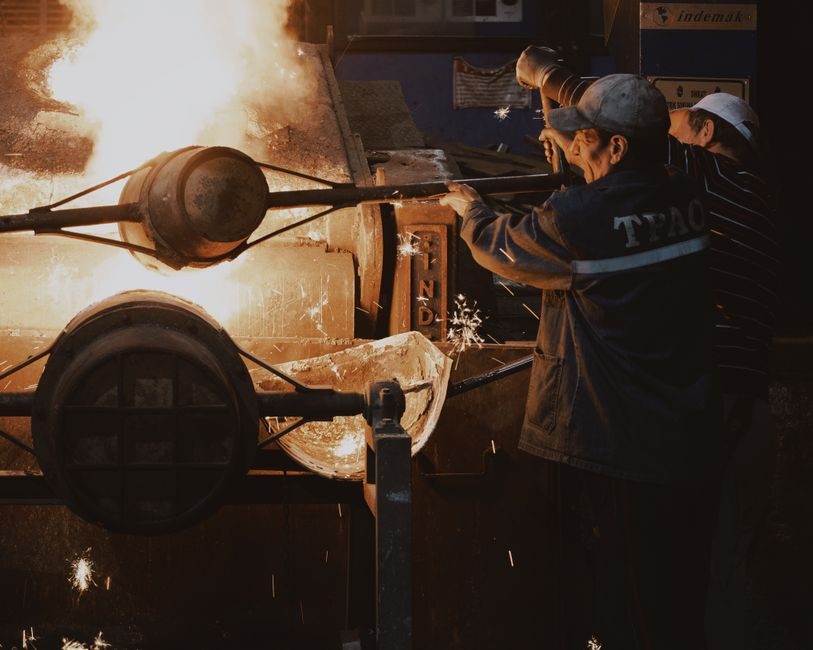
Cast aluminum selection is driven by four intersecting constraints: the casting process, the alloy's nominal chemistry, the operating environment, and the post-casting heat treat. The Aluminum Association cast designation system groups alloys into families 1xx.x through 9xx.x, with 3xx.x (Al-Si-Mg / Al-Si-Cu) accounting for the majority of commercial castings in automotive, pump, and electronics-housing applications [S4].
Selection starts with the question "what process will pour this part?" because each process has a different fluidity, solidification range, and as-cast tolerance envelope. Sand, permanent mold, die casting, and investment casting all favor different alloy families, and picking an alloy outside the process's solidification window is the single most common root cause of misruns and hot tearing [S1] (2025-11).
Match the Alloy Family to the Casting Process
The 3xx.x family (Al-Si with Mg) is the default choice for high-pressure die casting because near-eutectic silicon (typically 7-12% Si) gives the melt the fluidity needed to fill thin walls down to 2-3 mm before the skin freezes [S1] (2025-11). Alloys such as A380 and A383 are the workhorses for die-cast housings, brackets, and electronic enclosures because they balance castability, machinability, and pressure tightness.
For sand and permanent-mold work, the 3xx.x family still dominates but the spec window widens: lower Si variants (5-7%) such as 356.0 / A356 give better mechanical properties after T6 heat treatment and are the standard for structural castings like wheels, pump bodies, and aerospace fittings [S4]. Permanent mold also accepts the 2xx.x family (Al-Cu), which retains strength above 200 °C but feeds poorly and demands hot-topping — pick it only when elevated-temperature duty is non-negotiable [S1] (2025-11).
The 4xx.x family (Al-Si, high Si, no Cu) is the right call for sand castings where wear resistance matters — engine blocks, pistons, and large pump housings. With 5-13% Si and no copper to age-harden, 4xx.x is dimensionally stable but softer than the 2xx.x and 3xx.x alternatives.
Compare the Main Cast Alloy Families on Four Decision Criteria
Buyers usually shortlist alloys against four criteria: as-cast tensile strength, corrosion resistance, machinability, and thermal conductivity. The table below lines up the four most common families a sourcing engineer will see on an RFQ: [S3]
Family 2xx.x (Al-Cu): tensile 220-280 MPa T6, corrosion resistance poor (requires coating or cladding), machinability good, thermal conductivity ~150 W/m·K. Use only when the part runs hot — engine heads, helicopter housings — and the buyer accepts a coating step.
Family 3xx.x (Al-Si-Mg): tensile 200-260 MPa T6 for A356/A357, corrosion resistance good, machinability good, thermal conductivity ~150-160 W/m·K. The default pick for structural sand/permanent-mold castings and high-pressure die castings where post-c weld-repair is not required [S1] (2025-11).
Family 4xx.x (Al-Si, high Si): tensile 150-200 MPa as-cast, corrosion resistance good, machinability fair, thermal conductivity ~120-130 W/m·K. Specify when wear, dimensional stability, or low thermal-expansion tooling fitment matters more than peak strength.
Family 5xx.x (Al-Mg): tensile 150-200 MPa, corrosion resistance excellent (marine duty), machinability fair, thermal conductivity ~130 W/m·K. The right pick for marine hardware, food-contact parts, and any casting that sees salt water or aggressive chemicals — at the cost of being harder to cast and prone to porosity if Mg is not degassed properly [S1] (2025-11).
Heat Treatment, Temper, and What T6 Actually Buys You
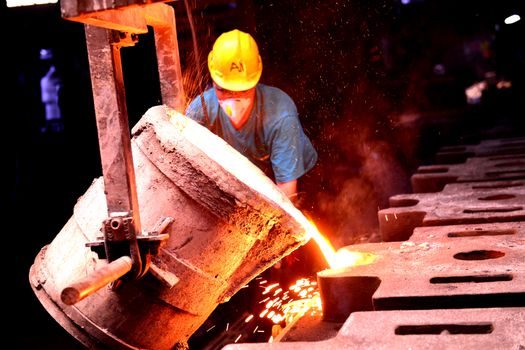
Most 3xx.x and 2xx.x castings are sold in a T6 temper: solution heat treat, quench, then artificial age. For A356-T6, typical properties are tensile strength ~228 MPa, yield ~152 MPa, and elongation ~6%, vs the as-cast F temper of ~159 MPa tensile, ~83 MPa yield, ~6% elongation [S4]. That delta is the entire reason buyers pay for T6 — it converts a casting into a structural part.
For die castings, T6 is rarely used because the rapid solidification traps gas porosity, which blisters during solution treatment. Die-cast parts are usually specified as F (as-cast) or T5 (artificial age only). If a buyer insists on T6 die casting, expect a premium for vacuum-assist die casting or for hot-isostatic pressing to close internal porosity [S1] (2025-11).
The temper designation should be written explicitly on the print: "A356-T6" is not the same as "A356-F" or "A356-T51". Conflating the two is one of the most expensive spec errors on a casting RFQ.
Standards, Designations, and What to Put on the Print
U.S. buyers should reference the Aluminum Association cast designation (e.g., A356.0, A380.0, 535.0) together with the temper code. European buyers typically cross-reference the same AA designations against EN 1706 (Aluminum and aluminum alloys — Castings — Chemical composition and mechanical properties) for sand and gravity castings, and EN 1676 for ingots. Japanese and Chinese suppliers will recognize JIS H 5202 and GB/T 8733 respectively — the AA designation is the lingua franca in 80% of cross-border RFQs [S1] (2025-11).
For aerospace and defense, the spec stack usually starts with the AA designation and adds a registered temper or a proprietary OEM variant (e.g., A357-T6 per AMS 4214). For automotive structural parts, the spec typically ends at AA + temper + a corrosion requirement (often ASTM B117 salt-spray hours).
Always state the inspection lot: radiographic severity per ASTM E192 (for aerospace) or per ASTM E155 for commercial, plus the pressure-tightness test if the part is a hydraulic or pneumatic housing.
Where the Common Pick Fails — and When to Step Off It
3xx.x is not the right answer for every job, and pushing it into the wrong duty is the second most expensive mistake after mis-typing the temper. If the casting runs above ~200 °C continuously, switch to 2xx.x or a high-temperature Al-Si-Cu variant — 3xx.x ages over and loses yield strength at those temperatures [S1] (2025-11).
If the part lives in salt water, atmospheric marine, or a caustic chemical environment, do not specify 2xx.x and do not specify any 3xx.x with >0.5% Cu. The copper forms galvanic cells and pits aggressively. The 5xx.x family or a silicon-only 4xx.x is the only sound call.
If the part is a thin-wall die casting with cosmetic Class-A surface requirements (consumer electronics, visible automotive trim), specify A383 or A384 over A380. A380 has a wider freezing range and is more prone to solder-flash and die-sticking, which shows as surface defects.
Real Use Cases and Sourcing Signals
Automotive: wheels, suspension knuckles, and engine cradles are almost universally A356-T61 or A357-T6 sand or low-pressure permanent-mold castings. Die-cast transmission housings are A380-F or A384-F. The shift to large integrated die-cast chassis parts (e.g., "gigacasting") is driving demand for vacuum-assisted high-pressure die casting of modified 3xx.x alloys with tighter Fe/Mn control [S1] (2025-11).
Industrial pumps and valves: 356.0-T6 for the body, B443.0-F (4xx.x) for the impeller when abrasion resistance is needed. For brackish-water service, 535.0 (5xx.x) is the standard cast aluminum for pump housings.
Electronics and consumer goods: A380 and A383 for die-cast enclosures; A360 (tightest die-cast alloy under ASTM B85) where pressure tightness matters, e.g., hermetic RF housings. The casting price band for these alloys in 2026 sits roughly $2.5-6.0/kg finished part for high-pressure die castings in Asia, with permanent mold and sand adding 20-60% premium for tooling and lower volume [S3] (2026-05).
For a broader view of the upstream aluminum market — ingot price, secondary alloy supply, and the aluminum alloy family at large — the SourceBySpec ingot market map tracks current capacity and price stack. Buyers sourcing thin-wall consumer enclosures that pair castings with cast iron inserts or steel fasteners should also weigh the galvanic-compatibility stack documented in the cast iron encyclopedia entry. For buyers who need to compare die casting machine capacity to downstream coil demand, the aluminum die casting machine and aluminum coil vs die casting machine cross-references are the right next read.
Limitations, Failure Modes, and Inspection Anchors

Cast aluminum is unforgiving of three things: improper melt degassing (gas porosity), wrong pouring temperature (cold shuts, misruns), and a heat-treatment recipe that does not match the alloy's quench sensitivity. The first is controlled by in-line rotary degassing with argon or nitrogen to <0.15 ml/100g H; the second by process-control charts on the casting cell; the third by a documented T6 recipe (e.g., 538 °C ± 5 °C for 8-12 h, water quench at 70-80 °C, age at 155-175 °C for 3-6 h for A356-T6) [S4].
Mechanical testing on a representative coupon (separately cast test bar, or a section cut from the casting itself per ASTM B557) is the only reliable way to verify a T6 temper — mill certs from the heat are necessary but not sufficient.
Trackable signals for buyers over the next quarter: the 3xx.x ingot spot price relative to A380 delivered, the lead time for permanent-mold tooling in low-cost regions, and any 2026 revision to EN 1706 chemical-composition tables. Lock the alloy designation and temper on the print, then track those three numbers rather than chasing the lowest unit price — a 4% cheaper quote that misses the heat-treat spec is a 100% rework cost.