
A diaphragm valve is selected by pressure class, temperature, media compatibility, and hygiene tier, not by brand — the elastomer and body geometry decide 80% of the service life.
Two recent OEM product sheets bracket the practical envelope: the SISTO CM1200 multiport block runs DN6–DN150 at up to 20 bar (290 psi) in stainless steel [S1], while the Alfa Laval DV-ST UltraPure ships DN8–DN100 at 0–10 bar (0–145 psi) from -40 °C to 175 °C with EPDM, PTFE/EPDM, and TFM/PTFE diaphragms [S2]. Anything outside that envelope is the wrong valve class.
Body geometry: weir, straight-through, or multiport block
Diaphragm valves come in three body geometries and the geometry is chosen by flow profile, not by line size. A weir-type body has a raised seat that the elastomer presses against; it gives tight shut-off on clean liquids and slurries but the raised boss causes pressure drop and is the first place fibres or crystals hang up. A straight-through (full-bore, often called “full-port”) body has no weir, so it handles fibrous media, high solids, and viscous polymers with the lowest Cv loss in the class [S1]. A multiport block geometry — the one SISTO builds in the CM1200 — replaces welded header piping with a single stainless block offering 6 or more channels, minimised deadleg, and CIP/SIP-ready internal chambers, with stated pressure rating 20 bar across the DN6–DN150 range [S1].
For new spec sheets, write the geometry decision first: weir for clean pharma/water duty, straight-through for slurries or fibres, multiport block only when several isolation or change-over paths would otherwise need welded manifolds.
Liner and elastomer: EPDM vs PTFE vs TFM/PTFE vs FKM
The diaphragm and any wetted liner are the consumables, so selection is driven by chemistry, temperature, and steam cycle count, not by body material. Alfa Laval lists three diaphragm grades on the DV-ST UltraPure: EPDM rated for continuous steam at 150 °C, PTFE/EPDM as a general-purpose barrier, and TFM/PTFE for higher-purity and higher-temperature sanitary service [S2]. SISTO likewise notes that the compact chambered sealing system is engineered to be replaced without breaking the body-side welds on the multiport block [S1].
Field rule: pick EPDM for hot water, steam, and CIP alkaline cleaners up to ~150 °C; pick PTFE-faced diaphragms whenever the media attacks EPDM (strong oxidizers, certain solvents) or when extractables must be minimised; pick FKM/Viton when the duty is hydrocarbon or solvent at modest temperature, and budget for shorter flex life. Goyen-style replacement diaphragm kits (EPDM, Viton, NBR) on 1/2″–2″ pulse valves are a useful benchmark for elastomer-only spares inventory [S6].
Actuation: manual lever, pneumatic, or electric
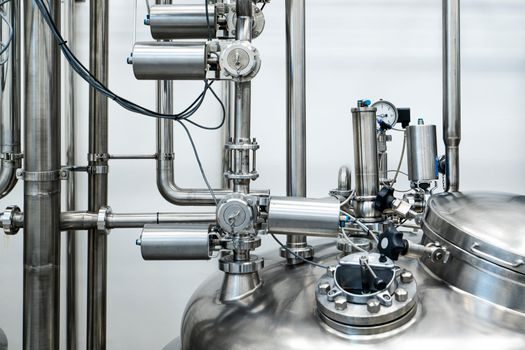
Manual lever operation gives fine throttling, over-closure protection, and zero air consumption — Alfa Laval’s manual handle on the DV-ST UltraPure is described as having “standard over-closure protection to help prolong diaphragm life” [S2]. Pneumatic actuation on the same body covers on/off or modulating control up to 10 bar product pressure, with actuator selection constrained by diaphragm material and valve size [S2]. SISTO’s CM1200 ships as a manual or pneumatically-operated shut-off block, sized to ISO/DIN face-to-face dimensions, which is what lets it drop into a multi-valve skid [S1].
Use manual on isolated sample lines, low-cycle bypasses, and any point where instrument air is unreliable. Use pneumatic where the valve is tied into a PLC or where a hygienic process must be repeatable across many cycles per shift; for ATEX zones, verify the actuator carries the right category marking before specifying it on a sanitary skid [S2].
Pressure, temperature, and size envelope
Two numbers from the public spec sheets define the safe envelope for stainless sanitary diaphragm valves in 2026: max 20 bar (290 psi) for multiport blocks at DN6–DN150 [S1], and 0–10 bar (0–145 psi) at -40 °C to 175 °C for 2-way hygienic bodies at DN8–DN100 [S2]. Sanitary double-angle-seat variants, which share the same bonnet geometry, are typically limited to lower pressures and are specced for clean-in-place booster service rather than line shut-off [S5].
If a duty exceeds 20 bar or 175 °C, a diaphragm valve is the wrong primary isolation device; a ball valve or a butterfly valve rated to the same line class should be the first line of defence, with the diaphragm valve retained for the chemical or hygienic trim.
Connection, surface finish, and documentation tier
Connection standard is the second most common spec error. Sanitary tri-clamp, DIN 11851, and ISO 2852 all look similar but are not interchangeable; OEM data sheets for the DV-ST UltraPure list a modular body in stainless steel with low-Ra surface finish, optional high-alloy body, and the Alfa Laval Q-doc documentation package for validation [S2]. For multiport blocks, the SISTO CM1200 data explicitly references ISO and DIN face-to-face dimensions to keep the block interchangeable with standard actuator footprints [S1].
Pharma and biotech buyers should request surface finish (typical Ra ≤ 0.8 µm or better), ferrite content (low-ferrite standard, high-alloy optional per Alfa Laval), material traceability, and the Q-doc / EN 10204 3.1 certificate set up front. Skipping these creates validation cost later that dwarfs the valve price difference.
When a diaphragm valve is the wrong choice
Do not pick a diaphragm valve as the mainline block valve on a high-pressure steam header above 20 bar, on abrasive slurries with sharp particles, or where the duty calls for metal-to-metal fire-safe shut-off in hydrocarbon service — those go to ball valve or butterfly valve territory with the right fire-test certification. Do not pick a weir-type sanitary diaphragm for fibrous or high-solids media; go straight-through. Do not specify pneumatic actuation on a hygienic skid without confirming ATEX category and air-quality class for the actuator [S2].
Buyers looking for the broader process-valve sourcing picture in 2026 will find overlap with the control valve suppliers map, and the solenoid valve shortlist for data-center cooling is a useful reference for how pneumatic-actuated valve classes are specced on instrument air. For plants that already use Goyen-type diaphragm pulse valves, the same elastomer grading (EPDM/Viton/NBR) carries over from the diaphragm pump spares logic.
Shortlist logic and trackable signals
Shortlist in this order: (1) confirm pressure/temperature envelope against [S1] and [S2]; (2) pick body geometry by media; (3) pick elastomer by chemistry and steam cycle; (4) pick actuation by control requirement and air availability; (5) lock connection standard, surface finish, and documentation tier before requesting quotes. Track two signals through 2026: published max-temperature ratings on TFM/PTFE diaphragms (Alfa Laval currently publishes 175 °C on the DV-ST UltraPure [S2]), and any tightening of ASME BPE or EN 12255 surface-finish language that would push Ra limits below the current sanitary norm.