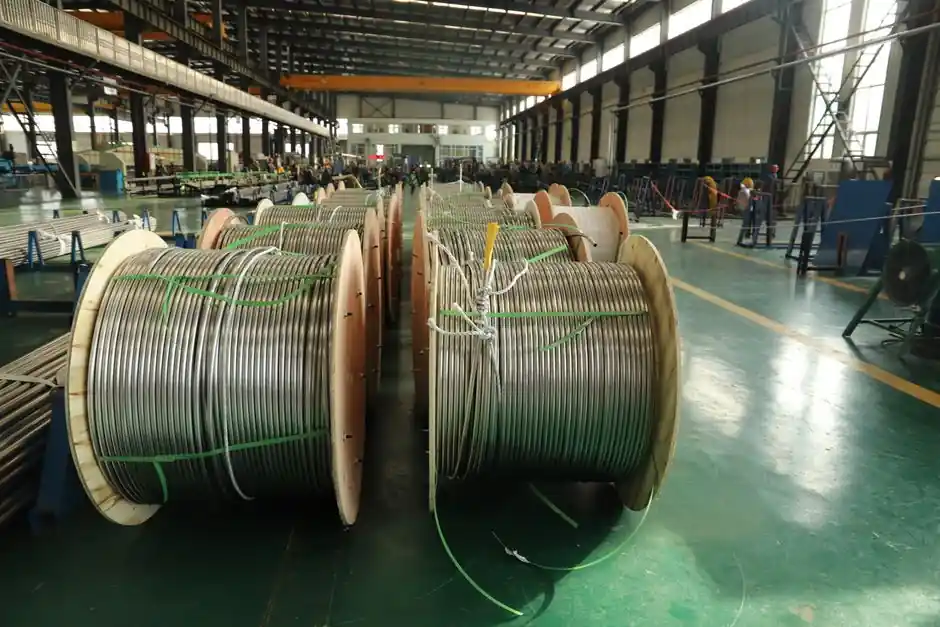
Spec a power cable by gating on conductor material, insulation polymer, voltage class, and armour type, then sanity-check the run against ampacity tables and the route environment.
The realistic market range in 2026 covers 0.6/1 kV low-voltage distribution, 6.35/11 kV and 12.7/22 kV medium voltage, and 33 kV supertension, with conductor cross-sections stocked from 1.5 mm² up to 400 mm² in copper and 25 mm² to 300 mm² in aluminium [S3]. Choosing wrongly wastes conductor copper on under-loaded runs or under-sizes a feeder until the insulation fails, so the four gates below belong on every requisition sheet.
Gate 1, Conductor Material: Copper vs Aluminium
Copper and aluminium remain the only two industrial-grade options, and the decision is almost always a trade between cost per amp, weight, and joint reliability [S1][S9]. A copper conductor of the same cross-section carries roughly 1.6x the sustained current of an equivalently sized aluminium conductor and weighs about 2.0x more, which matters for long vertical drops and tray-fill calcs [S5].
Pick copper when the run is short, the joint count is high, vibration exists (motors, generators, mobile equipment), or the spec sheet calls for flexible Class 5 stranding; pick aluminium when the feeder is over 50 m, the cross-section lands above 95 mm², and the terminators are designed and torqued for Al [S1]. For mixed-metal transitions, use bi-metallic connectors and never mix Cu/Al conductors inside the same compression lug without a cable maker's datasheet to back it.
Gate 2, Insulation Polymer: PVC vs XLPE vs FR/FRLS
Insulation polymer sets the upper conductor temperature, the flame behaviour, and the halogen content on a fire event, and the wrong choice voids the cable's compliance with the route's fire code [S1][S3]. PVC compounds typically rate to 70°C conductor temperature, while XLPE rates to 90°C continuous and 250°C on short-circuit, which is why XLPE has displaced PVC in most mining, utility, and industrial MV runs [S3]. Cablemack's low-voltage range is now predominantly XLPE-insulated, with SWA armour, and is offered in FR, Low-Halogen (LHC), and Halogen-Free (HFC) variants, all built to SANS 1507 [S3].
Spec FR-PVC or FRLS where the cable passes through confined public-access or transit routes (subway, data centre plenum, hospital riser) and the spec calls for low smoke; spec HFC where the corridor feeds a life-safety circuit and the code forbids halogens on combustion [S3]. For routine indoor LV distribution in conduit, plain PVC is acceptable and roughly 20 to 30% cheaper than XLPE, but the ampacity table you derate against must be the one for the polymer actually installed, not the cheaper one your estimator priced. Rubber (EPR/Neoprene) and silicone are reserved for welding, trailing, submersible pump, and high-flex portable runs, where conductor temperature and mechanical endurance override cost [S3].
Gate 3, Voltage Class and Conductor Cross-Section
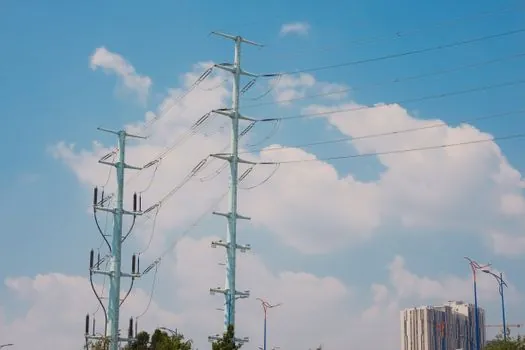
Voltage class sets the insulation thickness, the screen construction, and the applicable standard, and these must align with the system design before any ampacity calc [S3][S7]. The four industrial bands are: 0.6/1 kV (LV reticulation, house wiring, panel feeds, stock sizes 1.5 mm² to 300 mm² copper, 25 mm² to 300 mm² aluminium) [S3]; 6.35/11 kV and 12.7/22 kV (MV distribution, factory feeders, mining; 25 mm² to 300 mm² 3-core copper stocked) [S3]; up to 33 kV (supertension, built to order) [S3]; and 35 kV-class MV built to GB/T 12706 for Chinese infrastructure projects [S7]. For LV flexible cords, IEC designations H05VV-F (300/500 V, PVC) and H07RN-F (450/750 V, rubber) are the usual codespec anchors [S8].
Pick the voltage class one band above the system's line-to-line maximum, then size the conductor from the ampacity table for that polymer and installation method, and only then check voltage drop at the far end of the run [S1][S5]. A common 12 AWG (≈3.3 mm²) flexible cord caps at 600 V with a -40°C to 90°C range, while a 10 AWG PC-200 jumps to 1000 V and -50°C to 105°C, so the polymer and voltage rating move together on the OEM datasheet [S2]. Do not derate a 0.6/1 kV cable to 11 kV service under any circumstance; insulation thickness and partial-discharge behaviour are not linear with voltage.
Gate 4, Armour, Sheath, and Route Environment
Armour and sheath are how the cable survives the route, and the wrong combination is the fastest path to a service call at month six [S1][S3]. Steel Wire Armour (SWA) is the default for underground LV and MV in mining and reticulation, and three-core 11 kV is stocked standard as SWA; single-core 11 kV instead takes Aluminium Wire Armour (AWA) to avoid the magnetic heating loss that steel wire would induce [S3]. Steel Tape Armour (STA or DSTA) and Double Steel Tape Armour are used on paper-insulated lead-covered (PILC) MV feeders where radial protection matters more than tensile strength [S3]. Unarmoured PVC or XLPE is acceptable inside conduit, on cable tray indoors, and in any dry, mechanically benign route; outdoor, underground direct-buried, or exposed runs need UV-resistant PVC, PE, or XLPE sheaths [S1][S2].
Spec the sheath to the worst case in the route, not the average: UV-resistant jacket for any outdoor segment, water-blocking tape or PE sheath for any direct-buried or submersible segment, and APL (Aluminium Polyethylene Laminate) for surfix house wiring on surface runs [S2][S3]. For high-flex portable service, Neoprene Trailing, PVC Nitrile Trailing, and welding cable are the dedicated constructions, and ordinary LV distribution cable should never be substituted on a festoon or reeling drum [S3].
Comparison: Four Common Cable Builds on Selection Criteria
The four builds below are the realistic candidates for a single 11 kV factory feeder or a 0.6/1 kV indoor submain; line them up against four decision criteria before you pick [S1][S3][S7].
Cu/XLPE/SWA 0.6/1 kV: high ampacity per mm², good for indoor submain and tray, 90°C conductor limit, SANS 1507 build, 1.5–300 mm² stocked. Al/XLPE/SWA 0.6/1 kV: low cost per metre, 1.6x larger cross-section for equal amps, demands bi-metallic lugs, 25–300 mm² stocked, SANS 1507. Cu/XLPE/SWA 6.35/11 kV: standard MV feeder, 25–300 mm² 3-core stocked, 90°C continuous 250°C short-circuit, SANS 1339. Cu/XLPE/AWA 6.35/11 kV (single-core): used when the MV run is single-phase or the design calls for single-core trefoil, avoids steel's magnetic loss, same conductor and insulation envelope as SWA.
The deciding question is: is this run indoors on tray, underground direct-buried, or overhead on poles? Indoor tray: Cu/XLPE unarmoured or STA is fine. Underground: SWA with PVC or PE oversheath, Cu or Al depending on length. Overhead: ABC (Aerial Bundled Conductor) with XLPE sheath, aluminium conductor, 600/1000 V to 12.7/22 kV classes, in 1, 2, and 3-core configurations [S3].
Who Should NOT Spec the Default, and Why
Specifying XLPE/SWA Cu on every run is wasteful, and specifying PVC on every run is unsafe in several common cases [S3]. Do not use plain PVC-insulated LV cable in mines, tunnels, or any confined route with life-safety ventilation; the chlorine released on a fire event will corrode switchgear and injure crews faster than the flame itself; the FR, LHC, and HFC variants exist exactly for these routes [S3]. Do not use unarmoured cable in any direct-buried, outdoor, or mechanical-risk route; the sheath is not a substitute for armour, and rodent damage is a known failure mode on agricultural and remote sites [S1][S2].
Do not use copper on long, large feeders (typically above 150 mm² and 80 m) without checking the cable drum weight, tray fill, and the lifting gear on site; aluminium saves weight and cost and is the standard on utility reticulation for exactly this reason [S3]. Do not use a single-core SWA cable on MV three-phase runs; the steel armour on a single core overheats from eddy currents and the cable derates itself by 20 to 30% unless the design explicitly accepts the loss [S3]. For power distribution downstream of the cable, the choice of breaker, busbar, and distribution box has to follow the cable's short-circuit withstand, not the other way around, and the related power distribution box selection guide walks through that match-up.
Standards, Sourcing, and Audit Trail
Every cable on a PO should carry the standard number on the datasheet, not just a vague "IEC compliant" line, because the standard dictates construction, test voltage, and marking [S1][S3][S7]. The realistic set in this market is: SANS 1507 (LV XLPE/SWA, mining and reticulation), SANS 1339 (MV XLPE distribution), SANS 97 (PILC legacy MV), GB/T 12706 (Chinese 0.6/1 kV to 35 kV XLPE family), and the IEC 60502 family for international MV and LV projects [S3][S7]. Manufacturer datasheets also reference UL Listing, RoHS compliance, CE marking, and NEC alignment for North American and export builds [S2].
Insist on a test report (routine AC withstand, partial discharge for MV, and conductor resistance) and a drum-marking photo before sign-off, since unmarked cable is the single most common cause of wrong-cable-installed-on-site incidents in 2026 QA logs. For the upstream power supply side that the cable feeds, the matching power meter and power mixer selection follow a similar datasheet-discipline rule, and the same logic applies to any power tool lead on the construction site: voltage class, conductor size, insulation polymer, and route all written down before procurement.