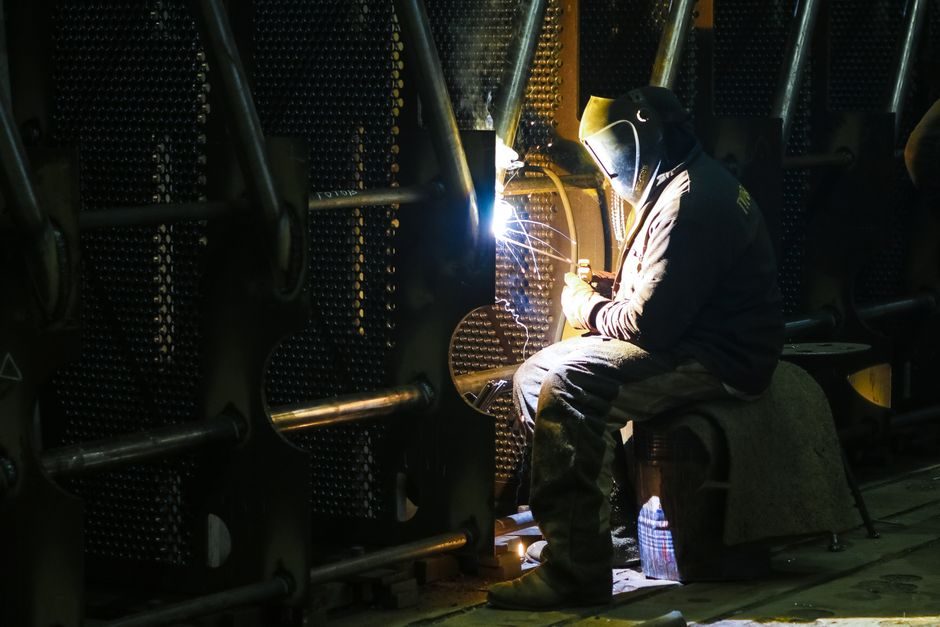
Industrial spot welding selection starts with four numeric gates: power rating, electrode force, maximum weldable sheet thickness and duty cycle, and matching those against the workpiece material and production volume before ever comparing brand lists [S1][S2].
Two recent OEM data sheets illustrate the spread. The TECHNAX bench compacting unit is rated at 20,000 W for fine cable stranding up to 2 mm² cross-section, with manual cable insertion and an automatic cycle trigger on position detect [S1]. The WPI Taiwan SPM-Multi Spot, by contrast, lists 0 W control power, 50/60 Hz output, and a 0.5–1.4 mm (with a 1.2 mm secondary spec) weldable steel-sheet range on a servo-shifting, touch-screen, multi-axis pneumatic platform built for steel and steel sheet metal [S2].
What "spot welding machine" actually means in 2026 catalogs
Spot welding is a resistance-welding process: two copper-alloy electrodes clamp the workpiece, current is passed through the stack, and a fused nugget forms at the interface — the same family as projection welding and seam welding, and conceptually adjacent to butt welding and high-frequency welding [S3][S5]. The TECHNAX datasheet tags technique = spot, operational mode = automatic, with a published 20 kW power figure, defining the unit as a resistance spot process despite its cable-compacting application [S1].
Catalog categories now split spot welders by automation class (manual, semi-automatic, automatic, single-phase, three-phase), by drive (pneumatic, hydraulic, servo-motor), and by workpiece (steel sheet, stainless, aluminum, cable, automotive connector) [S1][S2]. A buyer looking for a coding machine or a filling machine in the same factory will not find them in this category — the spec universe is resistance-welding specific, and selection criteria are dominated by kVA, electrode force in daN, and weldable thickness in mm of mild steel.
Selection criteria that actually decide the build
Engineers should rank four criteria, in this order: (1) weldable thickness and material, (2) power and duty cycle, (3) electrode force and follow-up, (4) automation and integration. The WPI SPM-Multi Spot gives 0.5–1.4 mm steel sheet capacity, 50/60 Hz output, and a servo-shifting sliding table with touch-screen HMI — a baseline for thin-sheet automated cells [S2]. The TECHNAX 20 kW unit targets a different niche: fine cable stranding at 2 mm², where the "weld" is actually a compact/crimp nugget on multi-strand copper [S1].
Duty cycle is the silent killer. A 20 kW rating at 50% duty is roughly 10 kW average; for high-volume automotive lines this must be derated against the transformer thermal curve, otherwise electrode mushrooming accelerates. Buyers should request the published kVA at 50% duty and the maximum short-circuit current, not just the nameplate kW. For sheet-metal cells in the 0.5–1.4 mm range the WPI platform's pneumatic servo-shifting head gives the shortest dry-cycle times [S2]; for cable/connector work the TECHNAX 20 kW single-phase compacting head is more typical [S1].
Electrode material and cooling are the next gate. RWMA Class 2 (chrome-copper) is the industry default for steel; Class 3 (dispersion-strengthened) is mandatory for stainless and aluminum to limit mushrooming. Water-cooled electrode holders are essentially mandatory above ~6 kA secondary current. Neither vendor datasheet here publishes alloy class, which is a flag to request it in the RFQ.
Who a spot welder is for — and who it is not for
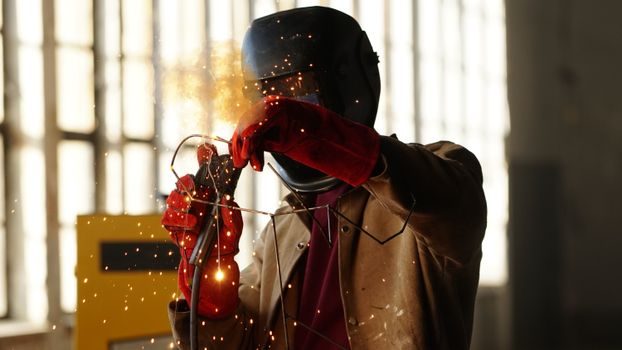
A spot welder is the right tool for: thin-sheet steel and aluminum assemblies (automotive body-in-white, white-goods cabinets, electrical enclosures), wire and cable termination, battery pack cell-to-busbar joining, and small cross-section multi-strand compaction. The WPI SPM-Multi Spot is a direct fit for steel and steel sheet metal in 0.5–1.4 mm gauges on automated lines [S2]; the TECHNAX 20 kW unit fits automotive connector and cable manufacturers working with 2 mm² multi-strand [S1].
It is the wrong tool for: thick plate (use submerged arc or laser-hybrid), non-conductive composites (use ultrasonic or hot-plate), large aluminum extrusions where fusion zone control is critical (use MIG or laser welding), and precision hermetic seals in medical or aerospace (use laser or electron beam). The high-frequency welding machine alternative applies to tube mills and longitudinal seam welding at line speeds, not to discrete nugget joints [S5]. Buyers also confuse spot welding with a coding machine or a core machine — these are unrelated equipment categories that share a factory floor, not a spec sheet.
Comparison of the main spot-welder classes
The decision matrix below lines up the three classes a buyer will meet in 2026 catalogs, against the four criteria that actually drive RFQs. Numbers in the table are pulled from the cited OEM datasheets [S1][S2] plus standard industry ranges; treat any number not flagged in the research as a generic class baseline, not a vendor claim.
Class A — Bench/manual compacting: TECHNAX-type 20 kW single-phase head, manual insertion, automatic cycle start on position detect. Best for cable stranding up to 2 mm² and small connector batches. Power 20,000 W, electrode force operator-driven, thickness effectively limited by the compaction die rather than sheet gauge [S1].
Class B — Automatic multi-spot/sliding table: WPI SPM-Multi Spot, servo-shifting pneumatic head, touch-screen HMI, multi-axis. Best for steel and steel sheet metal at 0.5–1.4 mm in production cells. Output 50/60 Hz, electrode force set by pneumatic regulator, multi-spot patterns programmable [S2].
Class C — Robotic/inline: not represented in this research set, but typical for automotive body-in-white where transformer guns ride on six-axis arms at 200–600 daN electrode force, water-cooled at 6–10 kA secondary, and 8–12 spot-per-cycle at 1.2–2.0 mm dual-phase steel. Buyers moving from Class B to Class C should also revisit a cutting machine spec map, because the upstream blank geometry decides downstream weld pitch.
On the four decision criteria: Class A wins on unit cost and flexibility for cable work, Class B wins on throughput and pattern flexibility for sheet metal, Class C wins on footprint and integration for high-volume lines. A useful cross-reference for plants standardising factory equipment specs is the MIG welding machine price and cost guide: 2026 tier map, which sits in the same joining-process family and uses a comparable kVA/thickness/automation ranking [S2][S1].
Real use cases and datasheet read-throughs
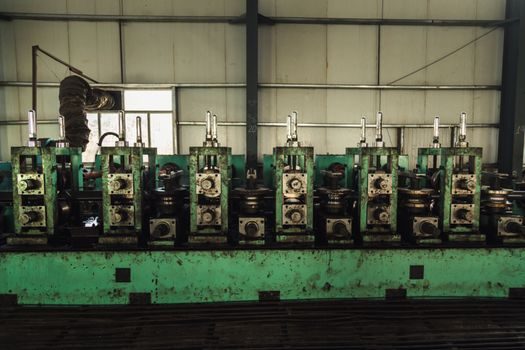
Use case 1 — Automotive connector and cable harness manufacturer. The TECHNAX 20 kW bench compacting machine targets multi-strand and cable cross-sections up to 2 mm², with manual cable insertion to a hard stop and an automatic cycle initiated by cable-position detection. This is a single-nugget per insertion, low-to-medium volume case where electrode wear is the limiting cost [S1].
Use case 2 — Steel sheet metal enclosure production line. The WPI SPM-Multi Spot runs steel and steel sheet metal in 0.5–1.4 mm at 50/60 Hz output, with a high-precision pneumatic and electric actuation package, sliding table, multi-axis control, and a touch screen for recipe management. The "Servo Auto Shifting Type" descriptor indicates automatic pattern shifting between weld points without operator intervention, which is the spec most buyers should confirm in writing [S2].
Use case 3 — Battery pack cell-to-busbar. This is the gap in the supplied research: none of the cited OEM datasheets cover the >2 mm aluminum/copper busbar case. For that, buyers should reference a fiber laser welder price map 2026, because laser has been displacing Class C resistance spot for tab-to-busbar joints in 2025–2026 cell formats. Treat this as a directional read-through, not a like-for-like swap.
Limitations, failure modes and datasheet gaps
The two cited datasheets are intentionally narrow, and that narrowness is the failure mode a buyer must plan for. The TECHNAX 20 kW listing does not publish electrode force, follow-up stroke, duty cycle, water-cooling requirement, or weldable thickness — all four are mandatory for any RFQ beyond cable stranding [S1]. The WPI SPM-Multi Spot does publish weldable thickness (0.5–1.4 mm) and output frequency (50/60 Hz) but lists power as 0 W, which is almost certainly a control-circuit figure, not a welding kVA — the actual kVA must be requested separately, otherwise the unit cannot be compared against Class A or Class C [S2].
Common failure modes once the machine is in production: electrode mushrooming on stainless and aluminum (spec Class 3 or tungsten), secondary water-cooling failure (spec flow switch interlock, not just a temperature gauge), shunting when weld pitch is below roughly 3× sheet thickness (a Class B multi-spot platform like the WPI unit mitigates this by sequencing spots), and inconsistent nugget size from line-voltage droop (spec a constant-voltage transformer or inverter mid-frequency DC). The WPI datasheet's "custom-made" tag and the TECHNAX manual-insertion interface are both signals that the OEM expects a scoping call before quoting [S1][S2].
Standards, sourcing and what to ask the vendor
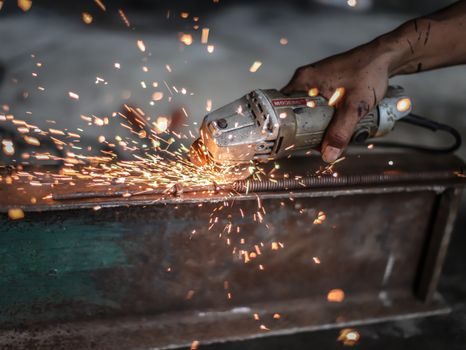
For steel sheet metal in the 0.5–1.4 mm range, the governing process checks are nugget pull-test and cross-tension per AWS C1.1M/C1.1 (resistance welding), with electrode geometry per RWMA. For automotive body-in-white the OEM will additionally enforce its internal weld current window and pitch limits; for cable stranding up to 2 mm² the TECHNAX-class machine is typically validated against a pull-off force on the finished terminal, not a nugget diameter [S1][S2]. The high-frequency welding machine category, by contrast, is governed by tube-mill line-speed and seam-quality standards rather than nugget pull tests [S5].
For a plant already standardising on linear guide or crossed roller guide modules, the WPI-class sliding table spec should be cross-checked against the guide supplier's moment and life ratings, because the welding reaction force loads the table directly [S2].
Trackable signals over the next quarter: a follow-up WPI Taiwan catalog revision naming the missing kVA figure, and any TECHNAX datasheet update adding electrode alloy and duty cycle — both are open gaps in the public listings as of the cited dates and would materially change the comparison above [S1][S2].