A 2026 industrial procurement of a laser welding machine collapses to four spec sheets: laser source and wavelength, maximum power output, sheet thickness range, and the level of automation (handheld, jig, or inline robot). General-purpose fiber-laser welders from 200 W to 2000 W dominate the price-comparison listings, while pulsed Nd:YAG units at 1064 nm remain the default for jewellery, electronics and fine sheet work [S2][S3].
Selection is driven less by brand than by the joint stack the machine will see in production. Stainless steel, carbon steel, aluminium, copper, titanium, gold, silver and K-gold alloys are all advertised as weldable on the same portable platform, but only when the power density, pulse width, and spot diameter are matched to the material's thermal diffusivity [S2]. For process engineers cross-shopping joining methods, the MIG welder selection guide sits adjacent as a useful arc-process comparator.
Source Type and Wavelength — the First Filter
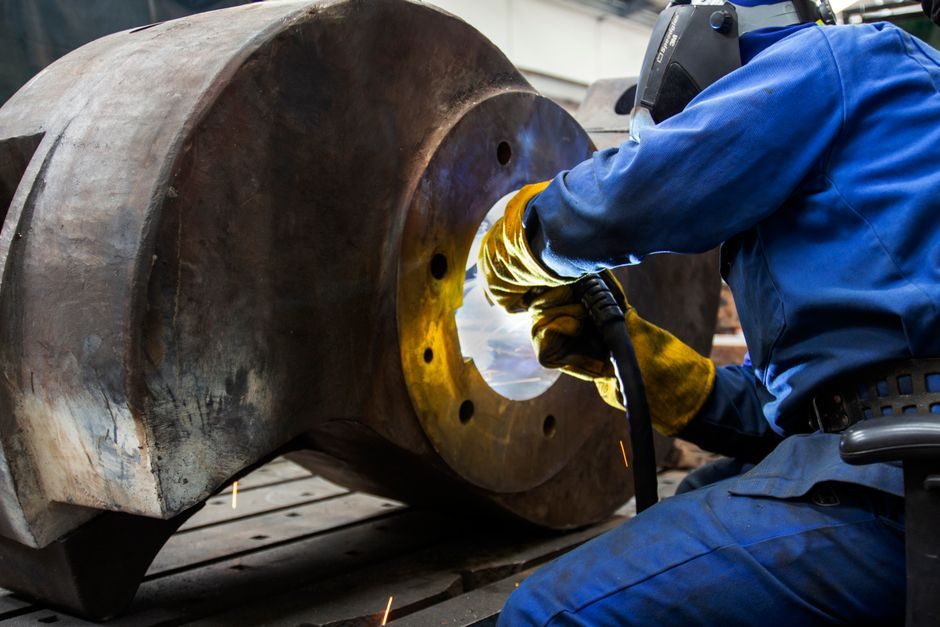
Continuous-wave (CW) fiber lasers and disc lasers in the 1070 nm near-IR band are the workhorses for metal-fabrication shops handling 0.5–6 mm carbon/stainless steel, and they appear as the default source on most 2026 production-line welders [S1]. A REEL CMF circular/longitudinal welding cell, for example, advertises laser, MIG, TIG, plasma, submerged-arc, MAG and hybrid-laser process heads on a single automatic platform, signalling that the laser source is treated as a process module rather than a standalone machine [S1].
Pulsed Nd:YAG at 1064 nm remains the reference source for thin-gauge and high-reflectivity work. The AHL-W75 / W90 / W220 portable series lists 1064 nm wavelength across the full power range, with maximum pulse energies of 50 J, 70 J and 90 J respectively, and adjustable spot sizes from 0.2 to 2 mm — the narrow spot window being exactly what makes the technology usable on jewellery, electronic components, and gold/silver/K-gold alloys without burn-through [S2]. For broader welding-machinery context across arc and beam processes, the industrial gearbox manufacturing process-selection article documents a similar "process module" philosophy.
Power Class, Pulse Energy and Productivity Envelope
Power class is the second hard filter. Below 100 W average power, the unit is a spot/repair tool — fine for electronics, jewellery, and small hole-closing work. The 75 W, 90 W and 220 W AHL-W series all sit in this hand-held desktop category, with a continuous welding frequency of 0.5–20 Hz, pulse width 0.2–10 ms, and a 220 V ±10 % / 50 Hz / 30 A single-phase supply [S2].
From roughly 500 W upward, the same OEM base hardware scales into sheet-metal and structural fabrication. Factory-priced 2000 W fibre-laser welding cells paired with six-axis robot arms appear on Made-in-China as a stock configuration for electronic-enclosure work and similar high-volume stainless/aluminium jobs [S3]. At the top of the envelope, fully automatic longitudinal and circular welding cells are rated for sheet thickness between 0.3 mm and 12 mm depending on the version, with productivity between 20 and 200 parts an hour according to the model [S1]. Engineers comparing this to casting-based fabrication flows can cross-reference the low pressure die casting machine selection guide when planning hybrid metal-forming cells.
Joint Stack and Material — the Compatibility Question
Material compatibility is where most laser-welding projects fail at the quoting stage. A portable pulsed-YAG unit that runs cleanly on stainless, copper, gold, silver and K-gold will burn, crack, or simply not couple on bare aluminium unless the surface is prepared — the 1064 nm wavelength is poorly absorbed by polished aluminium and copper at room temperature, so fibre-laser users on those alloys should expect to budget for beam-wobble, ring-mode optics, or a green-laser (515 nm) option instead [S2][S3].
For thicker structural joints, the laser source is normally paired with MIG or MAG in a hybrid-laser arc configuration to bridge gaps and tolerate fit-up variation. The CMF circular-welder line lists MIG/MAG (mono and twin), TIG, plasma, submerged-arc, laser and hybrid-laser as selectable processes within a single automatic cycle — useful when the same line must turn out cylindrical, rectangular, oval or triangular shells [S1]. Buyers evaluating a fabrication cell that may run both laser and arc heads on the same fixture should treat the metal stamping part selection spec-first buyer's guide as a useful parallel reference for downstream tolerance stack-up.
Automation Level — Handheld, Jig, or Inline Robot
Automation depth is the third spec-axis, and it is where the published catalogue data diverges most. A 75–220 W desktop unit with a microscope observation system, cross-cursor, and high-speed electronic eye-filter is a manual / fixtured tool aimed at sub-millimetre work and one-off repair jobs [S2]. At the opposite end, a 2 000 W fibre-laser head on a robot arm with an integrated enclosure-loading cell is an inline production asset, and its ROI case has to be built on cycle-time and labour-arbitrage, not on weld quality alone [S3].
Mid-range integrated cells — the FLEX-SEAM, CMF2500, H-PRS 3000 and i-PRO 2500 models in the REEL catalogue — sit between those poles and are configured for longitudinal or circular seams on shells from 100 mm diameter up to 6 m length, with automatic shell loading/unloading as an option [S1]. For buyers scoping a similar cell for tanks, fire-extinguisher bodies, exhaust silencer/catalyser shells, fuel tanks, or pump and compressor housings, the published productivity window of 20–200 parts/hour is the single most useful number on the datasheet [S1].
Use Cases the Technology Is — and Is Not — Built For
Laser welding machines are appropriate when the joint stack is thin (typically under 3 mm for hand-held units, under 12 mm for high-power cells), the cycle time per joint is short, the cosmetic and metallurgical quality bar is high, and the workpiece geometry permits access for a focused beam or a robot-mounted head [S1][S2][S3]. They are not appropriate for very thick plate, heavy repair, outdoor field work on dirty or rusty steel, or for high-reflectivity alloys without surface preparation or a wavelength the metal actually absorbs.
Two factual cross-references sharpen that boundary. The AHL-W220's published maximum monopulse energy of 90 J and 0.2–2 mm spot window define the upper limit of desktop fine-work; beyond that, the spec sheet ends and the user must move to a CW fibre or disc system [S2]. On the heavy end, the CMF cell's 12 mm thickness limit and 6 m shell length define the structural upper bound for the same product family [S1]. Engineers scoping heavy fabrication, stamping, or casting flows may also find the gravity die casting machine selection guide and the zinc die casting price and cost guide useful as adjacent process references.
Limitations, Safety Footnotes and Sourcing Signals
Every published spec sheet flags an eye-safety hazard and a beam-containment requirement. A microscope observation system with a cross-cursor and high-speed electronic filter is fitted as standard on the AHL-W series for that reason, and any Class 4 laser installation in the EU additionally falls under the Machinery Directive 2006/42/EC and the Low Voltage Directive 2014/35/EU, with operator training keyed to IEC 60825-1 laser classifications [S2]. Prospective buyers should not separate "laser safety" from "machine CE/UL compliance" in their RFQ — the two are linked by the same risk assessment.
Sourcing signals to track through 2026: (1) the continuing shift of pulsed-YAG prices downward as fibre-laser source stacks scale, visible in the broad 75 W–2 000 W spread in current factory listings [S3]; (2) deeper integration of laser heads with the same robotic cells already used for arc welding, exemplified by the 2 000 W fibre-laser + robot-arm stock configuration now appearing in wholesale catalogues [S3]; and (3) the migration of laser process modules into multi-process welding cells that previously only handled MIG/TIG/plasma, as seen in the REEL CMF circular-welder spec [S1]. For a wider view of how these machines sit inside a sheet-metal or stamping line, the wire mesh panel selection guide and the cleanroom system selection spec guide are useful adjacent references for enclosure and panel design.
For component-level specifications, see linear guide, crossed roller guide, and laser level.