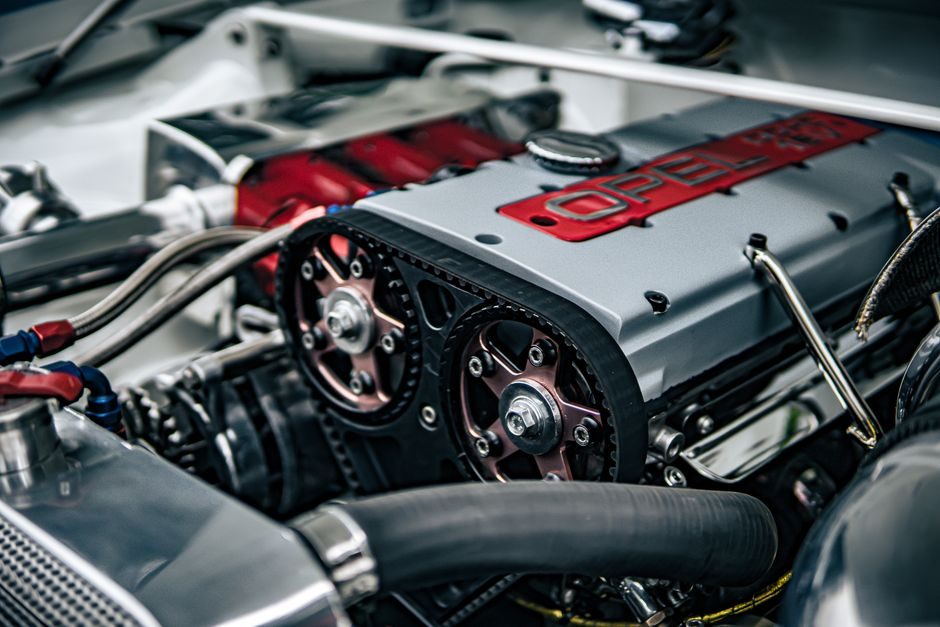
Synchronous drive selection starts with the tooth profile: metric pitches MXL, XL, L, and H cover 2.032, 5.08, 9.525, and 12.7 mm respectively, while curvilinear GT and HTD profiles (3M, 5M, 8M, 14M, 20M) handle higher torque at lower noise [S1][S2].
The same-pitch rule is non-negotiable — a pulley must mesh with a belt of identical pitch designation, otherwise the teeth will not seat, and speed ratio will be lost within the first few hours of run-time [S2][S3].
Pitch Family and Tooth Profile Comparison
Inch-pitch timing pulleys carry a trapezoidal tooth form based on inch (in.) measurements, while metric-pitch pulleys use millimeter-based pitch designations for synchronous power transmission [S1][S2]. The classic trapezoidal family — MXL (2.032 mm), XL (5.08 mm), L (9.525 mm), and H (12.7 mm) — remains dominant in packaging, small automation, and printer drives where the compact XL and MXL profiles dominate below 1 kW [S1][S3].
For higher-torque synchronous drives, the HTD (High Torque Drive) and GT (PowerGrip GT) curvilinear profiles handle loads that trapezoidal teeth cannot transmit without ratcheting; HTD uses a deeper, more rounded tooth, and GT adds the GT2/GT3 series with optimized backlash and noise reduction for servo positioning [S3]. The metric mini-pitch range S2M, S3M, and the higher-load P8M cover stepper, robotics, and small CNC applications where pitch accuracy below 3 mm keeps cogging torque minimal [S5][S6].
Material and Hub Construction
Aluminum alloys (including high-strength 2017/6061 variants) are the default stock for MXL through XL pulleys up to roughly 60 teeth, while steel (C45, with optional surface treatment) takes over for L, H, and HTD/GT pulleys above that count or whenever the application demands higher surface hardness for press-fit shafts [S6].
Bushing style is a separate decision from material: pilot-bore (plain bore) for prototype or low-volume builds, taper-bushed (e.g. 1108, 1210, 1610, 2012) for field-replaceable industrial drives, and keyless bushings for high-torque P8M servo applications where backlash must stay under 5 arc-minutes [S5]. The P8M High Torque series explicitly offers a Standard or Short Keyless Bushing option to handle shock loads and frequent direction reversals [S5]. Surface treatment — clear anodize for aluminum (corrosion resistance +0.1 mm dimensional growth, negligible for clearance) and black oxide or zinc plating for steel — is selected based on the surrounding atmosphere, not the load [S6][S7].
Sizing by Torque, RPM and Number of Teeth

The number of teeth is the primary speed-ratio lever: a 20-tooth driver running against a 40-tooth driven pulley delivers an exact 2:1 reduction with zero slip, which is the design property engineers actually buy synchronous drives for [S2][S3].
Below 10 teeth the belt loses wrap and jump-tooth risk rises sharply, so most catalogs refuse to quote less than 12 teeth on a driver for HTD/GT profiles and not less than 10 for XL/L/H. Belt width is the torque lever: doubling belt width from 10 mm to 20 mm on the same profile typically raises transmittable torque by 70–90 % before creep becomes the limiting factor [S6][S9]. Shaft bore diameter, keyway size, and the presence of set screws (two set screws at 90° is the common default) finish the mechanical spec and must match the drive shaft before any of the catalog data matters [S5][S7].
Who Should Pick Trapezoidal vs Curvilinear
Trapezoidal profiles (MXL/XL/L/H, plus T2.5 miniature) are the right call for office automation, small appliance drives, and instrumentation where cost per unit dominates the BOM and the duty cycle stays below roughly 3 kW [S2][S7].
Avoid specifying HTD 3M or 5M for legacy XL/L systems: the curvilinear teeth will not seat correctly on a trapezoidal belt, and the drive will fail in the first 50 hours regardless of tension setting. The same goes for trying to mix S2M with S3M in the same drive loop, since pitch and tooth depth both differ [S5][S7].
Standards, Tolerances, and Supplier Evaluation

Synchronous belt drives are governed by ISO 5295 for synchronous belts and ISO 13050 for HTD/GT curvilinear profiles, with inch-pitch pulleys typically referenced to JIS B 1802 and metric pitches to ISO 5294 — these documents define tooth addendum, dedendum, and the minimum number of teeth for each profile [S1][S2].
When evaluating a supplier data sheet, the verifiable points are: (1) stated pitch code (e.g. P8M, T2.5, XL), (2) number of teeth with a tolerance window, (3) stock bore or bushing series number, (4) belt-width compatibility, and (5) material grade with a heat-treatment or anodize callout [S5][S6][S7]. Lead time varies sharply: stock aluminum MXL/XL with standard bores from MISUMI ships in 12 days or less, while custom-bore steel pulleys in HTD 14M and above commonly run 17–18 days even from large catalog suppliers [S6][S9]. For a 2.5 mm pitch T2.5 stock pulley in aluminum, the same supplier lists 12-day shipment on standard configurations [S7]. For a broader look at how a sister commodity — flat belts — is sized against power and width, see Flat Belt Sizing and Selection: Power, Width and Tension Member Gates, which uses the same pitch-first logic that governs a timing-pulley BOM. For a related timing belt selection, the same-pitch rule and tooth-profile compatibility drive both decisions together; the timing pulley encyclopedia entry maps the standard profile families onto typical application envelopes.
Confirm the supplier's pitch-designation document revision and request a sample before committing to a 500-piece run — even a 0.1 mm pitch deviation on a P8M drive will show up as tooth-skip under shock load within the first 100 hours. Buyers evaluating larger power-transmission systems with similar tolerance discipline can cross-reference the Wind Turbine Gearbox 2026: Drivetrain Sizing, Reliability, and Sourcing Specs guide for the same kind of pitch-and-load shortlist logic. The next verification node is to lock the shaft-bore tolerance (typically H7) and the perpendicularity of the flange to the bore axis within 0.05 mm, then move to prototype sign-off.
Spec-level background on the components involved: pressure transmitter.