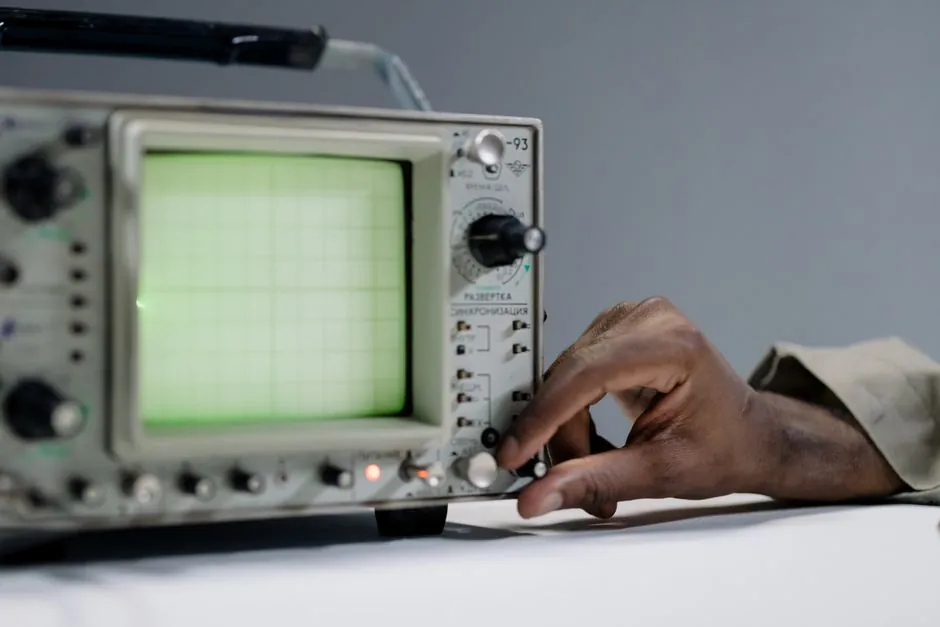
The fastest way to size a DC electronic load is to write down the device-under-test (DUT) maximums, then add headroom: pick a load whose continuous voltage, current, and power ratings each sit at least 20% above the worst-case DUT operating point, and confirm it supports the operating mode (CC, CV, CR, CP) that the test demands [S3][S4].
DC electronic loads are programmable current sinks used to validate batteries, DC power supplies, solar PV, fuel cells, fuses, circuit breakers, and DC/DC converters in automotive, defense, aerospace, and industrial labs [S2]. A common mid-range bench unit delivers 150 V / 40 A / 200 W (e.g. the Rigol DL3021 family cited in field discussions), which is the practical ceiling for most repair-bench and small-product work [S5].
Sizing the DUT Envelope: Voltage, Current, Power
Voltage, current, and power must be specified as a triangle, not a single number: a 200 W load rated only 60 V cannot test a 100 V supply, and a load rated 150 V / 5 A caps out at 750 W even if the DUT can deliver more [S3]. For a quick sanity check, multiply the rated voltage ceiling by the rated current ceiling and confirm the product equals or exceeds the rated power; mismatched triangles are a common return-engineering cause [S3][S6].
Field buyers in EEVblog threads routinely cross-shop Rigol DL3021-class (150 V / 40 A / 200 W) against used Dynaload Transistor Devices units, with used iron favoured for cost-per-watt and new programmable units favoured for sequencing and data logging [S5]. The decision almost always comes down to whether the test needs remote control via USB/LAN/GPIB or just front-panel knobs.
Operating Modes: CC, CV, CR, CP and When to Use Each
CC (Constant Current) holds a fixed current while voltage varies and is the default for battery discharge and power-supply load-step tests; CV (Constant Voltage) holds a fixed voltage and is used to evaluate voltage regulators and current-limit behaviour; CR (Constant Resistance) emulates a fixed resistor and is preferred for simulating real resistive loads; CP (Constant Power) holds a fixed wattage and is the most dynamic mode, useful for fuel-cell and battery endurance characterisation where current drifts as the cell discharges [S3][S4].
For a battery-cycling test, CC and CP together cover >90% of the curve; for a 24 V telecom PSU verification, CC plus CV covers both load-step and current-foldback tests. The Tek "Key Considerations" guide and the Keysight fundamentals white paper both stress that the same instrument must support the modes the test plan calls for, because no single mode fits every DUT type [S4][S6].
Cooling Architecture: Air-Cooled vs Water-Cooled
Air-cooled programmable loads are self-contained, portable, and standard from roughly 800 W up to 7.5 kW per chassis; water-cooled loads become attractive above 6 kW because they can deliver 6 kW to 36 kW per cabinet, are scalable up to ~250 kW, and use about 85% of each FET's capability versus ~50% for air-cooled designs, a ~35% reduction in FET count for the same power level [S2].
The trade-off is facility cost: water-cooled loads require a chiller and plumbing, so unless the lab already has a cooling loop, the chiller install and maintenance usually wipes out the per-cabinet savings below ~10 kW [S2]. For a 5 kW battery-cycling rig on a factory floor, air-cooled is almost always the right call; for a 100 kW+ EV pack tester in a power-electronics lab, water-cooled is the only realistic option.
Protection Features and Slew-Rate Capability
Every credible selection guide lists the same five protections as non-negotiable: overvoltage (OVP), overcurrent (OCP), overpower (OPP), overtemperature (OTP), and reverse-voltage protection, plus remote-sense fault detection so the load reads voltage at the DUT terminals instead of its own binding posts [S2]. Skipping remote sense on a 4-wire test can introduce 0.1 V to 1 V of error at 40 A, which is enough to fail a tight-tolerance PSU.
Slew rate (A/µs) is the second silent killer: a load that cannot transition fast enough will round off the leading edge of a transient test, masking a DUT's actual response. Bench units typically deliver 0.1 A/µs to 5 A/µs; mid-range programmable loads reach 10 A/µs to 30 A/µs; dedicated automotive transients need 50 A/µs or more [S3][S4]. If the test plan includes ISO 7637-2 or LV148-style transients, slew rate moves from "nice to have" to "spec gate".
Who Should NOT Pick a Benchtop CC-Only Load

A benchtop, single-mode, manually operated DC load is the wrong tool for production-line QA, regulated safety testing, or anything that needs logged data for traceability [S3][S4]. It is also the wrong tool if the DUT is a regenerative source, a bidirectional DC/DC converter, or a battery that must absorb charge, since a standard electronic load only sinks current in one direction and cannot return energy to the grid.
It is also the wrong pick for a solar-array test where the source impedance is non-constant; CR mode helps but only partly, and a real PV I-V curve tracer with a four-quadrant source-measure unit is more appropriate. For warranty and compliance evidence, choose a programmable unit with LAN/USB/GPIB, SCPI command set, and a documented calibration path to national standards [S3].
Comparison of Main Options by Decision Criteria
Manual benchtop single-mode (CC only): low cost, ~100 W to ~300 W per channel, 1 mA to 40 A, 60 V to 150 V, no logging, suited to repair benches and student labs [S5]. Programmable mid-range multi-mode (CC/CV/CR/CP): 200 W to 1.5 kW per channel, 150 V / 40 A class, LAN/USB, SCPI, suits product-validation and small-batch production [S3][S5]. Air-cooled high-power (800 W to 7.5 kW per chassis): suits battery cycling up to EV module level, requires 208 V single-phase or 400 V three-phase mains and 1 U to 6 U rack space [S2]. Water-cooled high-power (6 kW to 250 kW): suits EV pack, fuel-cell stack, and grid-tied inverter test stands; requires chiller, plumbing, and three-phase 400 V to 480 V feed [S2].
Decision gates: below 500 W and one mode, buy the manual benchtop; 500 W to 5 kW with logging, buy programmable multi-mode; above 5 kW, switch to air-cooled modular, and add water cooling only when air-cooled footprint or noise becomes the constraint [S2][S3].
Calibration, Traceability, and Sourcing Signals
Annual calibration with traceability to national metrology institutes (NIST, NPL, PTB) is the industry baseline, with a typical tolerance drift check on voltage (0.05% to 0.1% of reading plus offset) and current (0.1% to 0.2% of reading plus offset) [S3]. The 23 July 2026 Techmaster buying guide formalises this: choose a vendor that issues a calibration certificate with measured values, not just a "pass" sticker, and confirm accreditation to ISO/IEC 17025 [S3].
Two trackable signals to watch over the next two quarters: the rollout of bidirectional regenerative electronic loads in the 5 kW to 30 kW class, which would let test stands return energy to the AC mains instead of dumping it as heat; and tighter USB-C PD 3.2 EPR compliance testing, which is driving demand for sub-50 µs transient-capable loads. For a deeper dive on related test-instrument selection criteria used across the calibration lab, see the electronic test instrument encyclopedia entry, and for a parallel spec-first approach to handling and verification gear used on the same production lines, the electronic scale primer covers adjacent metrology. For buyers who already own a programmable load and want to push it into automated production ATE, the load cell module overview walks through signal-conditioning modules that pair with programmable loads in fixture racks.