For pulp and paper plant work, the most commonly specified LCR meters are 100 kHz handhelds with 0.1% to 0.5% basic Z accuracy, four-wire Kelvin connection, and a sealed IP54-grade housing, because paper stock and black-liquor loops are humid, hot, and chemically aggressive [S1][S3].
Handheld pricing on Amazon's Best Sellers list clusters between $19.99 and $254.69 as of 2026-09-18, with the FNIRSI LCR-ST2 100kHz at $47.31 and the DER EE DE-5000 at $175.00 occupying the top two slots by sales rank [S1]. Benchtop alternatives from the same brands (BK Precision, Hioki, Keysight) push the budget from roughly $1,500 to over $8,000, but the mill electrician usually needs the portable form factor first.
What Pulp and Paper Plants Actually Measure with an LCR Meter
On-line consistency and moisture sensors depend on reference cells, calibration shunts, and inductive proximity coils that must be characterised at the same frequency the loop runs at, typically 10 kHz to 100 kHz for the magnetic and capacitive probes used in stock preparation and the dryer section [S3]. LCR meters directly read inductance (L), capacitance (C), resistance (R), impedance (Z), phase angle (θ), quality factor (Q), dissipation factor (D), and equivalent series resistance (ESR) on those probes, which is the parameter set technicians need to confirm a transmitter or load cell has not drifted [S3].
Beyond sensors, mills use the meter to fault-find on variable-frequency drives: motor winding inductance, DC-bus capacitor ESR, and snubber networks are all checked during the 6-month or annual PM rounds. The 0.1% basic accuracy figure that separates laboratory meters from production meters matters here because a 2% drift on a 1 mH motor winding is enough to swap a stator unnecessarily, while a 0.1% bench reading confirms the winding is healthy and the problem is in the cable or connector [S3].
Form Factor: Handheld vs Benchtop vs Tweezer SMD
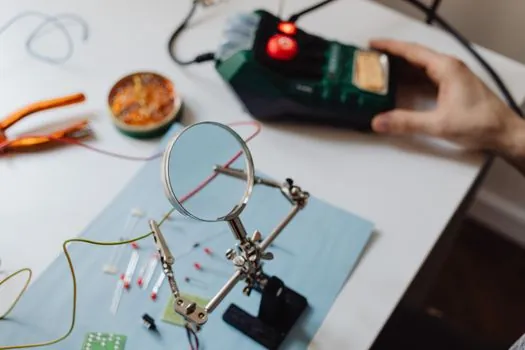
Handheld LCR meters in the 100 kHz class are the workhorse for the plant floor, because they accept 4-wire Kelvin clips with alligator jaws that grip motor lead lugs and capacitor terminals inside a live panel. The DER EE DE-5000 at $175.00, 4.6/5 stars across 630 reviews, and FNIRSI LCR-ST2 100kHz at $47.31, 4.3/5 across 80 reviews, both sit at the top of Amazon's LCR best-seller list on 2026-09-18 and explicitly advertise 100 kHz test frequency with autoranging L, C, R plus D, Q, and ESR [S1].
Benchtop manually operated meters offer higher precision and more measurement capabilities than handheld meters and are also more likely to support a 4-wire test fixture, binning, and SCPI over USB or RS-232 for cell calibration in a quality lab [S3]. For pulp and paper this is the right tool when the maintenance team needs a documented certificate rather than a pass/fail reading on a clip lead.
Tweezer-style SMD testers such as the FNIRSI LCR-ST2 double as a portable go/no-go station for surface-mount capacitors recovered from drive boards, with the bonus of full-band scan and auto sort, but the spring contacts are too small for the stud terminals found on mill capacitor banks, so they should be specified as a secondary electronics-bench tool rather than a field unit [S1].
Selection Criteria Mapped to Mill Conditions
Five criteria separate a usable mill LCR meter from a bench-only instrument: test frequency range, basic Z accuracy, test-signal level, fixture type, and environmental rating. The first two are where the data sheets diverge most, and the last is where most cheap units fail in a paper mill environment [S3].
For typical pulp and paper instrumentation, 10 kHz to 100 kHz covers 90% of the loop electronics, and pushing beyond that needs a VNA rather than a better LCR meter [S2].
Basic accuracy is the second gate, with 0.1% reserved for laboratory calibration, 0.5% standard on handhelds like the DE-5000, and 1% to 2% on the sub-$50 tweezer units that float to the top of the Amazon chart on price alone [S1][S3]. Test-signal level should be adjustable so that a 0.1 V to 1.0 V sine drive does not bias or saturate ferrite-cored inductors lifted from a winder cabinet, a point the Altium guide flags as a frequent source of mismatched readings [S3].
Fixture type matters more than brand. Four-wire Kelvin alligator clips are the minimum for low-impedance ESR work on large motor-run capacitors; spring-tip tweezers are fine for SMD work but not for a 30 A bus capacitor in a drive cubicle [S1][S3]. A 50 ohm coaxial fixture with a BNC to clip-lead adapter is the only way to get repeatable readings above 1 MHz, which is one reason the eevblog respondents lean toward a vector network analyser rather than a 100 kHz LCR meter for HF inductors [S2].
Decision Comparison: Handheld vs Benchtop vs Tweezer
For a pulp and paper maintenance team weighing handheld, benchtop, and tweezer LCR meters, three decision criteria line up the main options: typical use case, accuracy class, and price band. Handheld 100 kHz units such as the DER EE DE-5000 at $175.00 cover field troubleshooting on drives, sensors, and motor windings at 0.5% basic accuracy with autoranging plus D, Q, and ESR [S1]. Benchtop units from BK Precision, Hioki, and similar vendors add 0.1% accuracy, programmable bias from 0 V to 5 V, and a scanner option for multi-cell calibration, but start near $1,500 [S3]. Tweezer SMD testers such as the FNIRSI LCR-ST2 at $47.31 handle surface-mount rework and quick SMD sorting at 100 kHz with 4.3/5 stars across 80 reviews, but cannot clip onto a 30 mm capacitor can [S1].
The Mastech MS5308 at $254.69 is another field option noted in the EDN review series, sitting just above the DE-5000 price band with a wider feature set for component sorting rather than on-line sensor work, which makes it a better electronics-bench tool than a mill-floor instrument [S5]. When the mill team needs to capture traces for trend records rather than spot readings, the benchtop form factor wins on RS-232/USB SCPI output even though the ergonomics are worse in a steamy basement [S3].
Limitations and Failure Modes Specific to Mill Use
The biggest limitation in a paper mill is the humidity, not the meter's spec sheet, and a non-IP-rated handheld will fail its annual calibration within 6 to 12 months if it lives on a stock-prep cart. Rubber boots, conformal coating on the PCB, and replacement test-lead kits are the practical answer, while the budget answer is to keep one metered inside a desiccated case and rotate it out to the floor [S1][S3].
Frequency-related drift is the second trap, because the apparent inductance of a ferrite-cored motor winding or a paper-stock probe coil changes with the test frequency, and a 100 kHz reading is not necessarily representative of what the device sees at the loop's actual drive frequency. The Altium guide puts the same caveat in general terms: matching test frequency to operating frequency is the only way to make the reading meaningful, and a coil measured outside its operating range can be off by a factor of two or more [S3].
ESR measurement on large aluminium electrolytic capacitors is the third pitfall, because the standard 4-wire clip lead adds lead resistance and inductance that can swamp the capacitor's own ESR on sub-1 ohm devices. A shorting plate zeroing step, or a dedicated 4-wire clip with guarded tips, is required to read ESR accurately, and without that step a 0.05 ohm capacitor can read 0.3 ohm and trigger a false "replace" decision [S3].
Standards, Calibration, and Documentation Trail
There is no paper-mill-specific IEC or ISO standard that dictates which LCR meter to buy, but ISO 9001:2015 quality systems and typical mill calibration procedures expect a traceable certificate against a known reference impedance, with the test frequency and signal level recorded next to the reading [S3]. For drive work, IEEE 519 and manufacturer drive specs are the upstream documents, and the LCR meter is the verification tool downstream, not the compliance instrument.
The 100 kHz class handhelds on the Amazon best-seller list have no public IECEx or ATEX rating, so they cannot be carried into a classified hazardous area without a hot-work permit, and any intrinsically safe requirement in a pulp mill's black-liquor or chlorine dioxide area pushes the choice toward a vendor-supplied IS-rated tool rather than a general-purpose test instrument [S1]. Maintenance planners should write the IS rating into the calibration procedure, not the procurement list, because the meter will outlast the classification drawing in most older mills.
What to Buy First, and What to Add Later
For a new pulp and paper maintenance crew, the first LCR meter should be a 100 kHz handheld with 0.5% basic accuracy, 4-wire Kelvin clips, and a documented certificate, which the DER EE DE-5000 at $175.00 or equivalent covers on day one [S1]. Add a tweezer SMD unit such as the FNIRSI LCR-ST2 at $47.31 for the electronics bench, where its auto sort and full-band scan save time on recovered surface-mount parts [S1].
For the lab, a benchtop 0.1% meter with bias and scanner is the second purchase, justified by paper-stock probe calibration and ISO 9001 traceability rather than field troubleshooting [S3]. For HF probe work, the next node is a low-cost VNA such as the nanoVNA or a Bode100, because no 100 kHz LCR meter can replace a network analyser when the device under test runs above the meter's ceiling [S2][S4].
Two trackable signals: 2026 Q4 Amazon best-seller rank churn in the 100 kHz handheld tier, and any vendor release of an IS-rated 100 kHz LCR meter for the chemical side of the mill. Both are watchable in the LCR meter category and adjacent clamp meter listings, while the broader instrument map covers the conductivity meter used in stock-prep chemistry. For drying-section control loops, the related reading on the metal powder suppliers and manufacturers 2026 sourcing map and the programmable DC power supply suppliers 2026 vendor map round out the lab-side procurement picture.
