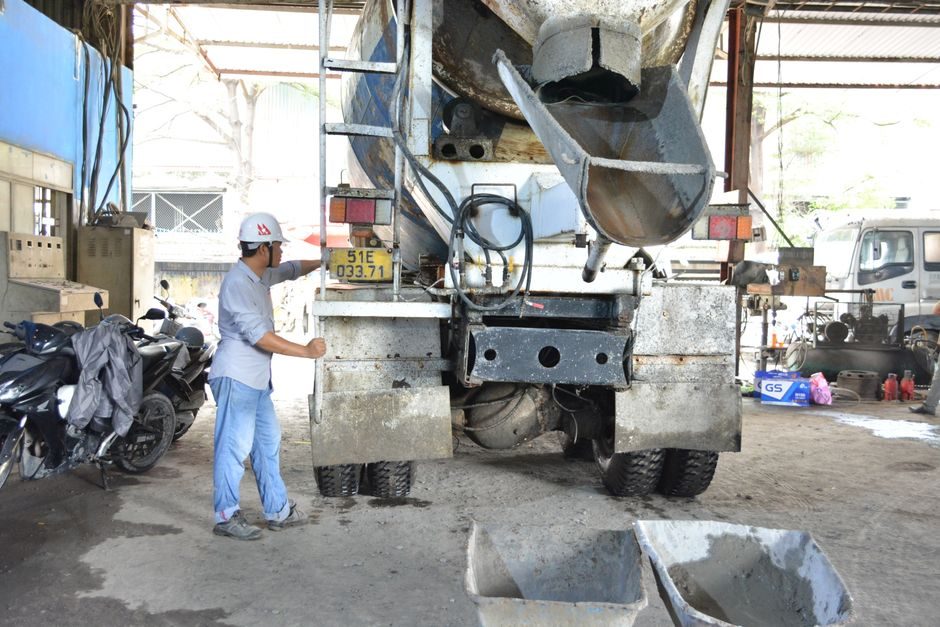
For 2026-spec buyers, the SANY SY306C-8(R) concrete mixer truck is listed with a 6 m³ (211.89 ft³) drum, 5 m³/min (176.6 ft³/min) output and a diesel powerpack on a SANY chassis, with the OEM quoting a 15% shorter braking distance and 50% less brake-lining wear from exhaust-valve braking [S1].
At the top of the volume range, an 8×4 BEIBEN chassis is offered with a 12–16 m³ tank, 16825 kg curb weight, 14045 kg loading capacity, 9.726 L Weichai WP10.375 engine rated 276 kW @ 2200 rpm and Euro III emission package — a typical heavy-haul configuration for 20 T payload work [S2]. For 6–7 m³ mid-volume fleets, the HOWO 6×4 QDZ5247GJBA sits between those two poles, with 55° hydraulically tilting forward control, 12.00-20 tyres and dual-sleeper V3 cabins [S5].
Drum Volume vs Pour Rate
Drum size dictates the number of trucks required to feed a pump or concrete pump truck; the SY306C-8(R) is rated to deliver 5 m³/min from a 6 m³ drum, meaning a single truck unloads in roughly 1.2 minutes when flowing freely [S1]. On large deck pours, contractors typically size the fleet at 1.2× peak pump output — a 60 m³/hr boom pump needs 12 m³ of drum capacity arriving every 12 minutes, which translates to two 6 m³ trucks in rotation or one 12 m³ unit.
The 12 m³ HOWO chassis on a ZZ5257GJBN4047A/N frame is a common single-trip unit for high-rise work, while the BEIBEN 8×4 12–16 m³ configuration targets infrastructure pours where the higher axle count (8×4) and 40% slope-climbing capability keep loads moving on rough access roads [S2][S6].
Drivetrain and Chassis Configuration
Drivetrain choice is governed by gross vehicle weight and route gradient: 4×2 chassis appear on light 4–5 m³ units, 6×4 dominates the 6–10 m³ segment (HOWO QDZ5247GJBA, HOWO ZZ5257GJBN4047A/N), and 8×4 is reserved for 12 m³ and above, where Mercedes-licensed double-reduction axles with hub reducers provide the low-ratio launch needed when a 16825 kg vehicle is fully loaded [S2][S5][S6]. The 8×4 BEIBEN also specifies 9T-180 manual gearbox with 9 forward ratios and gear ratios ranging from 12.82 down to 1.00, plus a reverse ratio of 11.21 — the wide spread is what enables a 40% grade claim on a fully loaded 20 T payload [S2].
Engine tier is the second gate: the BEIBEN WP10.375 is a 9.726 L, six-cylinder inline, turbocharged, direct-injection diesel with 126/130 mm stroke and Euro III certification [S2]. Buyers operating into Stage V or Euro VI jurisdictions must confirm the chassis code, as the same HOWO branding historically spanned Euro II through Euro V depending on the build year [S6].
Cabin, Visibility and Operator Ergonomics

Operator acceptance is decided by three measurable items: cab tilt angle, suspension travel, and sight lines. The HOWO 6×4 cab tilts 55° hydraulically for engine access — a 15° improvement over the older 40° flat-floor cabs — and rides on a 4-point fully floating suspension with shock absorbers [S5]. The BEIBEN V3 long-flat-roof cabin adds a single sleeper, full-steel skeleton with double-layer steel skin, and a forward-tipping design that exposes the driveline without disturbing the steering column [S2].
Safety tech on the SY306C-8(R) includes an optional panoramic monitoring system, exhaust-valve braking (the 15% braking-distance / 50% lining-wear figure), and a high-volume air compressor with upgraded piping for faster reservoir recharge on downhill descents [S1]. For mixed-fleet operators, specifying the same brake package across 6×4 and 8×4 units simplifies driver training and spares holding.
Mixer Drum Mechanics and Power Take-Off
The drum itself is a wear item: drum shell thickness, blade pitch, and hydraulic drive pressure govern mixing quality and cleanout time. A truck-mounted concrete pump boom draws from the same drum, so consistent drum speed (typically 0–14 rpm) is required to keep aggregate suspended during transit; if the truck sits in traffic, drum speed is increased by the operator to recover workability, which raises fuel burn. [S1]
For a 6 m³ drum running at 5 m³/min output, the hydraulic pump driving the drum must sustain roughly 60–80 L/min at 350 bar continuous — a spec rarely printed on OEM data sheets but the dominant cost driver in the mixer subframe. Buyers should request the hydraulic pump model code and PTO ratio before signing a PO, especially when comparing 6 m³ units from different chassis brands.
Certification, Compliance and Cross-Border Moves
The BEIBEN 8×4 12 m³ listing carries ISO9000, CCC, TS16949, EEC, RoHS and CE certifications, with SGS and GOST standards listed in the additional-info block, indicating pre-cleared export to the CIS market [S2]. HOWO units commonly clear CCC and ISO9000 minimums, with Euro II–V variants offered depending on destination [S6]. For buyers moving units between jurisdictions, the emission tier is the binding constraint: Euro III will not register in the EU, and Stage V/Euro VI will not register in many African and South American markets without adaptation.
Cabin safety compliance matters for cross-border work: the BEIBEN NG80B cab is documented as meeting European ECE R29 security regulations for occupant survival in a frontal impact — a spec that simplifies insurance and customs paperwork on CIS-bound shipments [S2]. Operators should keep the certificate file with the truck and renew it on every chassis-transfer.
Total Cost of Ownership Levers
TCO on a mixer truck is dominated by fuel, tyres, brake-lining replacement and drum maintenance; the SY306C-8(R) 50% reduction in brake-lining wear alone is roughly a 30–40% cut in annual brake spend on a high-cycle urban fleet [S1]. Tyre spec is the second lever — 12.00-20 radials on the BEIBEN and 12.00-20 on the HOWO 6×4 — and radial vs bias-ply choice changes casing life by 20–30% [S2][S5][S6].
Resale is a function of chassis brand recognition and emission tier, not drum size. For telehandler price and cost benchmarks on adjacent site equipment, fleet owners typically run a 7–10 year holding period on mixer trucks, after which emission-tier downgrades make the units unsellable in regulated markets.
Selection Checklist and Field Gates
Lock the chassis code, drum volume, emission tier and axle config first, then layer in cabin, brake package and certification. A 6 m³ / 4×2 unit covers urban 4-storey pours, 6×4 at 8–10 m³ covers mid-rise and infra, and 8×4 at 12–16 m³ is the only sensible choice for 40% grades and 20 T payloads [S1][S2][S5][S6].
For the next data refresh, watch the Euro VII timetable for European fleet renewal and the Stage V enforcement calendar in Southeast Asia, which together will reset used-truck pricing on 6×4 chassis built before 2024. The SANY SY306C-8(R) product page was updated 2026-06-07 and the BEIBEN 8×4 12 m³ listing was updated 2026-06-22, so both data points are current as of the July 14, 2026 reference window [S1][S2].