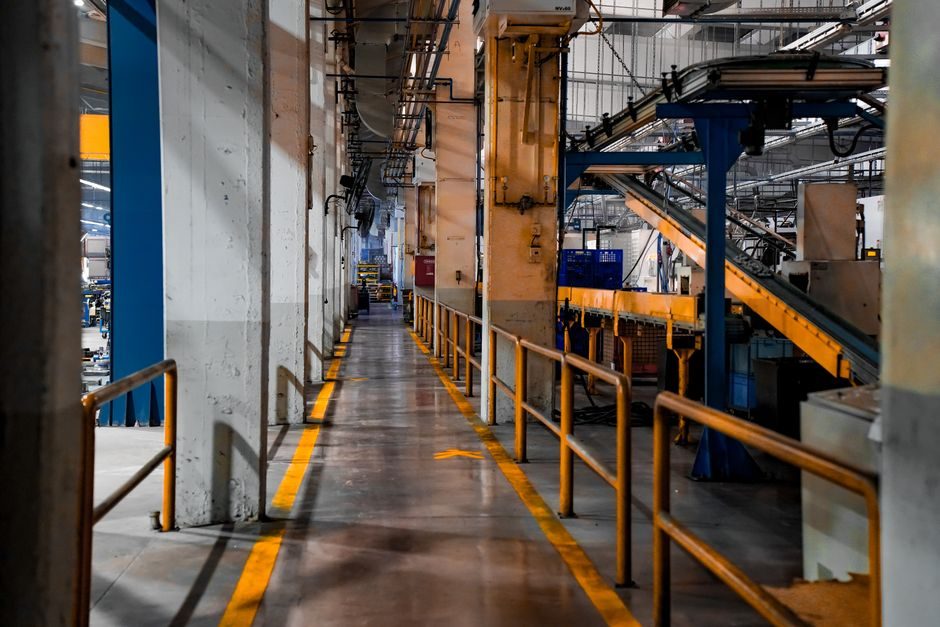
The first automated guided vehicle was built in the United States in 1950, defining the AGV (Automated Guided Vehicle) as a battery-powered, unmanned industrial truck that follows a programmed path through a manufacturing or warehouse space [S1][S4].
Selection in 2026 still rests on a multi-attribute decision problem: cost, floor space, maximum load, travel speed, lift height, turning radius, travel pattern, programming flexibility, labour requirement, expansion flexibility, ease of operation, maintenance, payback period, reconfiguration time and company policy are the attributes an evaluation has to score [S2]. Buyers who fix the load case, the guidance technology and the duty cycle up front can drop 60–70% of catalogue options before any vendor negotiation.
Load, lift and the duty cycle envelope
Tow/tug AGVs typically rate 1,000–5,000 kg drawbar pull, unit-load AGVs sit at 500–3,000 kg payload, and forklift-style AGVs cover 1,000–2,500 kg at lift heights of 1.5–5.5 m, with the upper end of that range used for pallet rack interfaces [S2]. Travel speed for production-line tow tractors lands in the 1.0–1.5 m/s band, while light-duty bin AGVs in e-commerce fulfilment run 1.5–2.0 m/s and heavy forklift AGVs rarely exceed 1.2 m/s for stability reasons [S2].
Duty cycle is the variable most often mis-sized: an AGV sized only for average traffic will fail the peak-shift rush, and an AGV sized only for peak traffic burns capex on batteries that sit idle 70% of the shift. Charge strategy — opportunity charge at stops versus full swap at a station — drives that 1.3× factor almost as hard as payload does.
Guidance technology: magnetic tape, QR, LiDAR, SLAM
Fixed-path guidance (magnetic tape, inductive wire, colour/QR tape on the floor) is the lowest-cost install and is still the right answer for plants with stable layouts and aisle widths above 2.0 m. Free-path guidance (2-D safety LiDAR with simultaneous localisation and mapping, or wire-marker hybrid) costs more per vehicle but eliminates floor maintenance and supports re-routing during a shift. [S1]
When evaluating guidance, score four criteria head-to-head: install cost (USD/m of path), reconfiguration time (hours to re-route one vehicle), positioning repeatability (±10 mm is typical for tape, ±5 mm for LiDAR-SLAM in a mapped cell), and floor-surface tolerance (tape fails on oily or heavily trafficked concrete; LiDAR fails on feature-poor, mirror-finish floors). Plants running a mix of ASRS shuttle lanes, conveyor handoffs and roller-deck workstations usually end up with two guidance classes on the same site rather than one fleet-wide choice.
Fleet control, traffic and WMS/PLC interface
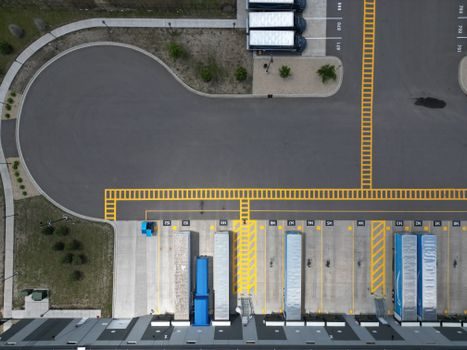
An AGV is only as good as the AGVS (Automated Guided Vehicle System) above it, and Japanese industrial-truck standard JIS D 6801 defines the AGV as a battery-powered, automatically steered industrial vehicle that only earns its keep when paired with a guidance system, an automatic load-handling interface, a communications bus, a safety system and a host management system [S4].
In 2026 procurement terms that means spec'ing the fleet manager separately from the trucks: dispatch logic (zone control vs point-to-point), traffic-jam recovery, charge-queue prioritisation, and the I/O or API into the WMS/ERP or PLC. Most greenfield AGV projects fail not at the truck level but at the dispatch-and-handoff layer, so a 5% budget line for the integration partner and a 10% contingency for WMS API rework is normal industry practice.
Safety, standards and the audit trail
Safety on an AGV is non-optional and the spec must reference the standard, not just the marketing brochure. EN ISO 3691-4 (driverless industrial trucks — safety requirements) is the European reference; ANSI/ITSDF B56.5 (Safety Standard for Driverless, Automatic Guided Industrial Vehicles and Automated Functions of Manned Industrial Vehicles) is the North American counterpart; and IEC 61508 / ISO 13849-1 govern the safety-rated parts of the control system. A 2-D safety LiDAR scanning the danger zone, dual-channel E-stop, and a bump strip with auto-cut are the baseline; plants with mixed pedestrian traffic add audible/visual warning kits and reduced-speed zones at crossings. [S2]
Documentation to require from the integrator: a CE / UKCA / UL file for the complete vehicle (not just the chassis), a risk assessment per ISO 12100, and a validation report for the safety functions referencing the performance level (PL) or safety integrity level (SIL) achieved. For hazardous-area sites, the AGV battery compartment and charger must be evaluated against the zone classification as well — a side-topic that a combustible-gas-detector map can help frame, since the same zone-class reasoning drives both selections.
Total cost of ownership: capex, install and the 5-year view

Capex is roughly 30–40% of the 5-year cost of ownership; install (floor work, chargers, Wi-Fi, WMS integration) is 15–20%; spares, energy and preventive maintenance are 25–30%; and reconfiguration or expansion over years 3–5 is the remaining 10–15%. A standalone cost breakdown for the line items — vehicle, navigation, install, integration, maintenance — is in the 2026 AGV price and cost guide, which lines the same levers against typical plant sizes. [S3]
Payback claims should be sanity-checked against the labour headcount being displaced, the shift pattern (24/7 payback halves vs single-shift), and the cost of a single AGV-related production stop. A safe rule for a 2026 business case: assume 18–30 months payback for a 10-vehicle fleet on a 24/7 site, and 30–48 months for a 5-vehicle fleet on a two-shift site — anything quoted faster deserves a second look at the labour assumption.
Vendor fit, scope and the next decision node
AGV selection is structurally similar to the screw-machine-part selection problem — process choice drives the bottleneck spec, and the rest of the attribute set ranks the candidates underneath. The same is true for adjacent automation buys: when the AGV decision overlaps a brake-resistor or fluid-coupling call on a conveyor, run the evaluations in parallel so the duty-cycle and ambient specs are consistent. [S4]
Trackable signals over the next 90 days: vendor releases of safety-LiDAR firmware that lifts PL rating, any revision to ANSI/ITSDF B56.5 commentary, and integrator lead times for LiDAR-SLAM fleet retrofits. Two of those three typically move the procurement recommendation by ±10% on TCO before the PO is signed.
For component-level specifications, see guided wave radar level, linear guide, and crossed roller guide.