
A remote I/O module on an MCC RFQ is specified by six decision fields: fieldbus protocol, I/O count and signal type, channel-to-channel and field-to-bus isolation, surge/EMC compliance, hazardous-area certification, and the physical base slot count. Each field has a default value and a worst-case envelope, and a buyer's failure to lock down any one of them is the single biggest cause of requote cycles on panel-builder quotes [S3][S4].
Concretely, a 16-channel discrete output module in the M-System R3 family is 27.5 mm wide and 109 mm tall on a backplane that supports dual-redundant internal buses A and B [S1]. Installation bases for that family ship in 0/2/4/8/12/16 slot sizes, and the 16-slot base weighs about 470 g with no I/O plugged in [S3]. These mechanical numbers set the floor on cabinet layout and must be on the RFQ.
Protocol and Backplane Selection
Ethernet-based protocols (PROFINET, EtherNet/IP, Modbus TCP) and RS-485 based protocols (Modbus RTU, PROFIBUS DP) dominate remote I/O on MCCs, and a 3-channel temperature/millivolt/ohm module like the M730 explicitly uses Modbus RTU over RS-485 with isolation between inputs, power, and network circuits [S4]. Buyrs who write only "Modbus" on the RFQ get either RTU or TCP and end up re-issuing the PO; the line item should read "Modbus RTU over RS-485, 2-wire, 2500 Vrms isolation" or "PROFINET, CC-A/B, 100 Mbit/s, dual-port switch" with the actual physical layer pinned [S4].
Redundancy is a separate RFQ line: the M-System R3 backplane exposes internal bus A and a redundant internal bus B for dual-redundant communication, and that option must be ordered as a distinct code rather than left to the panel builder's discretion [S1]. Skipping the redundancy line silently drops the second bus and changes the module's MTBF claim.
I/O Count, Signal Type, and Channel Density
Channel count is the RFQ field that drives both footprint and price the hardest, and 32-point modules are now common at 22.5 mm width as a de facto density benchmark for new builds [S5]. The R3-DC16AS gives 16 sourcing outputs at 24 VDC per point on a 27.5 mm module body, with M3 screw terminals and a separate COM terminal per group of channels, so the terminal plan must be on the RFQ before the panel builder commits to a gland layout [S1].
Mixed-signal MCCs need a separate line item per signal family: discrete input, discrete output, analog input (4-20 mA, 0-10 V, RTD, thermocouple), analog output, and specialty (counters, serial, load-cell). The MR400 platform is typical of the modular approach, where digital, analog, and temperature modules can be configured arbitrarily inside a single 22.5 mm-wide base [S5]. Forcing a single line "16 I/O" hides whether the channels are input or output and whether any are intrinsically safe, and that ambiguity routinely inflates quotes by 15 to 30 percent when a vendor adds a second module to recover the missing detail [S5].
Isolation, Surge, and EMC Conformance
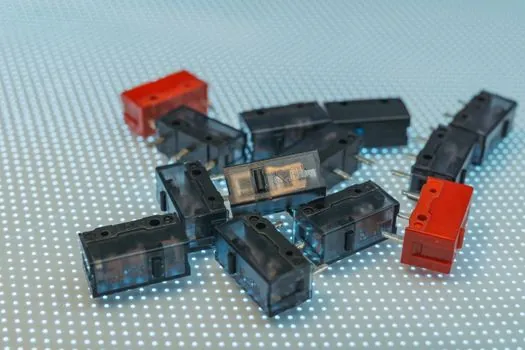
EMC and surge conformance is the field that gets written on paper and ignored on the shop floor, and the R30 series installation base is a useful benchmark because it carries EU conformity to EN 61000-6-4 (industrial EMI) and EN 61000-6-2 (industrial EMS) under the EMC Directive, plus RoHS EN 50581 [S3]. Buyers should write the EN 61000-6-2 and EN 61000-6-4 line items onto the RFQ by number, not by paraphrase, because a panel builder's house standard is typically lighter than the European industrial envelope [S3].
Dielectric strength is the second number worth writing: the R30 base specifies 1500 V AC for one minute between internal power or internal bus and functional earth, which is the figure to copy onto the RFQ when the MCC will sit in a plant with high fault levels or long cable runs [S3]. A surge protection circuit and reverse-wiring protection circuit are standard on safety-rated remote I/O such as the Keyence GC-R48, and that is a separate line on the safety RFQ, not bundled into the main module's spec [S2]. A practical comparison: discrete I/O modules in this class share the 24 VDC field supply, 1500 V AC dielectric to ground, and EN 61000-6-2 EMS conformance, but differ on per-channel isolation (none vs 500 V vs 2500 V), surge clamping (TVS only vs TVS plus gas discharge), and terminal type (M3 screw vs spring vs push-in), and that triplet is the right cut for vendor selection.
Hazardous-Area and Safety-Rated Sub-Lines
Remote I/O in Zone 1/2 or Class I Division 1/2 areas must be specified as a distinct line item with the protection concept (intrinsic safety, non-incendive, flameproof) called out, and the Keyence GC-R48 is a useful safety-side reference because it is rated to PNP transistor output at DC-13, Type 0.5 protected outputs, with safety input ON level of 11 V/2 mA minimum, OFF level of 5 V/1.5 mA maximum, and 100 m maximum cable length [S2]. Those four numbers (ON voltage, OFF voltage, cable length, switching capacity) are the minimum that a safety RFQ should carry; a quote returned without them is incomplete on its face.
Wiring protection circuitry on a safety input must include surge protection and wrong-wiring protection, with the GC-R48 drawing roughly 3 mA of short-circuit current per input, and that fault current is what the buyer's earth-fault calculation depends on [S2]. Buyers who fail to call out the safety sub-line separately get a non-safety I/O module in the safety slot and a full rewire downstream.
Mechanical, Environmental, and Base-Slot Sizing
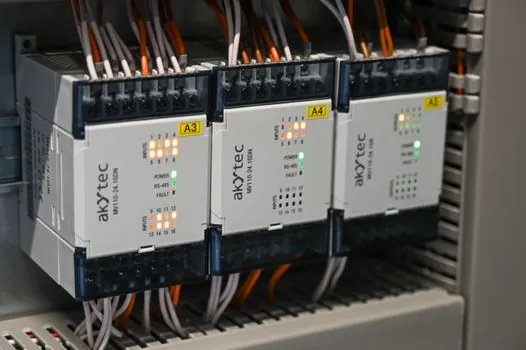
Operating temperature, storage temperature, humidity, and atmosphere are RFQ fields, not assumptions: the R30 base is rated for -10 to +55 degrees C operation, -20 to +65 degrees C storage, 10 to 90 percent RH non-condensing, with no corrosive gas or heavy dust [S3]. Plants with outdoor MCCs, coastal exposure, or washdown areas need to write the derate in: the panel builder's stock base will not meet the application.
Base-slot count is a directly billable line: 0/2/4/8/12/16 slot bases weigh from 50 g to 470 g empty, surface or DIN-rail mounted, and selecting a 16-slot base when only 8 slots are used costs roughly 470 g of cabinet space and one full backplane price step with no functional gain [S3]. The buying rule is to size the base at 1.25 to 1.5 times the current module count, not at the count itself, and to write the spare-slot policy on the RFQ so the panel builder does not pre-fill it with power-supply or terminal modules the buyer did not ask for. The interaction between a remote I/O module and the wider MCC cabinet layout is where most layout requotes originate.
RFQ Line-Item Checklist and Common Spec Mistakes
A clean RFQ for one remote I/O position reads as: (1) fieldbus protocol with physical layer, (2) redundancy line, (3) per-signal-type module count with channel count, (4) per-channel isolation voltage, (5) EN 61000-6-2 / EN 61000-6-4 conformance, (6) dielectric strength to functional earth, (7) hazardous-area class and protection concept, (8) operating temperature and humidity envelope, (9) base slot count and mounting, (10) terminal type and torque [S3][S4]. Anything left off this list is at the panel builder's discretion, and that discretion is what makes quotes non-comparable across vendors.
Three mistakes cause the largest requote cycles: writing "16 DI" without sink versus source direction, writing "PROFIBUS" without specifying PA versus DP, and writing "24 VDC" on the field side without specifying whether the module sources or sinks that current to the field device. Each of these has caused a documented re-engineering cycle on industrial MCC builds, and each is fixable on the original RFQ. As a cross-reference, the remote I/O module encyclopedia entry lays out the bus-side vs field-side isolation boundary that the RFQ must respect, and the relay module entry is the right counter-reference for any electromechanical output the buyer is weighing against a solid-state alternative. When the cabinet is being scoped against a new fieldbus gateway certification checklist for harsh factory floor, the protocol line on the remote I/O RFQ should match the gateway's supported physical layer so the two devices do not force a translator module into the BOM.