A remote I/O module is a field terminal that collects digital and analog signals from sensors and actuators near a machine and exchanges them with a central controller over an industrial network. Instead of running a dedicated copper pair from every field point back to the control cabinet, engineers place I/O stations beside the equipment and carry all their data on a single fieldbus or industrial Ethernet cable.
The category covers two physical forms: cabinet-mounted slice systems built from a bus coupler plus stackable terminals, and sealed block modules with M12 connectors for direct machine mounting. Both speak protocols such as PROFINET, EtherCAT, EtherNet/IP, Modbus TCP, and IO-Link, and both trace their signal definitions to the IEC 61131-2 controller standard.
This guide is written for industrial purchasing engineers and design engineers. It covers 6 chapters from architecture and bus protocols, module types, signal standards, ingress protection, to spec-sheet decoding and selection decisions, with 7 selection FAQs and manufacturer comparisons. All parameters reference the public IEC 61131-2 (programmable controllers, hardware), IEC 61131-9 (IO-Link / SDCI), and IEC 60529 (IP ingress protection) standards, plus published manufacturer datasheets.
Chapter 1 / 06
What is a Remote I/O Module
A remote I/O module is a distributed input/output device that connects field sensors and actuators to a programmable controller through an industrial network. Unlike traditional centralized I/O, where every signal wire runs back to cards inside the main control cabinet, a remote I/O system distributes the I/O electronics close to the field devices and communicates with the central controller over industrial Ethernet, a fieldbus, or in some cases a wireless link. Each remote station maintains a cyclic data exchange with the controller, gathering inputs and driving outputs in a fixed update period.
It is important to separate the remote I/O module from the controller. A PLC or PAC executes the user program: it scans inputs, runs the logic, and writes outputs. A remote I/O module ordinarily holds no control program. It is a peripheral that converts physical signals to network data and back, leaving the deterministic control loop in the controller. This division of labor is why the architecture is also called distributed I/O or decentralized peripherals; the term PROFIBUS DP literally stands for Decentralized Peripherals.
Structurally, a remote I/O node has three functional layers: (1) the network interface, which terminates the fieldbus or Ethernet protocol and manages the cyclic process-data exchange; (2) the channel electronics, which condition, isolate, and convert each digital or analog signal; and (3) the field-wiring interface, which lands the sensor and actuator wires, commonly through spring-cage push-in terminals inside a cabinet or through M12 circular connectors in the field. In a slice system the first layer sits in a bus coupler and the channel electronics live in separate terminals; in a block module all three layers share one sealed housing.
The architecture spread widely in the 1990s. PROFIBUS was introduced in 1989, and the faster PROFIBUS DP variant was specified in 1993 specifically to replace conventional point-to-point wiring with a single serial bus to distributed peripherals. The economic case was direct: instead of wiring every sensor and actuator individually to the PLC, an installer drops a remote I/O station next to the equipment and carries all its data over one RS-485 cable, cutting copper, cable trays, marshalling, and labor. From the early 2000s, industrial Ethernet protocols (PROFINET, EtherCAT, EtherNet/IP) layered deterministic real-time behavior on standard Ethernet hardware, and the same modules began offering IO-Link masters to digitize the last meters down to individual sensors.
Four practical attributes determine whether a remote I/O product fits a project: the supported network protocol and its timing, the channel mix and signal standards, the ingress protection and mounting form, and the diagnostic depth (per-channel fault reporting, hot-swap, and configuration tooling). These attributes, rather than headline channel count, decide installation cost and long-term maintainability, which is the lens this guide uses throughout.
Chapter 2 / 06
Architectures and Bus Protocols
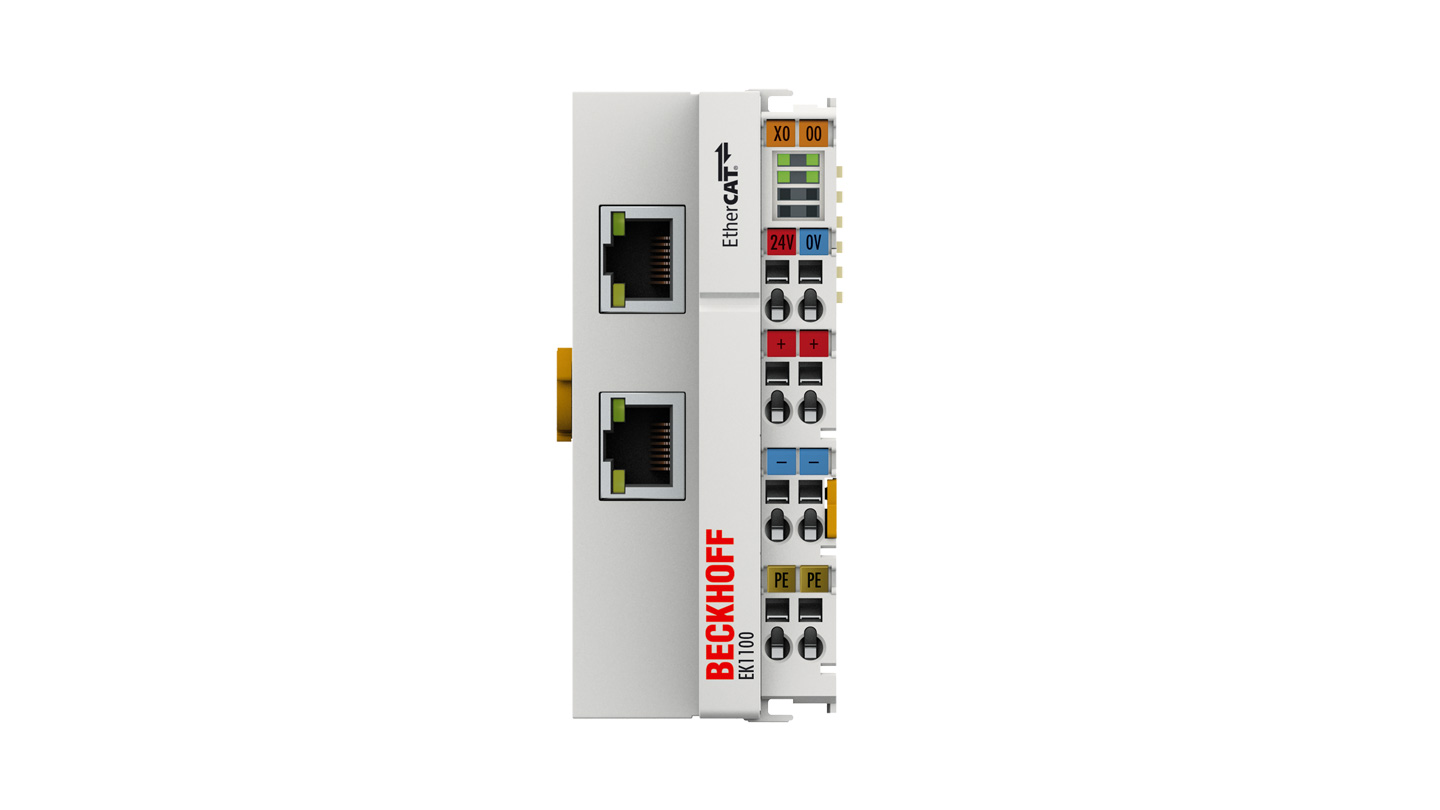
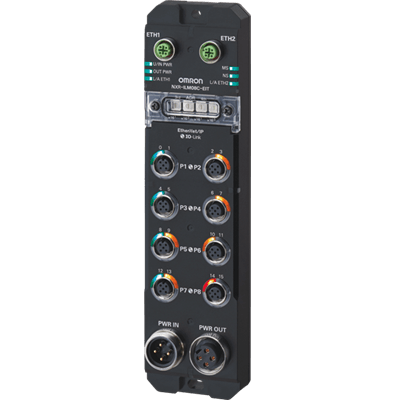
Two physical architectures dominate the category. A slice or modular system uses a head station, called a bus coupler or network adapter, that terminates the fieldbus and feeds an internal backplane bus. Slim I/O terminals then clip onto a DIN rail next to the coupler, one channel group per terminal, so the node is assembled to the exact channel mix a machine needs. Beckhoff EK1100 with EL-series terminals and Phoenix Contact Axioline F are representative slice systems. A block system integrates the network interface and a fixed channel set in a single sealed housing, usually with M12 connectors, so it mounts directly on the machine. Turck TBEN and Weidmuller u-remote IP67 are representative blocks.
The network protocol then determines timing, openness, and which controllers the node can join. The table below compares the four mainstream industrial Ethernet and fieldbus protocols used for remote I/O.
Protocol
Steward
Typical cycle time
Determinism
Common controller ecosystem
PROFINET
PROFIBUS & PROFINET International (PI)
1 to 10 ms (RT); sub-ms (IRT)
Deterministic
Siemens SIMATIC
EtherCAT
EtherCAT Technology Group
~100 us with distributed clocks
Highly deterministic
Beckhoff TwinCAT and open
EtherNet/IP
ODVA
1 to 10 ms (RPI)
Deterministic
Rockwell / Allen-Bradley
Modbus TCP
Modbus Organization
10 ms and up
Not deterministic
Open / multi-vendor
PROFINET runs deterministic real-time exchange on standard Ethernet. Each IO-Device exchanges input and output process data with the controller in a defined cycle. Standard real-time (RT) traffic suits most factory I/O, while Isochronous Real-Time (IRT) reserves bandwidth for motion-grade synchronization. PROFINET is the default in Siemens-centric plants, which makes a PROFINET-capable remote I/O block the path of least resistance for SIMATIC projects.
EtherCAT uses a processing-on-the-fly principle in which each slave reads and writes its data as the frame passes, giving the lowest cycle times in the group. Its distributed-clocks mechanism synchronizes every slave clock to the master so that input terminals sample as close as possible to the moment the fetching frame arrives. A fieldbus cycle of about 100 microseconds is achievable, which is why EtherCAT is favored on machines with many coordinated axes. Infrastructure couplers such as the Beckhoff EK1100 pass telegrams between 100BASE-TX Ethernet and the internal E-bus and do not themselves require distributed clocks.
EtherNet/IP, stewarded by ODVA, carries the Common Industrial Protocol (CIP) over standard Ethernet and is the native I/O network in Rockwell Automation systems. Devices exchange implicit (cyclic) data at a configured Requested Packet Interval. Modbus TCP keeps the simple request-response model of serial Modbus over TCP/IP, addressing each node by IP. It is the most open and easiest to integrate but is not deterministic, so it suits monitoring, slow control, and third-party gateways rather than tight motion loops. Many modern blocks ship multiprotocol firmware that auto-detects PROFINET, EtherNet/IP, and Modbus TCP, which lets a plant stock one spare across mixed controllers.
Chapter 3 / 06
Module Types and Signal Standards
Within either architecture, remote I/O is built from a small set of channel-type modules. Selecting the right module starts with the signal each field device produces or consumes, and signal definitions trace to IEC 61131-2 for discrete and analog process interfaces and to IEC 61131-9 for IO-Link. The table below summarizes the common module types and their signal standards.
Digital input modules read 24 V DC discrete states. IEC 61131-2 defines three sinking input types by voltage and current thresholds: Type 1 reads high at 15 V and above (sinking about 2 mA), Type 2 reads high at 11 V and above but sinks much more current (about 6 mA) for older 2-wire proximity sensors, and Type 3 reads high at 11 V and above while sinking roughly 2 mA for low-power semiconductor sensors. All three define a low level at 5 V and below. Matching the module input type to the sensor type prevents the classic fault where a low-power sensor cannot drive enough current to be recognized.
Digital output modules switch 24 V DC loads, usually through solid-state (transistor) outputs rated 0.5 to 2 A per channel, with electronic short-circuit and overload protection on better designs. Relay output variants handle higher voltages or AC loads at the cost of switching speed and contact life. Some block modules provide configurable channels that work as either input or output without parameterization, which simplifies stocking and late wiring changes.
Analog modules convert continuous process signals. The two dominant standards are 0 to 10 V voltage and 4 to 20 mA current; the 4 to 20 mA loop is preferred over distance because current is immune to cable voltage drop and a 0 mA reading flags a broken wire. Resolution is stated in bits (12-bit is 4,096 steps, 16-bit is 65,536 steps), but resolution is not accuracy: a module may resolve 16 bits yet specify total error as a percent of full scale plus a temperature coefficient. Temperature modules are specialized analog inputs that linearize RTD curves (Pt100, Pt1000) or thermocouple tables (type K, J, T). For example, the Beckhoff EL3204 is a 4-channel, 16-bit RTD (Pt100) terminal; thermocouple inputs additionally require cold-junction compensation, often via a Pt1000 element built into the connector.
IO-Link master modules digitize the last link to the sensor. IO-Link is standardized as the single-drop digital communication interface (SDCI) in IEC 61131-9, the first worldwide-standardized I/O interface, providing point-to-point communication between the master port and a smart device over a generic unshielded 3-wire sensor cable up to 20 m. It supports three baud rates: COM1 at 4.8 kbaud, COM2 at 38.4 kbaud, and COM3 at 230.4 kbaud, and it remains backward compatible with a plain binary sensor on the same port. IO-Link lets a remote I/O block read sensor parameters, push configuration, and pull diagnostics, which is the foundation of automated device replacement on a line.
Chapter 4 / 06
Mounting, Ingress Protection, and Power
Where a node physically lives drives much of its specification. The choice between a cabinet head station and a field-mounted block determines the connector system, the ingress protection class, the temperature range, and how power is distributed. Ingress protection is rated under IEC 60529, written as two digits: the first for solids and dust, the second for water. The table below maps the common IP classes to typical remote I/O placements.
IP class
Protection
Typical placement
Connector / wiring
IP20
Finger and small-object only, no water
Inside a closed control cabinet
Push-in / spring-cage terminals
IP65
Dust-tight, low-pressure water jets
Machine frame, mild environment
M12 circular connectors
IP67
Dust-tight, temporary immersion to 1 m
Direct field mount, no cabinet
M12 circular connectors
IP69K
High-pressure, high-temperature washdown
Food, beverage, hygienic lines
Encapsulated, sealed M12
Cabinet slice systems are almost always IP20. They rely on the enclosure for environmental protection and use push-in spring terminals for fast, screwdriverless wiring at high channel density. Phoenix Contact and Weidmuller both build IP20 slice systems for the control cabinet, optimized for the smallest footprint per channel. The trade is that every signal still travels from the field into the cabinet, so the wiring saving comes only from shrinking the marshalling, not from eliminating the home run.
Field block systems carry the protection on the module itself, typically IP65 or IP67, occasionally IP69K for washdown duty. Sealed zinc die-cast or reinforced-polymer housings with M12 connectors let the module bolt straight onto the machine, removing the local cabinet entirely. Phoenix Contact Axioline E, for instance, offers IP65/IP67/IP69 with a fully encapsulated zinc die-cast housing for harsh ambient conditions. In a typical installed base, roughly 72 percent of remote I/O is cabinet-mounted IP20, about 14 percent is IP67 machine-mounted, and about 11 percent is IP20 machine-mount, so most plants run a mix of head stations and field blocks.
Power and current capacity are easy to underestimate. Each node needs 24 V DC system power for its logic and, separately, field-side power for the output loads, and the module must carry the summed output current through its internal current path. Field block families publish a maximum feed-in current per node; Weidmuller u-remote in IP67, for example, raises the feed-in to the I/O system to 16 A. When a string of output modules approaches that limit, the design must add a fresh power-feed module or split the node, or the internal bus will overheat. Always sum the worst-case simultaneous output load and compare it against the node feed-in rating before finalizing the channel layout.
Hot-swap and diagnostics matter most in the field. Modules that support hot connect or hot swap let a maintenance technician replace one slice or block without powering down the line, and per-channel diagnostics report wire-break, short-circuit, and out-of-range conditions to the controller so a fault is located in seconds rather than traced by hand. These features cost little at purchase but dominate mean-time-to-repair after years of service.
Chapter 5 / 06
Key Specification Parameters
Reading a remote I/O datasheet means looking past the headline channel count. The same module may list dozens of lines, but a manageable set of parameters actually drives the selection decision: protocol and update time, channel mix, signal type and input class, analog resolution and accuracy, isolation, power and current path, environmental ratings, and diagnostic depth. Each is decoded below.
Protocol and update time. The datasheet states the supported network (PROFINET, EtherCAT, EtherNet/IP, Modbus TCP) and the minimum cycle or update time the node sustains. EtherCAT terminals reach about 100 microsecond fieldbus cycles with distributed-clock synchronization, while PROFINET RT and EtherNet/IP typically run in the 1 to 10 ms range. For monitoring duty, a slow update is fine; for interlocks and motion, the node cycle must comfortably beat the control-loop period.
Signal type and input class. For digital inputs, confirm the IEC 61131-2 type (1, 2, or 3) and the rated input current, because a low-power sensor on a Type 2 input may not be read. For outputs, confirm the per-channel current, whether the source is transistor or relay, and whether short-circuit protection is electronic. For analog, confirm the supported ranges (0 to 10 V, 4 to 20 mA) and whether channels are individually configurable.
Analog resolution and accuracy. Resolution (12 to 16 bit) sets the smallest distinguishable step, but accuracy is the trustworthy error figure, stated as a percent of full scale at a reference temperature plus a temperature coefficient such as percent FS per kelvin. A 16-bit module with weak thermal compensation can read worse in a hot cabinet than a 12-bit module with tight specs. For temperature inputs, also verify the supported sensor curves (Pt100, Pt1000, type K/J/T) and the presence of cold-junction compensation.
Isolation. Channel-to-channel, channel-to-bus, and channel-to-power isolation, stated in volts, prevents ground loops and protects the network when a field wire faults. Process-grade analog modules often provide galvanic isolation per channel; basic digital modules may share a common.
Environmental and mechanical. Key lines are the IP class (IEC 60529), the operating temperature range (commonly -20 to +60 degrees Celsius for cabinet modules, wider for field blocks), vibration and shock ratings, and the connector system (push-in terminal versus M12). Outdoor, mobile, or washdown duty narrows the field quickly.
Power, current path, and diagnostics. Note the system supply voltage and current draw, the field-side feed-in limit per node, and whether output current is summed through the internal bus. Finally weigh diagnostic depth: per-channel fault reporting, wire-break and short-circuit detection, hot-swap support, and the configuration tooling (GSDML for PROFINET, ESI for EtherCAT, EDS for EtherNet/IP) the module ships with. The list below ranks how these parameters typically gate a decision.
Protocol fit: the node must speak the controller's network, or be multiprotocol. This is usually the first hard filter.
Channel mix and signal class: the right count of DI/DO/AI/AO/temperature/IO-Link channels at the correct input type and signal range.
Update time: fast enough for the loop, with margin for future expansion of the node.
Ingress protection and temperature: matched to the mounting location and ambient.
Diagnostics and serviceability: per-channel faults, hot-swap, and standard description files for the engineering tool.
Chapter 6 / 06
Selection Decision Factors
To turn the preceding chapters into a specific model, follow the ordered sequence below. Most selection errors come not from one wrong number but from deciding the channel count before the protocol and mounting are fixed. These eight steps double as a reusable RFQ template.
Fix the network protocol first: identify the controller (Siemens, Rockwell, Beckhoff, or open) and choose PROFINET, EtherNet/IP, EtherCAT, or Modbus TCP accordingly, or pick a multiprotocol block if the plant runs mixed controllers. This decision constrains every later choice.
Decide the architecture: cabinet slice system (bus coupler plus terminals, IP20) for high density and flexibility, or sealed field block (M12, IP65/IP67) to mount on the machine and eliminate a local cabinet. Mounting location usually settles this.
Tally the channel mix: count DI, DO, AI, AO, temperature, and IO-Link points, then add 15 to 20 percent spare capacity for future signals. Confirm digital-input type (IEC 61131-2 Type 1/2/3) against the connected sensors.
Specify analog requirements: ranges (0 to 10 V, 4 to 20 mA), resolution (12 to 16 bit), accuracy as percent FS plus temperature coefficient, isolation, and for temperature, the sensor curves and cold-junction compensation.
Set the update-time target: derive the required node cycle from the control-loop period; reserve EtherCAT distributed-clock timing for motion and interlocks, accept PROFINET RT or Modbus TCP for monitoring.
Match ingress protection and environment: IP20 in the cabinet, IP65/IP67 in the field, IP69K for washdown; verify the operating temperature, vibration, and shock ratings against the location.
Size power and current path: sum the worst-case simultaneous output load, compare against the node feed-in limit (for example 16 A on some IP67 systems), and add a power-feed module or split the node before the internal bus is overloaded.
Weigh diagnostics, serviceability, and total cost: per-channel fault reporting, hot-swap, standard description files (GSDML, ESI, EDS), local spares, and engineering-tool support. Purchase price is a small share of lifecycle cost once installation, commissioning, and downtime are counted.
One frequently overlooked dimension is manufacturer serviceability and ecosystem fit: availability of local spare modules, the quality of the configuration tooling and its description files, firmware update policy, and how cleanly the node integrates with the chosen controller's engineering environment. Beckhoff, Phoenix Contact, Weidmuller, Turck, Siemens, Rockwell Automation, Wago, and Murrelektronik all maintain broad remote I/O catalogs with regional support, which makes them safe defaults for large multi-year projects; the right pick is the one whose protocol, form factor, and tooling align with the controller already on the line.
FAQ
What is the difference between remote I/O and a PLC?
A PLC executes the control program: it scans inputs, runs user logic, and writes outputs. A remote I/O module has no program of its own. It is a field terminal that gathers sensor and actuator signals near the machine and exchanges them with a controller over an industrial network such as PROFINET, EtherCAT, EtherNet/IP, or Modbus TCP. The PLC remains the brain; remote I/O is the distributed nervous system that moves wiring out of the central cabinet and into the field, cutting cable length and terminal count. Some modern blocks add edge logic or IO-Link masters, but the deterministic control loop still lives in the PLC or PAC.
How does a bus coupler differ from a block I/O module?
A bus coupler (also called a network adapter or head station) is a slice-system head that speaks the fieldbus on one side and a local backplane bus on the other, then accepts a stack of slim I/O slices you assemble channel by channel, for example Beckhoff EK1100 plus EL-series terminals or Phoenix Contact Axioline F. A block I/O module integrates the network interface and a fixed channel set in one sealed housing, typically with M12 connectors for IP65/IP67 field mounting, for example Turck TBEN or Weidmuller u-remote IP67. Couplers favor flexibility and high density inside a cabinet; blocks favor fast machine-mount installation with no cabinet at all.
Which industrial protocol should I choose for remote I/O?
Match the protocol to the existing controller and the determinism you need. PROFINET dominates Siemens-centric plants and supports IRT for motion-grade timing. EtherCAT gives the lowest cycle times, on the order of 100 microseconds with distributed-clock synchronization, and suits high axis-count machines. EtherNet/IP is the default in Rockwell/Allen-Bradley lines. Modbus TCP is the simplest and most open choice for slow monitoring or third-party integration but is not deterministic. Many block I/O families ship multiprotocol firmware that auto-detects PROFINET, EtherNet/IP, and Modbus TCP, which de-risks stocking spares across mixed-controller plants.
What do the digital input Type 1, Type 2 and Type 3 ratings mean?
IEC 61131-2 defines three 24 V DC sinking digital-input types by their voltage and current thresholds. Type 1 reads a high level at 15 V or above and a low level at 5 V or below, suited to mechanical contacts and 3-wire sensors. Type 2 needs a high level at 11 V or above and sinks much more current (about 6 mA), suited to older 2-wire proximity sensors. Type 3 reads high at 11 V or above but sinks roughly 2 mA, suited to low-power semiconductor sensors. Always confirm the input type on the module datasheet so the connected sensor can drive enough current to be read reliably.
How are analog input and output resolution and accuracy specified?
Resolution is the number of bits the converter resolves the signal into: 12-bit gives 4,096 steps, 16-bit gives 65,536 steps. Resolution is not accuracy. Accuracy is the total measurement error stated as a percent of full scale, for example plus or minus 0.1 percent FS at 25 degrees Celsius, plus a temperature coefficient such as plus or minus 0.01 percent FS per kelvin. A high-resolution module with poor temperature stability can read worse than a coarser, better-compensated one. For RTD and thermocouple inputs, also check the linearization tables supported (Pt100, Pt1000, type K/J/T) and whether cold-junction compensation is built in.
What IP rating do I need for field-mounted I/O?
IP20 modules have no protection against water and are for inside a closed control cabinet. IP65 resists low-pressure water jets; IP67 withstands temporary immersion to 1 m; IP69K withstands high-pressure, high-temperature washdown used in food and beverage lines. Machine-mounted block I/O with M12 connectors is typically IP65 or IP67 so it can sit directly on the machine frame without a local cabinet. Surveyed installations skew about 72 percent cabinet-mounted IP20, with roughly 14 percent IP67 and 11 percent IP20 machine-mount, so most projects still split signals between a cabinet head station and field blocks.
Does remote I/O really reduce wiring cost?
Yes, and that was the original reason the architecture spread in the 1990s with PROFIBUS DP. Instead of running a dedicated pair from every sensor and actuator back to a central cabinet, you place I/O stations next to the equipment and carry all their data over a single bus or Ethernet cable. This cuts copper, cable trays, marshalling terminals, and labor, and it shrinks the central cabinet. The trade is added network engineering, more powered nodes to maintain, and dependence on bus availability, so very small machines with a handful of points may still be cheaper to hard-wire directly to the PLC.
Remote I/O Module Manufacturers
Source-backed product routes. Open a company dossier for procurement scope and cited evidence.