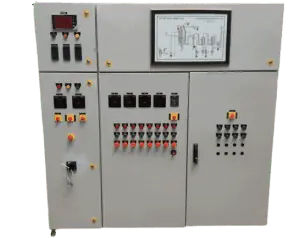
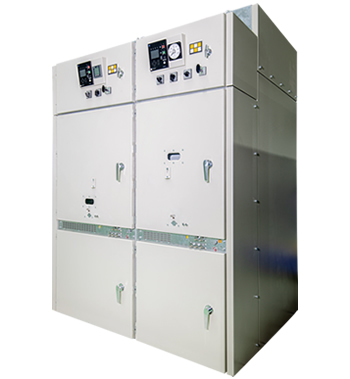
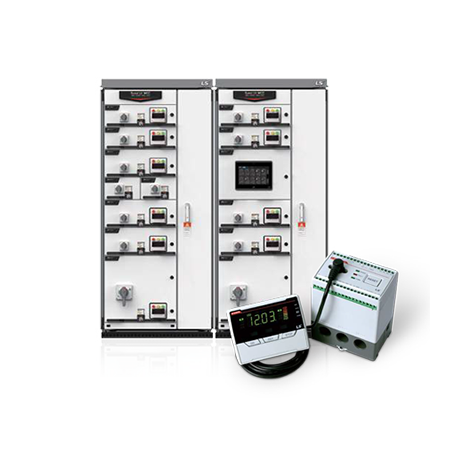
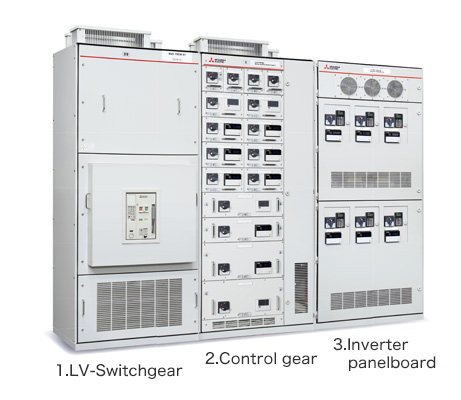
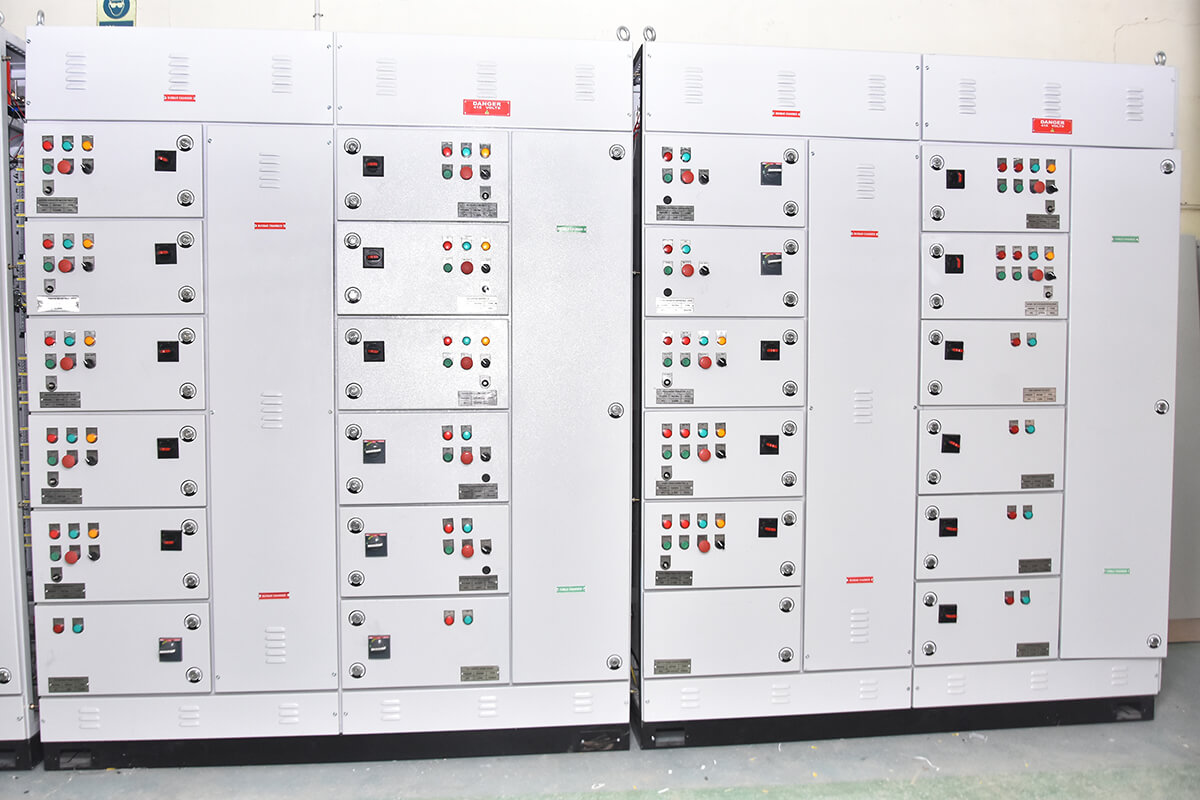
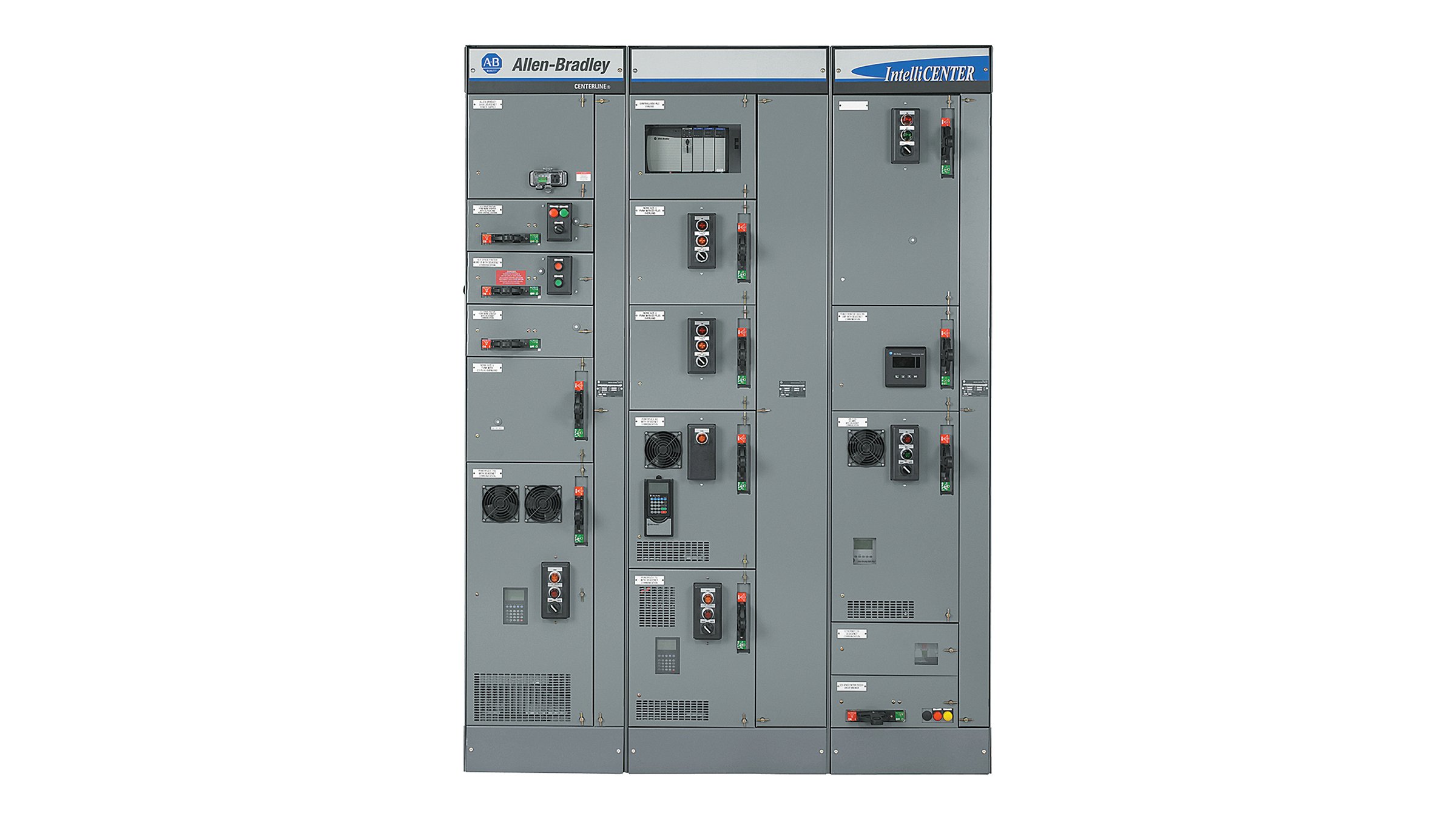
A motor control center (MCC) is a floor-standing, metal-enclosed assembly that groups the starters, protective devices, and control for many electric motors into one factory-built lineup, fed from a common power bus. Instead of scattering individual starters across a plant, an MCC stacks compact plug-in units, called buckets, into vertical sections so that dozens of motors are powered, protected, and operated from a single coordinated structure.
MCCs are a backbone of process automation in water and wastewater plants, oil and gas, chemicals, mining, food and beverage, and large HVAC systems. This guide covers the two governing frameworks (North American NEMA ICS 18 and UL 845, and international IEC 61439-2), the construction classes and forms of separation, the bus and short-circuit ratings that drive selection, the contents of a starter bucket, and the move toward intelligent, networked MCCs.
Photo: Wtshymanski, CC BY-SA 3.0, via Wikimedia Commons
This guide is written for industrial purchasing engineers and design engineers specifying or comparing MCC lineups. It covers 6 chapters from what an MCC is, through NEMA and IEC construction classes, bus and short-circuit ratings, the starter bucket and its components, the key spec-sheet parameters, to a step-by-step selection sequence, with 7 selection FAQs and manufacturer comparisons. All parameters reference the public standards NEMA ICS 18, UL 845, IEC 61439-1 and IEC 61439-2, IEC 62208, IEC TR 61641, IEEE C37.20.7, and CSA C22.2 No. 0.22.
Chapter 1 / 06
What is a Motor Control Center
A motor control center is a low-voltage or medium-voltage assembly that consolidates the control and protection of multiple motors into one enclosure lineup. It receives incoming power at a main, distributes it through a continuous horizontal bus along the top of the lineup, taps that bus into a vertical bus inside each section, and feeds a stack of removable units that each contain the starter and protection for one motor or feeder. The result is a single, coordinated, serviceable structure rather than a wall of individually mounted starters and disconnects.
The defining feature of an MCC, and what separates it from a panelboard or a switchgear lineup, is unit density combined with modularity. A standard vertical section, roughly 508 mm (20 in) wide and 2,286 mm (90 in) tall, is divided into standardized unit spaces in 152 mm (6 in) height increments. A single section can hold a dozen or more small buckets, or a few large ones, and units can be added, removed, or rearranged in the field. Plug-in units engage the vertical bus through spring-loaded stabs, so a bucket can be replaced without disturbing the bus or the adjacent loads.
Inside each combination starter bucket sit the same building blocks an engineer would otherwise wire by hand: a disconnecting means (a molded-case circuit breaker or a fusible switch), a contactor that switches power to the motor, an overload relay that protects the motor against sustained overcurrent, and a control circuit, typically a control power transformer with a start and stop scheme. Reduced-voltage starters, soft starters, and variable frequency drives are increasingly installed in the same bucket format.
Historically, the MCC emerged in North America in the 1950s as factories electrified large numbers of motors and needed a compact, standardized way to house starters. NEMA published construction and classification guidance that became NEMA ICS 18, and Underwriters Laboratories developed UL 845 as the product safety and listing standard. In Europe and most of Asia, MCCs are designed and verified to the IEC 61439 series, with IEC 61439-2 as the specific part standard for power switchgear and controlgear assemblies that superseded the older IEC 60439-1. The two traditions describe the same machine with different rating philosophies, terminology, and test regimes.
By application scale, MCCs span a wide envelope. Low-voltage units are rated up to 600 V AC in North America and up to 690 V under IEC, with main bus current commonly from 600 A to 2,000 A and individual sections handling motors from a fraction of a horsepower up to several hundred horsepower. Medium-voltage MCCs extend the same architecture to roughly 7.2 kV using vacuum contactors and current-limiting fuses for large pumps, fans, and compressors. There is no single universal MCC; selection is the work of mapping a motor list to the right bus, bracing, bucket sizes, enclosure, and control architecture.
Chapter 2 / 06
MCC Types and Construction Classes
MCCs are categorized along several independent axes: voltage class, unit mounting style, control intelligence, and arc-fault containment. These are not mutually exclusive; a real specification combines one choice from each axis. Confusing the axes (for example, treating intelligent and arc-resistant as alternatives rather than features that can coexist) is a common cause of incomplete RFQs. The table below summarizes the main families and where each is used.
Type
Voltage / Rating
Distinguishing Feature
Typical Use
Low-voltage MCC
Up to 600 V AC (690 V IEC)
Plug-in starter buckets on vertical bus
General process plant motors
Medium-voltage MCC
Up to 7.2 kV
Vacuum contactor plus current-limiting fuses
Large pumps, fans, compressors
Intelligent MCC (iMCC)
Up to 600 V AC
Networked motor management relays
Many motors, DCS or SCADA plants
Arc-resistant MCC
Up to 600 V AC
Vented, tested to IEEE C37.20.7
High fault energy, operator safety
Withdrawable (drawout) MCC
Up to 600 V AC
Units rack out under interlock, IEC Form 4
High-availability, fast unit swap
Low-voltage versus medium-voltage. The overwhelming majority of installed MCCs are low-voltage, rated to 600 V AC under NEMA and UL, or to 690 V under IEC. They use air-break contactors and molded-case breakers or fusible switches. Medium-voltage MCCs, rated to about 7.2 kV, are a different mechanical design: each starter uses a vacuum contactor and current-limiting fuses, units are physically larger, and the assembly carries the higher creepage, clearance, and insulation requirements of medium-voltage gear. They serve motors too large to start economically at 480 V.
Plug-in versus fixed versus withdrawable. Plug-in (stab-on) units, the dominant low-voltage style, connect to the vertical bus through stabs and can be removed by loosening a few fasteners. Fixed (bolted) units are hard-bolted to the bus and are used for larger feeders where the available unit current exceeds practical stab ratings. Withdrawable or drawout units, common in IEC designs and in arc-resistant lines, rack the entire functional unit out on rails behind an interlocked door, isolating the unit from the bus without exposing live parts. Withdrawable construction supports the highest IEC forms of separation and the fastest hot-spare swaps.
Conventional versus intelligent. A conventional MCC wires each bucket's overload relay, control transformer, and pushbuttons discretely, bringing control to terminal blocks for field wiring. An intelligent MCC replaces the discrete overload device with a networked motor management relay (Rockwell E300, Schneider TeSys T, Siemens SIMOCODE pro, or Eaton C440) that reports current, thermal state, run hours, and trip history over an industrial network. Conventional MCCs remain the right choice for small lineups, simple loads, and sites without a control network; intelligent MCCs earn their premium where motor count, downtime cost, and data needs are high.
Standard versus arc-resistant. A standard MCC is built and tested to contain normal operation but is not qualified for an internal arcing fault. An arc-resistant MCC adds reinforced construction, controlled venting, and plenum routing so that the pressure and plasma of an internal arc are directed up and away from personnel. It is tested to IEEE C37.20.7 (with CSA C22.2 No. 0.22) in North America or to the guidance of IEC TR 61641 internationally, and is specified where the available fault energy and arc-flash incident energy demand an extra layer of operator protection.
Chapter 3 / 06
NEMA and IEC Construction Frameworks
Two standards families govern MCC construction, and a buyer must know which one applies before reading any spec sheet. North American projects follow NEMA ICS 18 for classification and UL 845 for listing; international and most Asian, European, and Middle Eastern projects follow the IEC 61439 series, with the general rules in IEC 61439-1 and the assembly-specific requirements in IEC 61439-2. Enclosures referenced by IEC fall under IEC 62208. The table below maps the equivalent concepts so a NEMA-trained engineer can read an IEC spec and vice versa.
Concept
NEMA / UL Framework
IEC Framework
Governing standard
NEMA ICS 18, UL 845
IEC 61439-1 and IEC 61439-2
Control integration
Class I, Class II
Defined per project, not by class
Wiring termination
Type A, B, C
Forms of separation 1 to 4
Internal separation
Implied by Class and Type
Form 1, 2, 3, 3b, 4a, 4b
Internal arc test
IEEE C37.20.7, CSA C22.2 No. 0.22
IEC TR 61641
Design verification
UL 845 listing tests
Type tests plus routine verification
NEMA ICS 18 classes. The standard defines two classes by how much control integration the manufacturer supplies. A Class I MCC is a mechanical grouping of units with the horizontal-to-vertical bus connections made, but with no interwiring or interlocking between units provided by the factory. A Class II MCC adds factory interwiring and electrical interlocking between units, executed to match the plant control diagrams, so the lineup arrives as a more complete control system. Class II is normal for process plants where many units must coordinate.
NEMA ICS 18 wiring types. Three wiring types describe where unit field wiring terminates. Type A provides no terminal blocks; field conductors land directly on the device terminals inside each unit, which is permitted only on Class I. Type B brings unit wiring to terminal blocks located inside the unit or adjacent to the vertical wireway, so field wiring connects at the unit. Type C brings every unit's terminations to master terminal blocks mounted at the top or bottom of each vertical section, which dramatically simplifies and speeds field wiring on large installations. Most maintainable process MCCs are specified Class II, Type B or Type C.
IEC forms of separation. Rather than wiring classes, IEC 61439-2 grades internal segregation as a Form. Form 1 has no internal separation. Form 2 separates the busbars from the functional units. Form 3 separates the busbars from the units and the units from each other. Form 4 additionally separates each unit's outgoing terminals, and the common subdivision Form 4b keeps each unit's terminals in their own compartment with the cables. Higher forms reduce arc propagation between compartments and allow one unit to be worked on while adjacent units stay energized, which is why withdrawable IEC MCCs such as ABB MNS commonly target Form 4b.
Design verification. IEC 61439-2 replaced the loose phrase type-tested with a structured set of verifications covering temperature rise, dielectric strength, short-circuit withstand, and other properties, provable by testing, by comparison with a tested reference design, or by calculation within defined limits. For temperature rise, the standard limits bare copper busbar rise to 105 K and terminals for external conductors to 70 K under rated current. UL 845, by contrast, qualifies the complete MCC through its own listing tests. In both regimes, the listing or verification is only valid for the as-built configuration, so substituting a non-listed device into a bucket can void the rating.
Chapter 4 / 06
The Starter Bucket and Its Components
The unit, or bucket, is the functional heart of an MCC. Each bucket is a self-contained module that occupies one or more 152 mm (6 in) unit spaces and houses everything needed to control and protect one load. Understanding the bucket lets a buyer translate a motor list into a section layout and a bill of material. A typical combination starter bucket contains four element groups: a disconnecting means, a switching device, a protection device, and a control circuit.
Disconnecting means. Every bucket starts with a means to isolate the unit, operated by a handle on the door that is interlocked so the door cannot open while energized. This is either a molded-case circuit breaker, which provides instantaneous magnetic short-circuit protection and resets after a trip, or a fusible disconnect switch using current-limiting fuses, which can offer very high interrupting capacity and let-through limiting at lower cost. The choice affects the bucket's short-circuit current rating and how easily faults are cleared and restored.
Switching device. A contactor makes and breaks the motor current under command of the control circuit. For across-the-line (full-voltage) starting, one contactor is sized to the motor by NEMA size or IEC utilization category. Reduced-voltage buckets add contactors and resistors or an autotransformer; soft-starter buckets use an SCR-based soft starter; and VFD buckets house a variable frequency drive in place of the contactor for adjustable speed and soft starting.
Protection device. An overload relay protects the motor against sustained overcurrent that would overheat the windings. Conventional buckets use a thermal or electronic overload relay matched to the motor full-load amps. Intelligent buckets replace this with a networked motor management relay that adds thermal modeling, ground-fault, phase-loss, jam, and underload protection plus data reporting. Short-circuit protection is handled upstream by the breaker or fuses; overload and short-circuit are separate, coordinated functions.
Control circuit. A control power transformer typically steps 480 V down to 120 V for the coil and pilot devices, feeding a start and stop scheme with seal-in contacts, pilot lights, and selector switches. In an intelligent MCC, much of this control logic moves into the motor management relay and onto the network, reducing the hardwired control wiring that field crews would otherwise terminate.
The table below maps common NEMA contactor sizes to their continuous current and maximum three-phase motor horsepower, the figures that determine how many unit spaces a bucket needs and how the vertical bus is loaded. NEMA sizing is conservative and discrete; IEC sizing rates the contactor to the actual application by utilization category (AC-3 for motors), so an IEC frame is often smaller for the same motor but must be matched more carefully to duty.
NEMA Size
Continuous Current
Max HP at 230 V
Max HP at 460 / 480 V
Size 00
9 A
1.5 HP
2 HP
Size 0
18 A
3 HP
5 HP
Size 1
27 A
7.5 HP
10 HP
Size 2
45 A
15 HP
25 HP
Size 3
90 A
30 HP
50 HP
Size 4
135 A
50 HP
100 HP
Size 5
270 A
100 HP
200 HP
Chapter 5 / 06
Key Specification Parameters
An MCC spec sheet lists many numbers, but a handful drive selection and price: system voltage, horizontal and vertical bus ampacity, bus bracing and unit SCCR, enclosure type, bus material, and the wiring class or IEC form. Each is decoded below so a buyer can read any manufacturer's data sheet and compare like for like.
System voltage. Low-voltage MCCs are rated to 600 V AC under NEMA and UL, or 690 V under IEC; medium-voltage designs extend to roughly 7.2 kV. The control voltage is separate, usually 120 V AC from an in-bucket control transformer. Always confirm the system voltage and whether the MCC neutral and ground bus are required.
Bus ampacity. The horizontal main bus carries current across the whole lineup; it is commonly rated 600 A to 2,000 A, with some product lines offering 2,500 A or more. The vertical bus that feeds the buckets in each section is commonly 300 A to 1,200 A. UL 845 sets the floor at 600 A horizontal and 300 A vertical. Size the horizontal bus to the diversified lineup load plus growth, and the vertical bus to the worst-loaded section.
Bus bracing and SCCR. Two distinct fault numbers must be checked. Bus bracing is the symmetrical RMS short-circuit current the structure's bus can withstand mechanically; typical values are 42 kA, 65 kA, and 100 kA at 480 V. The unit short-circuit current rating (SCCR) is set per bucket by the weakest protective device in that branch and the tested combination, and can be lower than the bus bracing. Under NEC 110.10 and 430.99, the marked SCCR must equal or exceed the available fault current at the installation; series-rated combinations and current-limiting devices are used to reach 100 kA economically.
Enclosure type. The enclosure rating matches the environment. Common NEMA types are listed below; IEC uses IP codes, where roughly IP4X corresponds to a degree of finger and small-object protection often required between compartments.
NEMA 1: General-purpose indoor, basic protection against contact, the default for clean electrical rooms.
NEMA 1 gasketed: Indoor with dust gasketing, common in process areas with airborne dust.
NEMA 12: Indoor, dust-tight and drip-tight, for dirty or oily industrial environments.
NEMA 3R: Outdoor, rain-tight, often as a walk-in or non-walk-in weather enclosure.
NEMA 4 and 4X: Watertight; 4X adds corrosion resistance (stainless), used in wash-down and wastewater service.
Bus material and plating. Bus and stabs are usually tin-plated or silver-plated copper; silver plating lowers contact resistance for high-current joints, tin plating is the economical default. Aluminum bus is offered at lower cost and weight where the joint plating and torque are specified for it. Plating directly affects the temperature rise and long-term joint reliability of plug-in stab connections.
Wiring class or IEC form. The NEMA Class (I or II) and wiring Type (A, B, C), or the IEC form of separation (1 to 4b), are spec-sheet line items, not afterthoughts. They determine maintainability, the ability to work on one unit with the lineup energized, and the degree of arc and contact protection. They should be fixed in the specification before quotes are requested, because they affect both price and footprint.
Chapter 6 / 06
Selection Decision Factors
To turn the preceding chapters into a buildable lineup, follow the decision sequence below. Most MCC selection errors come not from one wrong number but from deciding the bucket details before the system-level choices (voltage, bus, bracing, enclosure) are fixed. These nine steps double as an RFQ template.
Build the motor list: tabulate every load's HP, voltage, full-load amps, starting method (full-voltage, soft starter, or VFD), and control type. This list drives every later step and is the single most valuable document in the RFQ.
Fix system voltage and bus: confirm 480 V, 600 V, or medium voltage; size the horizontal bus to the diversified lineup load plus 20 to 30 percent growth, and the vertical bus to the heaviest section.
Determine available fault current: obtain the utility or upstream transformer fault current; the structure bus bracing and every bucket SCCR must equal or exceed it per NEC 110.10 and 430.99.
Assign bucket sizes and stack sections: map each motor to a NEMA size or IEC frame and a unit-space count; stack buckets into about 508 mm (20 in) wide by 2,286 mm (90 in) tall sections, reserving 20 to 30 percent spare unit space.
Choose enclosure type: NEMA 1 or 1 gasketed for clean indoor rooms, NEMA 12 for dusty or oily areas, NEMA 3R for outdoor, NEMA 4X for wash-down or corrosive wastewater service.
Select construction class and form: NEMA Class II with Type B or Type C wiring for maintainable North American projects, or IEC Form 3b or 4b for international projects needing energized-adjacent service.
Decide conventional or intelligent control: conventional for small or simple lineups; intelligent (networked motor management relays over EtherNet/IP, PROFIBUS, Modbus TCP, or PROFINET) where motor count, downtime cost, and data needs justify the premium.
Set protection and safety options: arc-resistant construction to IEEE C37.20.7 where arc energy is high, plus arc-energy reduction settings, ground-fault protection, and coordination with upstream devices.
Evaluate total cost of ownership: purchase price plus installation, commissioning wiring, spare unit inventory, and downtime exposure. An intelligent or higher-form lineup costs more upfront but can recover the difference in reduced wiring, faster diagnostics, and shorter outages.
One last frequently overlooked dimension is manufacturer serviceability: local availability of spare buckets, the lead time for matched replacement units, field service for racking and calibration, and software support for the motor management relays over a 15 to 25 year service life. Eaton (Freedom), Rockwell Automation (CENTERLINE 2100), Schneider Electric (Model 6 and Model 6 iMCC), Siemens (tiastar with SIMOCODE pro), and ABB (MNS) all maintain engineering, parts, and service networks across major industrial regions, which is decisive for a structure expected to run for decades. Confirm that the as-built unit configuration is fully UL 845 listed or IEC 61439-2 verified, because field substitutions can invalidate the rating that the entire safety case depends on.
FAQ
What is the difference between a motor control center and a switchgear lineup?
Both are metal-enclosed assemblies fed from a common bus, but they serve different jobs. A motor control center groups many small to medium motor starters and feeders into compact plug-in units (buckets), with up to a dozen or more units stacked in one vertical section, optimized for density and for distributing power to dozens of motors. Switchgear is built around larger drawout circuit breakers, one or two devices per section, optimized for high interrupting capacity, main and tie distribution, and metering. As a rule of thumb, switchgear distributes and protects feeders at the head of a system, while an MCC sits downstream and starts and protects the individual motor loads. MCCs are covered by UL 845 and NEMA ICS 18 (or IEC 61439-2 internationally), low-voltage switchgear by UL 1558 and IEC 61439-1.
What do NEMA ICS 18 wiring Class I, Class II, Type A, B, and C mean?
NEMA ICS 18 defines two classes by control integration and three wiring types by how field wiring terminates. Class I is a mechanical grouping of units with no interwiring or interlocking between units supplied by the manufacturer. Class II adds factory interwiring and interlocking between units per the plant control diagrams. Type A wiring has no terminal blocks, so field wires land directly on device terminals inside the unit (Class I only). Type B brings unit wiring to terminal blocks located inside the unit or near the vertical wireway. Type C brings all unit terminations to master terminal blocks at the top or bottom of each vertical section, which simplifies field wiring on large projects. Most process plants specify Class II Type B or Type C for maintainability.
What is the IEC equivalent of NEMA wiring classes, and what are forms of separation?
Internationally, MCCs are built and verified to IEC 61439-2 (the part standard for power switchgear and controlgear assemblies), with the general rules in IEC 61439-1 and enclosure requirements in IEC 62208. Instead of NEMA wiring classes, IEC uses forms of internal separation: Form 1 has no internal segregation; Form 2 separates the busbars from the functional units; Form 3 separates busbars from units and units from each other; Form 4 additionally segregates each unit's terminals (Form 4b keeps each unit's terminals in its own compartment). Higher forms reduce arc propagation and let one unit be serviced while adjacent units stay energized. Withdrawable IEC MCCs such as ABB MNS commonly reach Form 4b.
How are MCC short-circuit current rating and bus bracing specified?
An MCC carries two distinct short-circuit numbers. The structure (horizontal and vertical bus) has a bus bracing rating, the symmetrical RMS fault current the bus support can withstand mechanically: common values are 42 kA, 65 kA, and 100 kA at 480 V. Each unit, or bucket, has its own short-circuit current rating (SCCR) set by the weakest protective device in that branch and the tested device combination. The branch SCCR can be lower than the bus bracing, so both must be checked against the available fault current at the installation, which under NEC 110.10 and 430.99 must not exceed the marked rating. Series-rated combinations and current-limiting fuses or breakers are used to reach 100 kA economically.
What is an intelligent MCC and when is it worth the cost?
An intelligent MCC (iMCC) replaces the discrete overload relay and hardwired control in each bucket with a networked motor management relay (for example Rockwell E300, Schneider TeSys T, Siemens SIMOCODE pro, or Eaton C440) that communicates over EtherNet/IP, PROFIBUS DP, Modbus TCP, PROFINET, or DeviceNet. This delivers per-motor current, thermal capacity, run hours, trip history, and remote start and stop without pulling control wires to every bucket, cutting commissioning wiring and enabling predictive maintenance. The trade-off is higher unit cost and network engineering. iMCC pays back fastest where there are many motors, where downtime is expensive, and where condition monitoring or a DCS or SCADA integration is already planned.
What is an arc-resistant MCC and which standards apply?
An arc-resistant MCC is tested so that an internal arcing fault is contained and the hot gas is vented away from the operator rather than blasting out the front. In North America, arc resistance is tested to IEEE C37.20.7 and CSA C22.2 No. 0.22, with an accessibility type assigned: Type 1 protects the front, Type 2 protects all freely accessible sides, and the suffix B, C, or D denotes protection at compartment or door boundaries. Internationally the equivalent guidance is IEC TR 61641 applied to IEC 61439-2 assemblies. Arc-resistant construction does not lower the fault energy; it redirects it, so it complements but does not replace arc-flash PPE, current-limiting protection, and arc-energy reduction settings.
What NEMA starter sizes and bus ratings should I expect in a low-voltage MCC?
Low-voltage MCCs are rated to 600 V AC (some to 690 V). The horizontal main bus is typically rated 600 A to 2,000 A (up to 2,500 A or higher on some lines), and the vertical bus that feeds the buckets in each section is typically 300 A to 1,200 A. UL 845 sets a minimum of 600 A horizontal and 300 A vertical. Combination starter buckets use NEMA contactor sizes: Size 1 (27 A, up to 10 HP at 480 V), Size 2 (45 A, 25 HP), Size 3 (90 A, 50 HP), Size 4 (135 A, 100 HP), and Size 5 (270 A, 200 HP). Bus and contacts are usually tin-plated or silver-plated copper. Aluminum bus is offered at lower cost where the connection plating is specified for it.
Motor Control Center Manufacturers
Source-backed product routes. Open a company dossier for procurement scope and cited evidence.