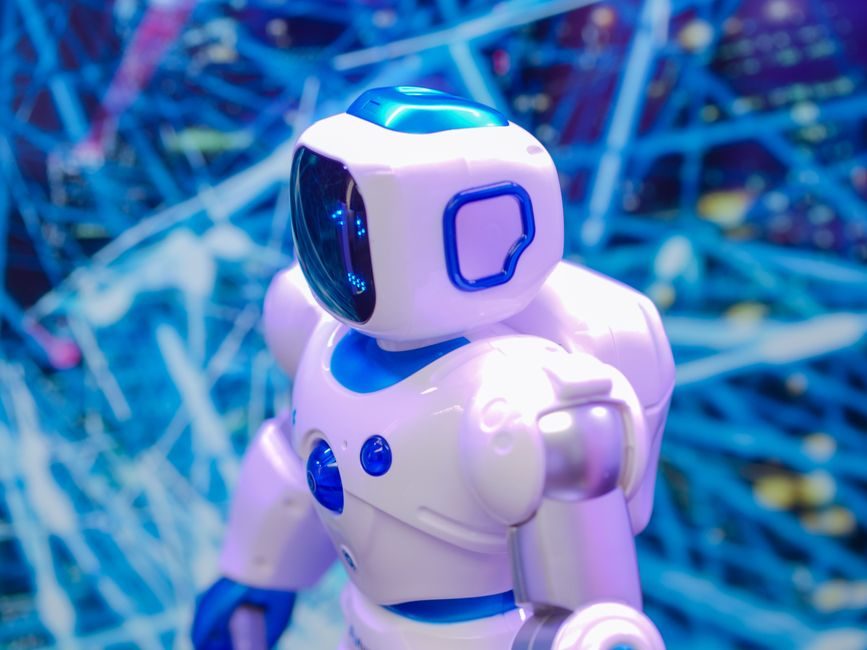
The humanoid robot value chain in 2026 runs from harmonic reducers, quasi-direct-drive actuators, 6-axis force/torque sensors, 3D LiDAR and high-bandwidth AI compute at the upstream end, through integrators bundling those into platforms, to downstream end-users that are dominated — for now — by automotive final assembly and parts inspection cells on production lines such as NIO's Second Advanced Manufacturing Base [S4].
Policy frames the picture: Beijing's draft action plan released in early January 2025 sets a 2027 threshold of "no less than 50 core enterprises in the upstream and downstream of the embodied intelligent robot industrial chain," "no less than 50 mass-produced products," "no less than 100 large-scale industry application projects," and the first city to break a total production scale of 10,000 units [S1]. NVIDIA's Cosmos platform was announced at CES 2025 with six Chinese launch partners — ROBOTERA, Agibot, Fourier, Galbot, Unitree and XPENG — tying upstream AI compute to downstream automotive and warehouse pilots [S1].
Upstream Tier 1: Actuators, Reducers, and Drive Electronics
Harmonic-drive reducers and quasi-direct-drive (QDD) frameless torque motors dominate the knee, hip and ankle joints, where torque density (Nm/kg) and back-drivability for compliant contact set the spec race [S3]. ROBOTERA's XHand, shown at CES 2025, separates the end-effector as its own sub-system and signals that dexterous hands are now an upstream commodity a platform integrator can buy, not a one-off design [S1]. QDD actuator benchmarks on GitHub projects such as the USTC NMPC/WBC biped stack (updated 2025-01) use MuJoCo simulation to validate whole-body control loops against measured joint torque limits [S3]. The drive side has standardised around EtherCAT and CAN-FD buses; SEROW (legged state estimation, last updated 2026-07) and the iCub Gazebo grasping sandbox (2026-02) both expose those buses for real-time control loops [S3].
Upstream Tier 2: Sensors — LiDAR, IMU, Force/Torque
Perception stacks fuse 3D LiDAR, depth cameras, IMU arrays and 6-axis force/torque sensors at the wrist and ankle; a humanoid like XPENG's "Iron," which debuted in November 2024, carries the same sensor family found on an AGV robot but at a different DoF count and bandwidth. Galbot's collaboration with NVIDIA on simulation and synthetic data, announced in January 2025, is explicitly aimed at training these multi-modal perception stacks without hand-labelling every scene [S1]. For a LiDAR-first plant-floor spec, the LiDAR upstream-downstream chain map is the closest peer reference and aligns on Velodyne/Hesai-class devices plus RoboSense short-range units for foot-mounted safety zones.
Upstream Tier 3: AI Compute, Foundation Models, and Sim Tooling
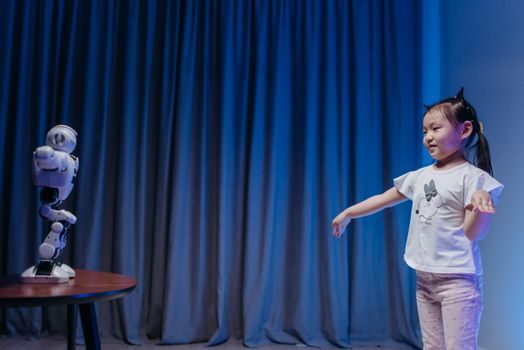
Cosmos is NVIDIA's "physical AI" foundation-model platform, designed to advance autonomous vehicles and robots through synthetic data generation; six Chinese humanoid OEMs are first adopters [S1]. Open-source counterparts are visible on GitHub: ProtoMotions is a GPU-accelerated simulation framework last updated 2026-07-06, the SOMA BVH retargeting library (Newton + NVIDIA Warp, updated 2026-03-25), and the FRoM-W1 whole-body-control repo tied to an arXiv 26 paper (updated 2026-06-05) [S3]. On the model side, the Embodied Intelligence introductory practice from OpenMOSS Lab at SII & Fudan (updated 2026-05-27) signals Chinese academic labs shipping reference training pipelines alongside the OEM stacks [S3].
Mid-Stream: Integrators and Platform OEMs
Integrators such as XPENG, Unitree, ROBOTERA, Agibot, Fourier and Galbot assemble the upstream BOM, write the safety PLC logic, and own the platform SDK [S1]. The split between full-body humanoid (dual-arm + bipedal) and articulated-arm "torso-on-mobile-base" form factors is now a hard product-line choice; integrators publish separate datasheets because payload (kg), reach (mm) and battery kWh differ by an order of magnitude. For a head-to-head on the cell-level robot class, the machine vision supply shortage 2026 piece traces the same integrator-side bottlenecks — 3D-camera calibration engineers and FPGA programmers — that are now throttling humanoid ramp.
Downstream: Where the First 10,000 Units Are Going
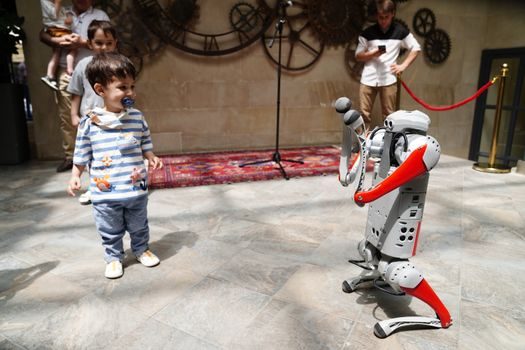
Beijing E-Town's published case study, dated 2024-08-21, shows a 1.7 m humanoid at NIO's Second Advanced Manufacturing Base walking the line and performing quality inspections on door locks, taillight covers, and seat belts, then affixing a label — a task set that is camera-and-force dominated and well within current perception limits [S4]. XPENG's "Iron" has been deployed in XPENG's own auto assembly plant in Guangzhou, validating the OEM-internal-loop business model where the integrator and the end-user are the same balance sheet [S1]. The same NIO cell format is the immediate template for a SCARA robot retrofit path: existing conveyor-and-pedestal cells become humanoid cells when the pedestal is removed.
Selection Criteria: What Specs Decide the Buy
For a process engineer choosing between humanoid vendors in 2026, the four load-bearing spec lines are: (1) joint torque density, typically quoted as Nm/kg at the actuator output after the harmonic stage; (2) end-effector repeatability, with a 0.05 mm threshold needed to mirror a SCARA on screw-driving tasks; (3) safety rating, with ISO 13849-1 PL d and ISO/TS 15066 power-and-force-limiting becoming the default cage-free spec; (4) battery energy per shift, where a 1 kWh class pack covers roughly four hours of mixed walking-and-inspection duty. The AMR robot decision tree is a useful proxy for path planning, SLAM and fleet management, since most humanoid fleets will operate alongside, not in place of, AMRs on the same plant floor. [S4]
Limitations, Failure Modes, and Open Standards
Three constraints still gate the 10,000-unit threshold. First, the 6-axis force/torque sensor supply remains concentrated in two or three vendors, and the machine vision skill shortage feeds straight into calibration throughput. Second, no consolidated international safety standard exists for free-moving humanoids outside a cage; ISO/TS 15066 power-and-force-limiting limits were written for stationary collaborative robots, and bipedal fall dynamics sit outside that envelope. Third, the simulation-to-reality gap is the bottleneck that the NVIDIA Cosmos partnership is meant to close, but Galbot's own statement on 2025-01-09 only claimed "progress" in simulation and synthetic data, not deployment [S1].
Sourcing and Standards Reference
Key sources: Global Times 2025-01-09 coverage of CES 2025 and the Beijing draft action plan [S1]; ShanghaiTech 2024 robotics course report on Sophia's 33-DoF facial expression system using "Frubber" skin and a transformer-based ARKit-to-motor mapping [S2]; People's Daily 2024-08-21 report on the NIO E-Town humanoid inspection cell [S4]; the GitHub "humanoid-robots" topic page, listing 75+ repos with last-update stamps running from 2021 (Raspberry Pi reference) through 2026-07-06 (ProtoMotions) [S3]. Standards in scope: ISO 13849-1 PL d for safety-related control, ISO/TS 15066 for collaborative robot power-and-force limits, IEC 61508 for functional safety of electrical systems. Trackable next signals: a first public post-2025 NIO deployment count, the release of a final (not draft) Beijing action plan, and any ISO or IEC working group publication on bipedal humanoid safety.