Wall chasers in the 1700–4800 W class, 110 V, fitted with twin parallel diamond blades of 125–133 mm diameter, dominate HVAC concealed-pipe routing on concrete, brick, cement block, and plaster substrates, with 4800 W units shipping as the upper mainstream tier for HVAC and plumbing work as of 2026-03 [S1][S4].
The HVAC groove-cut decision is driven by three measurable constraints: pipe outer diameter plus 10–15 mm cover depth, wall substrate hardness, and site dust-compliance class. Reference tools at this power tier include the VICSEC 110 V unit with five 133 mm blades, dust-resistant housing, and infrared line guide [S4], and 4800 W machines such as the VEVOR and TIEKJOT wall chasers listed alongside it for marble, granite, concrete, and brick [S4].
What a wall chaser actually does, and why HVAC picks it over hammer-and-chisel
A wall chaser, in HVAC and electrical installation work, is a twin-bladed portable power tool that mills two parallel kerfs into masonry so the web between them can be knocked out as a clean channel, typically used for refrigerant line sets, condensate drains, and electrical conduit runs in retrofit and new-build interior walls [S1]. The two-blade parallel-kerf geometry produces grooves of uniform width and depth, a measurable improvement over manual hammer-and-chisel work, which is slow, irregular, and forces additional surface patching after the pipe is bedded [S1].
For HVAC specifically, the advantage is geometric: refrigerant copper pairs (commonly 1/4" + 3/8" or 1/4" + 5/8" line sets) need a single straight channel of controlled width, not a series of overlapping holes. A wall chaser delivers that in one pass, while a concrete groove cutter running a single blade is better suited to slab sawing and joint cutting than to chase work in finished walls.
Spec bands HVAC installers actually specify in 2026
Three spec bands are common on 2026 HVAC jobs. Entry / light-duty: 110 V, 1700–2200 W, no-soft-start, manual depth stop, 125 mm twin-blade stack, dust port but no integrated M-class extraction, suited to plaster and aerated block [S1]. Mid-range HVAC: 110 V or 220 V, 2500–3200 W, electronic soft-start, adjustable depth up to 30–40 mm, infrared line guide, dust-resistant housing, the typical spec for residential refrigerant line-set chases [S4]. Heavy / commercial: 110 V, 4800 W, twin 125–133 mm diamond blades, soft-start, depth stop, dust port sized for M-class vacuum, the upper mainstream tier for granite, marble, and reinforced concrete [S4].
Blade diameter sits at 125–133 mm across all three bands; 5-inch (133 mm) is the dominant SKU as of 2026-05 in the wall-chaser aftermarket, with 5 blades shipped as a standard accessory pack on 110 V units [S4]. Adjustable groove width is achieved by shimming the blade spindle or by an integrated width mechanism; adjustable depth and angle are delivered through handles that rotate up to 180° on one axis and 90° on the other, so the operator can chase into corners and along ceilings without re-positioning the body [S4].
Matching voltage, amperage, and site distribution
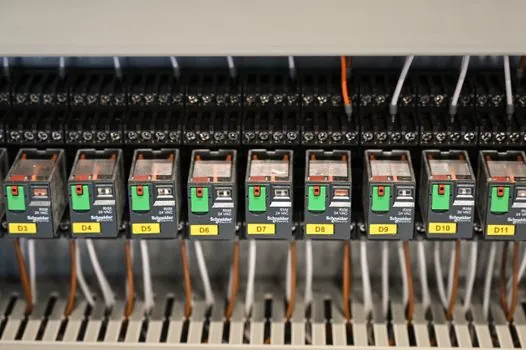
110 V units at 4800 W draw roughly 43.6 A, which means a 32 A site transformer is overloaded and a 16 A corded tool is impossible at this wattage; in practice, 4800 W wall chasers are fed from a 110 V centre-tapped 5 kVA site transformer through a 32 A or 63 A breaker, and the cord gauge must be sized to limit voltage drop below 5% at full load [S4]. Where 230 V single-phase is available, a 220 V 4800 W class machine draws roughly 21.8 A and can be run on a standard 32 A site outlet without step-down loss, which is why commercial HVAC contractors in 220 V regions (most of Europe, GCC 220 V sites) prefer the 220 V SKU.
For the 110 V HVAC market in North America and the 110 V GCC jobsite, the 4800 W class is workable but not silent: 110 V tools at this wattage will trip a residential 15 A circuit immediately, and a dedicated 20 A or 30 A breaker on the 110 V leg of a 5 kVA centre-tapped transformer is the minimum. Soft-start electronics on mid-range and heavy units reduce the inrush spike, which matters because the 110 V transformer leg is the usual nuisance-trip source on HVAC retrofit sites [S4].
Dust control, silica compliance, and the M-class extraction question
Dry-cutting masonry generates respirable crystalline silica, and OSHA 1926.1153 in the US plus equivalent EU and GCC occupational exposure rules require either wet cutting or on-tool dust capture with an M-class (or higher) HEPA-filtered vacuum when chasing concrete, brick, granite, or marble [S2]. Wall chasers in the 2026 HVAC spec band ship with a 32–50 mm dust port on the housing, sized to mate with M-class vacuum hose; 4800 W commercial units use the larger 50 mm port to keep airway velocity above the capture threshold when cutting 40 mm deep channels in one pass [S4].
For HVAC retrofit work inside occupied buildings, the practical decision is wet versus dry. Wet chasing keeps the slurry out of the air but forces a downstream water-management step, slows blade changeover, and cannot be used near live electrical conduits (a real hazard on HVAC retrofit sites where the new line set shares a chase with existing 230 V wiring). Dry chasing with M-class capture is the dominant 2026 retrofit method, and water-supplied cutting remains the choice for outdoor slab and road work where concrete groove cutter walk-behinds are the workhorse.
Cutting depth, pipe OD, and the cover-rule calculation
The HVAC depth rule of thumb is: groove depth must equal pipe outer diameter (including insulation) plus 10–15 mm of cover so the wall finish (plaster, gypsum, tile adhesive) can sit flush without telegraphing the pipe. For an uninsulated 22 mm OD refrigerant line, the minimum useful groove depth is 32–37 mm; for an insulated 1/4" + 3/8" line set with 13 mm Armaflex, total OD is around 50 mm, so the chase must be 60–65 mm deep, a depth that pushes beyond the single-pass capability of most 110 V wall chasers and forces two-pass cutting or a deeper-cut 230 V unit [S1][S4].
Adjacent related applications in plumbing follow the same depth-plus-cover logic, and the concrete groove cutter specs for plumbing channel cutting reference covers the water-supply and drain-pipe variants of the same calculation.
Selection criteria: chaser versus angle grinder versus single-blade cutter
Three tools compete for the HVAC channel task: twin-blade wall chaser, single-blade angle grinder with a diamond tuck-point or grooving blade, and walk-behind concrete groove cutter. Comparison on four HVAC decision criteria: channel straightness, dust capture, depth control, and portability. [S4]
Wall chaser wins on channel straightness (parallel twin-kerf geometry holds a true line over 2–3 m runs) and on dust capture (integrated shroud matched to a 32–50 mm port); it scores medium on depth control (adjustable depth stop, but limited to 30–40 mm single-pass on most 110 V units) and high on portability (8–12 kg handheld class) [S1][S4]. Angle grinder with a grooving blade scores medium on straightness (operator skill dependent), low on dust capture (shroud retrofit possible but not native), high on depth control (freehand), and high on portability. Walk-behind concrete groove cutter scores high on straightness and depth control, low on dust capture in a residential wall context, and low on portability (60–150 kg class); it is the right tool for floor-slob sawing and road-joint cutting, not for vertical wall chases in finished interiors.
For interior HVAC line-set work in finished walls, the wall chaser is the correct tool 90% of the time; the angle grinder is the fallback when the wall chaser's twin-kerf width exceeds the pipe OD and the installer wants a narrower single-kerf slot for cosmetic reasons; the walk-behind cutter is wrong for the application and should not be specified.
Failure modes, when to stop, and what to escalate
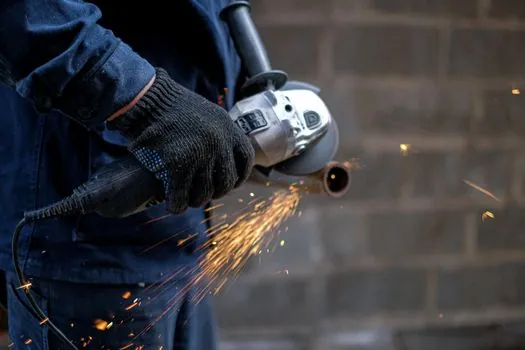
Three failure modes terminate the cut and force a tool change or work stoppage. First, blade glazing: a glazed diamond blade shows bright segments with no fresh abrasive, cuts slowly, and overheats the workpiece; the corrective action is a dress cut in an abrasive block (typically a concrete paver or dressing stone, 3–5 seconds per segment), and if dressing does not restore cutting rate within two passes, replace the blade [S2]. Second, segment loss on 133 mm blades, visible as a missing segment or a chipped segment tip; this is a stop-work condition, because an unbalanced blade will chatter the spindle bearings and can throw a segment at high speed, so replace the blade immediately rather than continuing.
Third, electrical trip on a 110 V 4800 W unit fed from an under-rated transformer, the most common HVAC site failure; the corrective action is to re-feed from a 5 kVA centre-tapped transformer on a dedicated 30 A breaker, not to bypass the breaker. Do not repair a cracked housing, a water-ingressed motor, or a seized spindle bearing on a wall chaser: these are replacement conditions, because the dust-resistant seal is a one-time engineered fit and field re-sealing does not restore the IP rating required for dry-cutting masonry [S4].
Process fit: where the wall chaser sits in the HVAC install sequence
The wall chaser is used after the HVAC line-set path is marked and before the pipe is bedded; the sequence is mark, chase, knock out the web, vacuum the channel, lay the insulated line set, bed in mortar or gypsum, then finish. The chaser cannot be used after the wall is plastered, and it must not be used on a wall that has live electrical conduit in the chase path until the circuit is locked out, a point reinforced in the cross-discipline two-hand control selection for construction sites reference for hazardous-tool interlocks. [S1]
For interior finishing trades that need shallower, cleaner chases at 10–25 mm depth for surface-mount conduit or thin-wall piping, the lighter spec band documented in concrete groove cutter selection for interior finishing covers the appropriate tool choice. Track for the next 6 months: OSHA 1926.1153 enforcement actions on silica dust from masonry chasers in occupied interiors (M-class capture is now the de-facto rule), and the 110 V 4800 W class continuing to displace 220 V mid-range units on GCC 110 V jobsites as 5 kVA centre-tapped transformers become standard HVAC retrofit equipment [S1][S2][S4].
The underlying component specifications are covered under marble cutter, and plasma cutter.
