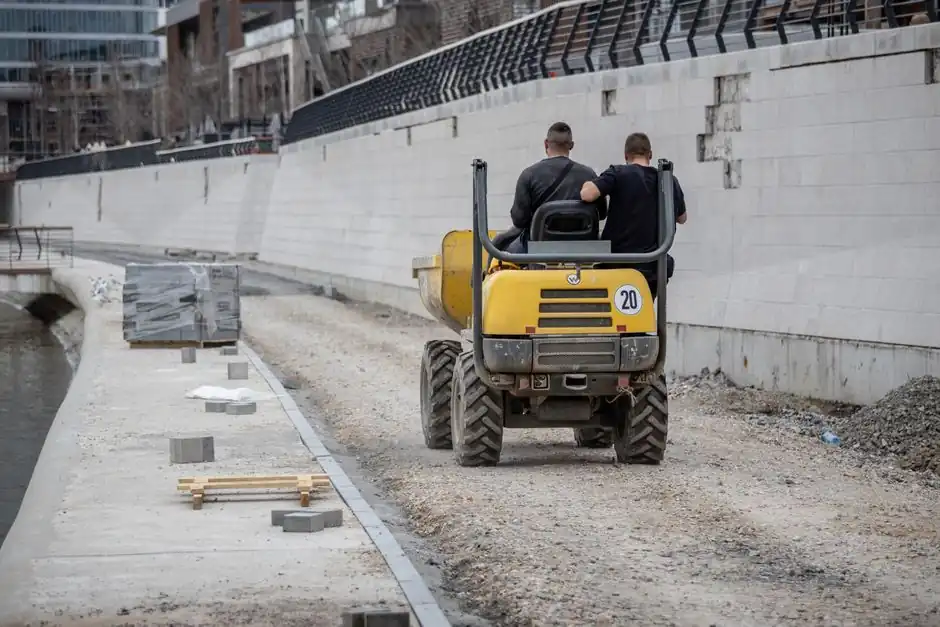
Two-hand control (THC) on construction and metal-forming sites requires an operator to depress two spatially separated pushbuttons within 0.5 s of each other, with continuous hold through the dangerous portion of the stroke per ISO 13851:2012 Type IIIC [S3].
Ohio Administrative Code Rule 4123:1-5-10 mirrors the same logic for mechanical power presses, requiring a two-hand trip with anti-repeat, single-stroke, and concurrent operation of the individual operator's hand controls on full-revolution clutch machines [S1].
What the standard actually requires on a construction site
ISO 13851:2012 Type IIIC sets four enforceable conditions: both buttons must actuate within 0.5 s of each other, both must stay held through the dangerous motion, releasing either one immediately de-energises the machine control circuit, and both must be fully released before a new cycle is permitted [S3].
The 0.5 s simultaneity window is the anti-tamper check; it blocks the classic bypass of wedging one button with tape or a block while pressing the other with a single hand [S3]. On US construction and press work, Ohio rule 4123:1-5-10 adds a separate requirement: a two-hand trip on a full-revolution clutch press must also carry an anti-repeat feature and a dedicated set of hand controls per assigned operator on multi-station presses [S1].
Hardware: safety relay, not a PLC input
Standard PLC digital inputs are not safety-rated, and a shorted output defeats the entire function, so a purpose-built safety monitoring relay is mandatory for THC [S3]. A compliant architecture needs three blocks: a safety control relay enforcing timing and output integrity, two mechanical actuators with positive-opening NC safety contacts, and a safety-rated contactor or drive enable on the machine interface [S3].
Typical safety relay parameters for THC: PLd / Cat 3 minimum per ISO 13849-1, simultaneity tolerance of 0.5 s (adjustable on some models), dual-channel NC inputs, force-guided outputs in a 3 safety + 1 auxiliary pattern, response time ≤20 ms, and supply variants at 24 VDC, 110 VAC, and 230 VAC [S3].
Wiring: dual-channel, never series into one input
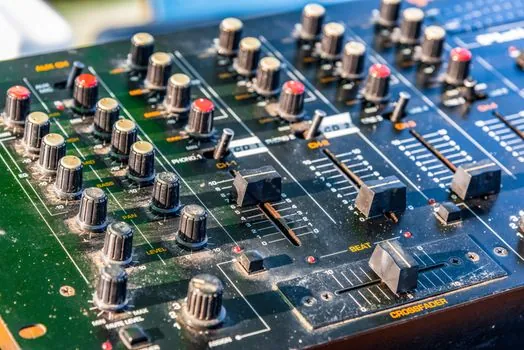
Each pushbutton must land on a separate safety-rated input channel on the monitoring relay so the relay can verify simultaneity inside the timing window [S3]. Wiring both buttons in series into a single PLC input fails to detect a wedged button and lets one operator run the machine single-handed, which is the exact failure mode the standard is built to prevent [S3].
Prohibited configurations are explicit: buttons in series into one PLC input, buttons into standard PLC digital inputs, software-only timing checks in a non-safety PLC, and a single pushbutton with two contacts that actuate together without any anti-tamper check [S3]. For broader wiring and control-cable guidance in safeguarding cabinets, see the control cable selection reference.
Control station layout, spacing, and actuators
The control station has to satisfy OSHA two-hand control layout guidance and ISO 13851 spacing rules: buttons must be far enough apart that a single hand, elbow, or knee cannot reach both, and the station itself must be rigidly mounted so a struck or kicked actuator cannot move into an unintended position [S3].
On outdoor construction sites, capacitive two-hand controls such as the CAPTRON SL3x with a Ø 50 mm sensing face and sealed housing are used after a documented risk assessment, because they tolerate gloves, dust, and water spray better than unsealed mechanical buttons [S5]. For construction-tool integration and station mechanical design, the construction tools encyclopedia page covers the surrounding enclosure and mounting practice.
Where THC fits and where it does not
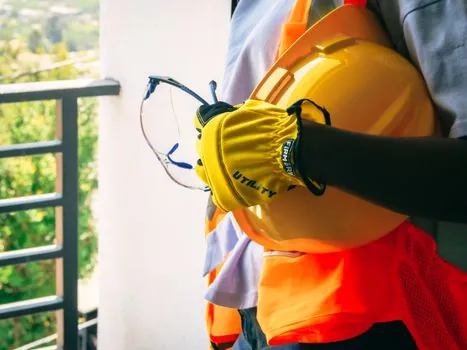
THC is a fit for single-operator hazardous cycles where both hands are naturally free during initiation, including mechanical power presses covered by rule 4123:1-5-10, hydraulic and pneumatic press circuits that adopt the same principle, metal-forming nibblers, and outdoor construction rebar benders or stud welders with a single assigned operator [S1][S3].
THC is not a fit for collaborative multi-operator lifts, for cycle initiation where the operator must hold a workpiece with one hand, for any guarding function that needs a hold-to-run only on one hand (use a three-position enable device instead), or for any machine where the dangerous motion persists after the operator releases the buttons but the standard PLC alone handles the stop logic [S3]. For an entry gate on a guarded cell rather than a THC station, the access control selection page covers interlock switch logic and holding force.
Comparison: THC vs enabling device vs single e-stop
Selection between these three comes down to four criteria: required operator count, the portion of cycle that is hazardous, the standard governing the application, and the integrity level needed. A compliant THC is dual-hand, simultaneity-checked, ISO 13851 Type IIIC, PLd / Cat 3 minimum, and gives protection through the whole dangerous stroke [S3]. A three-position enabling device is single-hand, requires middle-position hold, and is preferred when the operator needs one hand for the workpiece. A single e-stop is one-hand, latching, ISO 13850, and only stops, it does not initiate a safe cycle.
On a construction site the practical rule is: use THC when both hands are free and the hazard is initiated by the operator, use a hold-to-run enabling device when one hand is occupied, and use an e-stop as the backstop in all cases, never as the primary safeguarding device for initiation.
Implementation checklist and field signals

Before sign-off, verify: the safety relay carries PLd / Cat 3 or higher per ISO 13849-1, the simultaneity window is set to ≤0.5 s, each button lands on its own safety input channel, the station spacing defeats single-hand reach, an anti-repeat function is enabled on full-revolution clutch presses per rule 4123:1-5-10, and the entire THC function is documented in the risk assessment for the site [S1][S3].
Trackable signals over the next planning cycle: any OSHA letter referencing 29 CFR 1910.217 for mechanical power presses, and any site-specific risk assessment that reclassifies a THC station to Type IIIC after a near-miss involving a wedged button, both of which will force a re-spec of the relay and the station layout [S3]. For a deeper dive into two-hand control device principles, types, and standards, the encyclopedia entry consolidates the ISO 13851 hierarchy.
For related coverage, see Silicone Rubber Selection for Rail: EN 45545-2 Spec Map.