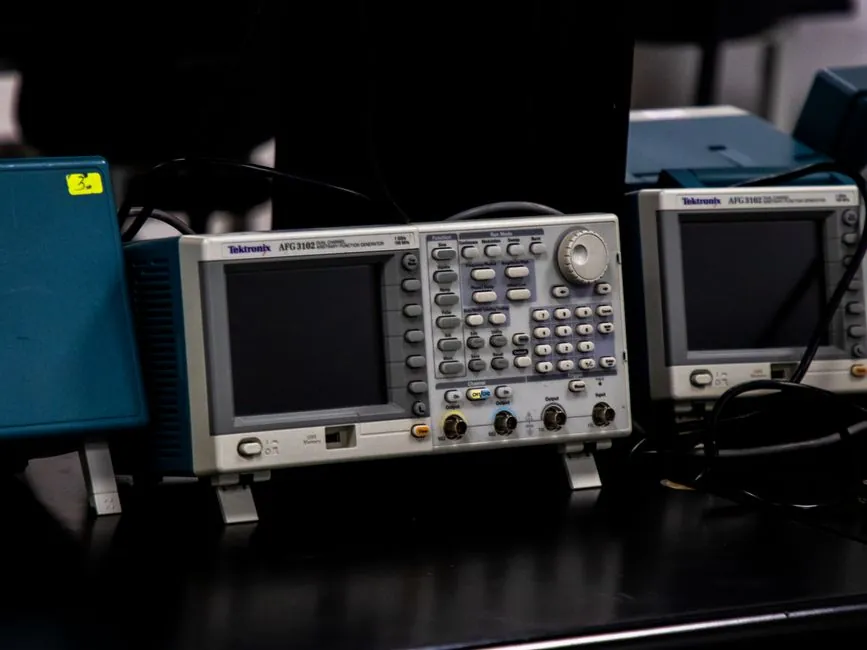
A modern hydraulic end-of-line (EoL) test stand runs every finished part through a sequenced set of checks (leak, functional, dimensional, marking) and writes one serialized pass/reject record per unit to the MES, with no manual data entry [S4].
Closed-loop control rates of 10-300 kHz are now standard on hydraulic EoL cells, with T-12-class real-time processors executing 32 PID loops at 300 kHz while monitoring pressure, flow, displacement, and temperature simultaneously [S3].
What an EoL test stand actually does
An EoL test system is the final verification machine on a hydraulic production line: it presents the finished part (a cylinder, cartridge valve, pump, or motor) to a barcode-triggered recipe and decides whether the unit ships, is reworked, or is scrapped [S2][S4].
Hänchen's published EoL cell for hydraulic cylinders runs at up to 500 bar, supplied through a Hänchen pressure intensifier, with a maximum adjustable flow rate of 30 l/min and HLPD46 hydraulic oil, while a Beckhoff controller and a 30 kW radial-piston pump drive the test envelope [S2]. That same cell holds cylinders from 25 mm to 500 mm outside diameter and up to 2.50 m length, with a safety concept rated to PLe [S2]. Hänchen states explicitly: "Hänchen hydraulic cylinders go through many production steps during manufacturing. Each one guarantees the high precision and quality of Hänchen products ... they are 100% tested on the end-of-line test stand after assembly" [S2].
The EoL architecture categories tracked by AMD Machines are standalone gate stations (10-30 s cycle), in-line single stations (8-25 s), and rotary-index cells with 4-8 positions at 5-15 s per index, with leak, functional, mark, and unload split across positions [S4].
Data capture: real-time DAQ and serialized records
Real-time DAQ is the difference between a test stand and a measurement instrument: ADwin-class controllers execute the stimulation (force or position controlled), the wave-function generation, the feedback measurement, and the analysis in a single deterministic loop, with each measurement processed immediately after acquisition [S3].
ADwin benchmarks cited by the manufacturer include a T-11 processor running 20 PID loops at 100 kHz and a T-12 running 32 PID loops at 300 kHz, with cycle times 10-25x faster than conventional PC-based control [S3]. DAQ channels on a hydraulic EoL cell typically include pressure, flow, displacement, and temperature, with the test software generating a per-unit test certificate archived to a document management system (DMS) and retrievable on customer request [S2][S3].
A serialized record per unit is now the contractual default in automotive, aerospace, and consumer programs; AMD Machines lists OPC UA, MQTT, and SQL as the typical MES transports and cites IATF 16949 MSA and PPAP as the audit framework [S4]. Pass/reject/rework is enforced by a physical reject-bin lockout so a failed part cannot reach pack-out [S4]. For an overview of how DAQ modules fit the broader control-panel component stack, the related architecture typically separates the safety-rated I/O, the deterministic real-time controller, and the MES-facing edge gateway.
Selection criteria: takt, mix, and traceability
Standalone gate stations fit low-mix, low-to-mid volume builds with a single-test focus and an operator or robot feeding the nest [S4]. In-line single stations are the right pick when one platform must hold takt for a single line, while rotary-index (4-8 positions) cells handle multi-test content that exceeds single-station takt by splitting load, leak, functional, mark, and unload across positions [S4].
The decision driver is rarely the sensor: AMD Machines lists the common instrument brands on a hydraulic EoL fixture as CTS, ATEQ, Inficon, Keysight, Chroma, Cognex, and Keyence, and the controls layer as Allen-Bradley, Siemens, or Beckhoff TwinCAT [S4]. The recipe load is barcode, DataMatrix, or RFID at infeed: no scan, no test, which forces traceability into the process rather than relying on operator discipline [S2][S4].
For higher-frequency test content, the data logger layer must keep up with valve dynamics, including the time to open/close, the exact pressure at which a relief valve opens, and the peak pressure spike when a spool valve shifts from open to closed, all of which require sub-millisecond sampling that PC-based SCADA cannot deliver [S3].
Hydraulic specifics: pressure, flow, and oil conditioning
Hydraulic EoL cells are unusual among production testers because the source side of the loop is itself a high-power hydraulic system: the Hänchen cell uses a 30 kW radial-piston pump and a Hänchen pressure intensifier to reach 500 bar, with continuous monitoring of oil temperature, oil level, and supply pressure [S2].
The 500-bar ceiling is set by the pressure intensifier, not the pump: the radial-piston pump supplies the 30 l/min flow, and the intensifier steps it up to the configurable test pressure up to 500 bar [S2]. A separate data-capture concern is oil cleanliness: contamination control and temperature stability are what allow a flow-versus-pressure curve captured at the start of the shift to be comparable to one captured at the end, and AMD Machines lists pressure, flow, and temperature as the standard sensor complement on the bench [S3][S4].
For the broader hydraulic system context, the EoL cell is the final gate in a chain that begins with component-level materials testing and R&D stands, and it is differentiated from R&D benches mainly by barcode-driven recipes, serialized records, and physical reject lockout [S2][S3][S4].
Comparisons: architectures and control platforms
Four decision criteria line up cleanly across architectures: cycle time, footprint, multi-test content, and traceability depth [S4].
On the controls side, the practical split is between PC-based SCADA with soft-PLC (adequate for slow functional checks) and a deterministic real-time system (ADwin or equivalent) for sub-millisecond valve dynamics, with the T-12 at 32xPID @ 300 kHz cited as the high end for the most demanding test benches [S3]. For programs running VDA 301 or VDA 302, the same EoL fixture typically also runs a frequency-and-damping check (Maul-Theet FDT, compliant with SAE J2598, SAE J2933, and VDA 302) on the same part before the marking station [S5].
Standards, audit, and what the data has to prove
IATF 16949 MSA, PPAP, and Gauge R&R are the audit framework most automotive EoL programs must satisfy, with one serialized record per unit across every channel rather than separate per-station logs [S4]. AMD Machines notes that EoL is "where leak, functional, vision, dimensional, and marking checks converge onto one platform, and where good engineering or bad engineering shows up immediately in PPM and OEE" [S4].
For damping and frequency content specifically, suppliers build the EoL cell around recognized test standards: SAE J3001 for damping, SAE J2598 and SAE J2933 for natural frequency, and VDA 301 / VDA 302 for automotive quality control, with the FDT stand covering frequency and damping in a single cell [S5]. For automotive cylinder programs, the same EoL stand often runs a mechanical load test as an option, retrofittable to the base cell after the functional test is validated [S2].
On the safety side, the published Hänchen cell is rated to PLe (ISO 13849-1 Performance Level e), with software-monitored test-stand doors and a Beckhoff controller handling both sequencing and safety [S2]. The safety concept must cover the energy stored in the hydraulic intensifier, the 500-bar test pressure, and any stored electrical energy in the cell, not just the mechanical interlocks [S2].
Where EoL stops and inline inspection starts
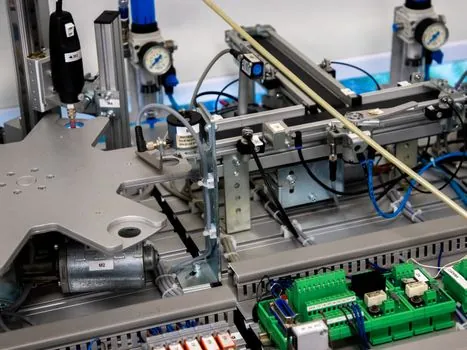
EoL is one of three layers: subcomponent benches (pump-only, motor-only, valve-only), subassembly benches (cylinder with no auxiliary ports), and the final EoL cell where every part ships with a single consolidated record [S3][S4]. Sensorstecnics' aerospace actuators and hydraulics testing notes that aerospace stands "simulate the actuators in various directions that they will likely see in use", which is a more aggressive loading profile than the typical EoL functional check [S8].
Lithium-ion battery EoL is a useful non-hydraulic contrast: DMC describes a battery EoL stand for accurate validation and reliable quality assurance, with the same barcode-driven recipe and serialized record pattern, but the source side is a cycler rather than a hydraulic pump [S9]. For the broader construction machinery and equipment context, the EoL cell is what validates the hydraulic subassemblies before they ship to the assembly line, and a failure at EoL is far cheaper than a failure in the field [S4][S7].
For broader lighting and electrical integration, the lamps and light fittings and lighting equipment and electric lamps categories sit on the inspection side of the same EoL philosophy: serialized, barcode-driven, vision-verified, and archived to MES. PLC conversion projects such as legacy-to-modern controller migrations are a common adjacent decision because EoL upgrades often coincide with a controller platform swap; see how much of legacy logic typically survives in PLC code conversion tools.
The next two trackable signals to watch on hydraulic EoL in the back half of 2026 are: (1) whether the 300 kHz closed-loop class spreads from valve-only EoL into cylinder EoL (currently dominated by 100 kHz-class T-11 controllers), and (2) whether MES transports converge on OPC UA over MQTT for new cells or stay split across the three transports AMD Machines currently lists (OPC UA, MQTT, SQL) [S3][S4].