A hydrogen fuel cell is an electrochemical device that combines hydrogen and oxygen across a proton-exchange membrane (PEM) to produce electricity, water, and heat, with no combustion byproducts; the unit cell stacks in series to scale voltage, and the manufacturing line is essentially a precision lamination, coating, and assembly operation rather than a heavy fab [S2].
Industrial cell output is set by three knobs engineers can actually control on the line: active area (cm²), catalyst loading (mg Pt/cm²), and number of cells in the stack (typically 30–400 for stationary and 200–400 for automotive) [S1][S2]. Cell-level voltage is roughly 0.6–0.8 V at rated current density of 0.5–1.5 A/cm², which is why almost every datasheet you read is quoting a stack, not a cell [S2].
Core Bill of Materials and Stack Architecture
Every PEM fuel cell stack is built from the same six building blocks: membrane-electrode assembly (MEA), gas diffusion layer (GDL), bipolar plates, gaskets/frames, current collectors, and end plates with tie rods [S1][S2]. The MEA itself is a five-layer laminate — catalyst-coated membrane (CCM), anode GDL, cathode GDL, plus sub-gaskets — and it is the single most expensive and most tightly toleranced sub-assembly on the line [S2].
Voltage is set by the cell count, not the chemistry, which is why stack integrators specify it as a 30 V, 70 V, or 400 V module depending on the downstream power electronics [S1]. Temperature is held at 60–80 °C for low-temperature PEM and 160–220 °C for HT-PEM; relative humidity is normally pinned to 50–100 % on the inlet to keep the Nafion-class membrane above its dehydration knee [S1][S2]. Each cell is monitored at the stack level by per-cell voltage taps and a cell-voltage monitoring (CVM) board, which is the dominant sensor count on a finished stack [S1].
Bipolar Plate Manufacturing: Metal, Graphite and Additive Paths
Bipolar plates account for 60–80 % of stack mass and roughly 35–45 % of stack cost, which is why plate fabrication is the process step that defines the rest of the line [S2]. The 2026 market splits cleanly across three plate build paths, and each one comes with a different tooling, tolerance, and surface-finish story.
Stainless metal plates (typically 316L, sometimes coated with gold, graphite, or amorphous carbon) are stamped or hydro-formed, then welded or diffusion-bonded to make the coolant cavity. Tolerances of ±0.02 mm on channel depth are typical, and the run is set by a progressive die that costs roughly $250k–$1M to tool [S2]. Resin-impregnated graphite plates, including phenolic-resin-impregnated graphite in standard 12 in × 12 in × 0.125 in sheets, are CNC-machined to the flow field; electrical resistivity is roughly 10–20 µΩ·m, and the plate is preferred for low-volume and laboratory stacks because no stamping die is required [S4].
The third path is additive manufacturing of flow fields, where laser powder-bed fusion (LPBF) prints the plate body in 316L or titanium and embeds the cooling channels directly into the geometry — see how additive manufacturing material selection drives corrosion vs conductivity trade-offs. The 2026 build path looks like this:
1) Metal stamped plate: high volume (≥10k stacks/yr), tightest tolerance, lowest per-plate cost, requires die investment [S2]. 2) Resin-impregnated graphite plate: low-to-mid volume, machined, no die, faster prototype turn, slightly higher resistivity [S4]. 3) AM flow field: complex internal cooling in one piece, mid volume, longer build cycle per plate [S2][S4].
Engineers evaluating sourcing should also look at how this technology sits inside a wider additive manufacturing meets smart factory workflow, where in-line metrology feeds the same data backbone that runs the plate CNC cell.
MEA Coating, CCM Production and Catalyst Loading
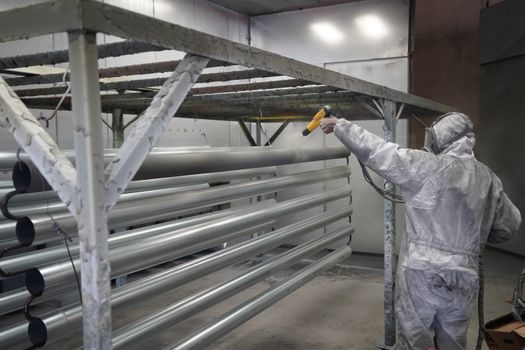
The catalyst-coated membrane is made by slot-die coating, decal transfer, or direct spray of a Pt/C catalyst ink onto a Nafion or hydrocarbon membrane; Pt loading sits at 0.05–0.4 mg/cm² per electrode on 2026 production parts, with R&D lines pushing below 0.05 mg/cm² [S2]. Membrane thickness is normally 8–25 µm for perfluorosulfonic acid (PFSA) and 20–50 µm for HT-PEM PBI-type films.
After coating, the CCM is hot-pressed against two gas diffusion layers (carbon paper or woven carbon cloth, 100–400 µm thick) at 120–150 °C and 0.5–5 MPa to form the MEA; active area is then laser- or die-cut to the cell geometry, typically 25–300 cm² for stationary stacks and 200–400 cm² for automotive [S1][S2]. This is the step where scrap rates are highest because any pinhole in the membrane fails the helium leak test downstream.
Stack Assembly, Torque Sequence and Compression Control
Stack assembly is essentially a tolerance stack-up problem: a 300-cell automotive stack can drift more than a millimeter if the cell-to-cell height is not pinned, so compression is held at 1.0–2.0 MPa across the active area with a controlled torque sequence on the tie rods [S1][S2]. End plates are machined aluminum or steel, tie rods are M6–M10 stainless, and the bolt-up pattern is torqued in a star pattern in three to five increments.
For a process engineer buying assembly tooling, the relevant controlled parameters are: surface flatness of the end plate (≤0.05 mm), bolt elongation or torque-angle (commonly 8–14 Nm on M8 for a 100-cell stack), and a final cell-height measurement logged against serial number [S1]. Cell-voltage monitoring wiring is integrated at this step, with one tap per cell brought to a load cell module style backplane or a dedicated CVM PCB [S1].
Test, Conditioning and the End-of-Line Stack

Every production stack is conditioned on a test station before it ships, and the test platform itself is one of the more interesting pieces of capital equipment on the line [S3]. The standard end-of-line sequence is: leak test (pressure decay or helium), purge and nitrogen flush, controlled hydrogen-nitrogen activation at open-circuit voltage for 2–6 hours, and a polarization curve at 25 %, 50 %, 75 %, and 100 % of rated current, with temperature, flow, and humidity pinned to a written profile [S1][S3].
Test stations are typically built around a configurable data-acquisition chassis with high channel-to-channel isolation — Yokogawa-class instrumentation is a common reference for the cell-voltage tap array, and the same monitoring philosophy transfers directly to grid-scale batteries and electrolyzers [S1]. Stack-level KPIs pulled from the test report are: peak power (kW), rated power at 0.65 V/cell, and a polarization curve that the multifunction process calibrator traceable flow, pressure, and temperature instrumentation has validated against [S1][S3].
Integration Into Vehicles, ITS and Stationary Power
Once the stack passes end-of-line test, it ships as a sub-assembly that a system integrator packages with BoP (balance of plant) — filters, humidifier, hydrogen recirculation blower, and DC-DC converter — into a finished power module [S6]. 2026 product lines split three ways: heavy-duty fuel cell vehicles and buses using 30–70 kWh on-board hydrogen storage, stationary prime power at 100 kW–10 MW for data center and grid firming, and small-format 1–5 kW backup units for intersection traffic cabinets and ITS enclosures [S2][S6].
HyMax's 1.1 kW hydrogen backup cabinet for signalized intersections is a useful reference for the small-format class: 1.1 kW continuous, hours-class runtime on a stored H2 cylinder, sized to keep an intersection running through a grid outage [S6]. At the other end of the curve, FuelCell Energy's molten-carbonate and solid-oxide platforms push into the hundreds of kW per stack, and their hydrogen production stations are used to fuel the vehicle class on the other side of the same molecule cycle. The sourcing map for a 2026 system integrator therefore reads: stacks and BoP from Asia-Pacific and US, graphite plates and AM flow fields from EU and North America, system integration local to the deployment region [S5].
Process Risks, Failure Modes and Sourcing Constraints

Three failure modes dominate 2026 warranty data on PEM stacks: membrane pinhole from coating defects, bipolar plate delamination from uneven compression, and catalyst degradation from air-inlet contamination or fuel starvation events [S2]. The first two are process-engineering problems that lean on line-side inspection and torque control; the third is system-engineering and ties to how the BoP handles transient load.
On the sourcing side, the practical constraints in 2026 are: Pt group metal pricing on catalyst-loaded MEAs, long lead times (8–16 weeks) on graphite plates from EU specialty suppliers, and a limited number of qualified end-plate machine shops in North America that can hold ±0.05 mm flatness at automotive volumes [S2][S4]. Buyers are increasingly dual-sourcing metal plates and graphite plates, and qualifying AM flow fields in parallel for the next generation of high-power-density stacks [S2]. For reference, the related server hardware manufacturing process faces a similar tolerance-vs-volume curve, and the metrology stack on a fuel cell line borrows heavily from the same optical and CT inspection playbook.
Trackable signals over the next two quarters: DOE and EU hydrogen bank award decisions for 2026 stack manufacturing capacity, the next revision of the Fuel Cell Technical Roadmap, and any tier-1 OEM announcement of an in-house MEA coating line — those three are the cleanest indicators of where 2026–2027 stack volumes will actually land [S2].