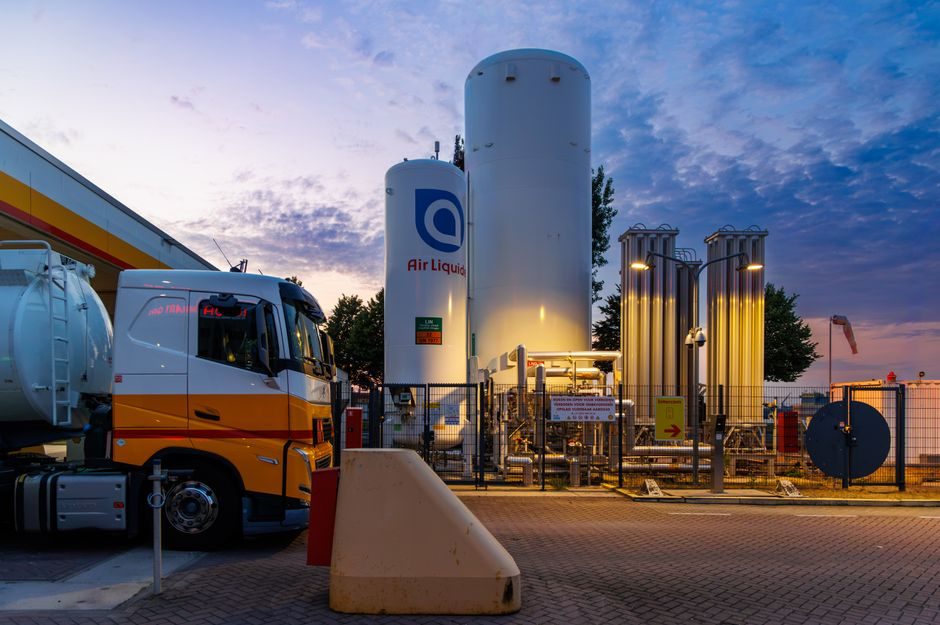
A hydrogen fuel cell supply chain spans four coupled tiers: (1) hydrogen production via electrolysis (green) or steam-methane reforming (grey/blue), (2) compression to 350 or 700 bar and transport in tube trailers or liquid tankers, (3) PEM or solid-oxide stack assembly using platinum-group-metal catalysts and bipolar plates, and (4) BoP (balance-of-plant) integration of DC power supplies, DC-DC converters, humidifiers and hydrogen recirculation blowers into a deliverable module.
Stack makers source membrane electrode assemblies (MEAs) from specialty chemical firms, gas-diffusion layers from carbon-paper suppliers, and metallic or composite bipolar plates from stamping or compression-moulding shops; downstream OEMs add hydrogen-supply, thermal-management and high-voltage power distribution hardware before the pack reaches a vehicle, vessel or stationary generator. ABB's 2023 order for Samskip's hydrogen-fueled short-sea container vessels bundled fuel cells with an Onboard DC Grid, showing the chain's endpoint is rarely a bare stack [S1].
Hydrogen Production and Colour Coding: From Grey to Green
Steam-methane reforming (SMR) with carbon capture delivers "blue" hydrogen at typical purities above 99.95% and remains the lowest-cost pathway on a $/kg basis, while polymer-electrolyte-membrane (PEM) electrolysers fed by renewable power deliver "green" hydrogen at a measurable cost premium but with no process CO2 [S2]. Alkaline electrolysers, the most mature technology, operate at cell efficiencies around 63-70% (HHV) and produce hydrogen at 30-35 bar stack outlet, requiring a downstream mechanical compressor to reach 350 or 700 bar vehicle refuelling pressure [S2].
For fuel-cell mobility, hydrogen ISO 14687 grade D purity (≥99.97%) is the binding contaminant ceiling because CO levels above 0.2 ppm irreversibly poison platinum-group-metal PEM catalysts; suppliers unable to certify S (sulphur) below 4 ppb and total hydrocarbons below 2 ppm are routinely rejected by automotive stack OEMs. As of mid-2026, electrolyser deployments in the EU, China and the US Gulf Coast dominate green-hydrogen capacity additions, with PEM units favoured where intermittent renewable input requires rapid ramp rates of 10%/second or higher [S2].
Compression, Storage and Transport: 350 vs 700 bar Decision Bands
Doosan Mobility Innovation's Powerpack design pressurises fuel-cell stacks with refuelled hydrogen tanks feeding a closed anode loop, with a recirculation blower returning unused H2 to the inlet to maintain membrane humidity and raise utilisation above 97% [S3]. Liquid-hydrogen (LH2) trailers operate at −253 °C and 1-10 bar and are economically justified only when a single delivery exceeds roughly 1,000 kg, which is why urban bus fleets typically receive gaseous tube-trailer drops every shift.
Stack Architecture: PEM vs Solid-Oxide, with Concrete Spec Bands
Stack bill-of-materials: membrane electrode assembly (MEA) accounts for 35-45% of stack cost, the bipolar plate (stamped metal or composite) 25-35%, and gas-diffusion layers plus gaskets the remainder; platinum loading has dropped from 0.4 mg/cm² in 2010 to roughly 0.05-0.1 mg/cm² in 2025-26 production stacks, with Toyota's Mirai 2 reportedly at the lower end of that band [S4]. Bipolar plates must demonstrate contact resistance below 10 mΩ·cm² at 1.4 MPa compaction and corrosion current below 1 µA/cm² under accelerated stress tests, which is why coated stainless (e.g. 316L with amorphous carbon or gold-nickel layers) is now displacing graphite in high-volume passenger-vehicle lines.
BoP Integration: DC-DC Converters, Humidifiers and Power Electronics
A 100 kW automotive fuel-cell engine packages the stack with a high-voltage DC-DC converter stepping the stack's 300-450 V output up to the 650-800 V traction bus, an air compressor (typically a scroll or centrifugal unit driven by a three-phase inverter), a hydrogen recirculation ejector or blower, and a membrane humidifier maintaining inlet RH at 80-100% to keep the PEM ionically conductive [S2].
ABB's Onboard DC Grid architecture used for Samskip's hydrogen vessels replaces conventional AC distribution with a common DC bus, which the supplier states improves part-load efficiency, reduces footprint, and lets fuel cells, batteries and shore-power feeds share one DC power supply rail without synchronising AC generators [S1]. System integrators in stationary markets add a load cell module-style monitoring chain to log stack voltage per cell, enabling predictive maintenance when individual cells drift more than 5-7% below average [S2].
Reference Comparison: PEM vs SOFC vs Alkaline Fuel Cell on Six Criteria
On a side-by-side decision matrix, PEM stacks win mobility applications (60-80 °C operation, fast start, 30-40% peak electrical efficiency) but carry the highest $/kW stack cost and the tightest hydrogen-purity requirement of below 0.2 ppm CO; solid-oxide stacks win stationary CHP above 250 kW with 50-60% electrical efficiency plus useful heat at 700-800 °C but cannot cycle rapidly and require 30+ minute cold-starts; alkaline fuel cells (AFC) deliver 60% efficiency in legacy space and stationary roles with non-precious-metal catalysts but reject CO2 above 50 ppm and therefore need scrubbed inlet gas. [S1]
For a 100 kW-class light-commercial truck scheduled for 4,000+ hours/year service, PEM with a Pt-loading near 0.1 mg/cm² and a 350 bar storage system is the default 2026 specification; for a 1 MW data-centre backup unit running under 1,000 hours/year, an SOFC CHP module with natural-gas reformers on the front end is typically selected on levelised-cost grounds. Procurement teams evaluating suppliers should request quantified figures for Pt-loading, bipolar-plate contact resistance, rated cycles to 10% voltage decay, and BoP converter peak efficiency — vague "automotive-grade" or "industrial-grade" labels are insufficient for stack sourcing in 2026.
Limitations, Failure Modes and 2026 Watch Items
Carbon monoxide above 0.2 ppm in feed gas causes reversible PEM performance loss within minutes and irreversible Pt-CO bonding within hours, which is why onboard reformers are paired with selective-oxidation or methanation cleanup stages; sulphide above 4 ppb is a permanent poison and is the most common cause of catastrophic stack failure in field units. Membrane thinning under high-temperature/low-RH operation and bipolar-plate passivation are the two dominant end-of-life mechanisms, typically limiting stacks to 5,000-8,000 hours in heavy-duty transit duty and 20,000+ hours in stationary CHP service [S2].
For raw-material reference bands and standards cross-references used by stack sourcing teams, see this hydrogen fuel cell raw material sourcing guide on the same site.