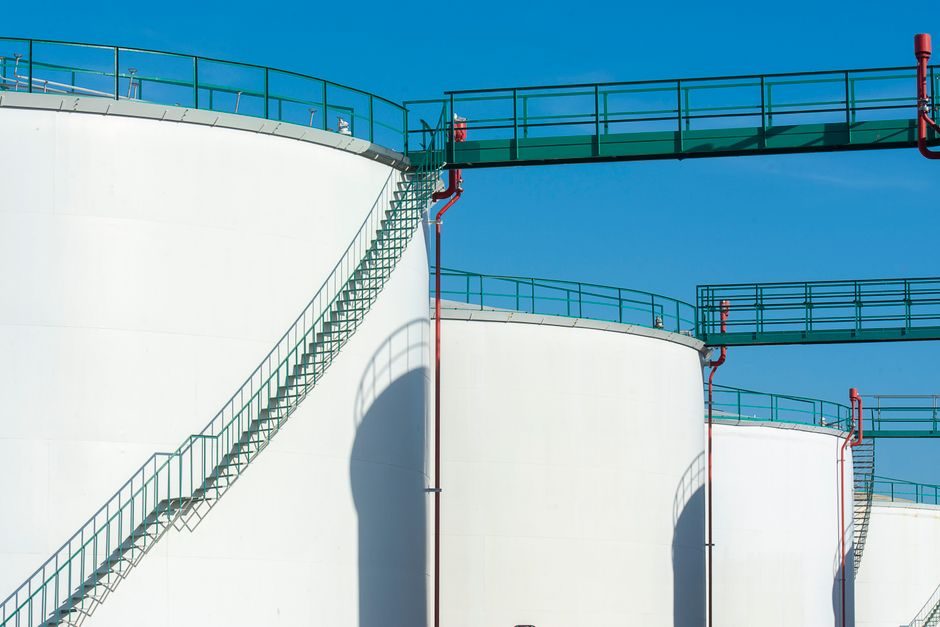
An IBC tank is a composite liquid container combining a high-density or low-density polyethylene inner bottle with a welded tubular-steel protective frame and an integrated plastic or steel pallet base, with the industry-standard 1,000 L (264 gal) build shown at assembled dimensions of 1,200 × 1,000 × 1,175 mm by Palletco LLC [S1]. A storage cage is a wire-mesh or fully welded steel enclosure sized to a pallet footprint, sold without any inner pressure-rated or liquid-rated bottle, and used to contain bagged, drummed, or loose dry goods.
The two products overlap only in name and footprint, not in duty cycle. IBC tanks are designed to hold liquid chemistries including Class II and below dangerous goods (石化, 染料, 中间体, 农药, 酿造, 日化) and food liquids such as olive oil [S6]; storage cages carry propane cylinders, machine parts, and palletized dry inventory, priced as low as US$ 2-10 per piece for cylinder-bundle cages out of Shanghai [S4]. Mixing the two in a spec sheet is a procurement error that shows up in the receiving dock and in the dangerous-goods audit.
Core Definition and Scope Boundary
An IBC (Intermediate Bulk Container, sometimes called 吨桶 / 吨装桶 / 千升桶 in Chinese) is defined by its composite structure: HDPE or LDPE inner bottle for chemical resistance plus a welded steel frame for stacking and forklift handling, with 1,000 L the de-facto working volume [S1]. Body dimensions vary: ARICON GmbH's TP-series rectangular polyethylene IBC lists 640 L and 980 L capacities with heights of 1,495 mm and 1,775 mm and lengths from 800 mm to 1,210 mm, all on a near-EUR-pallet footprint [S2].
A storage cage, sometimes called a stillage or pallet cage, is a hollow rigid enclosure. The wire-mesh variant is collapsible for return logistics; the full-welding variant (Qingdao Chenghui Automation Storage Equipment) is rigid and stackable, with rust-proof hot-galvanised steel and pricing in a US$ 60-120 per-set band for a 10-set MOQ out of Shandong [S3]. Both are typically sized to a 1,200 × 1,000 mm EUR-pallet base, which is the only point of dimensional contact with an IBC.
Decision Criteria: Liquid State, Certification, Footprint, Stack Load
Selection on a process line is driven by four data points: product state, certification, footprint, and stack load. An IBC tank answers yes to liquid + UN-classifiable + EUR pallet + 4-high stackable with 2,000 kg+ dynamic load. A storage cage answers yes to dry/solid + no UN pressure-rating requirement + same EUR pallet + 1,000-1,500 kg static load. The crossover is rare and almost always wrong: do not use a wire-mesh storage cage for free liquid (no inner bottle, no leakproofness, no UN mark), and do not use an IBC for a 1,500 kg engine block (the HDPE bottle will deform and the steel frame is rated for stack compression, not point impact). [S1]
For chemical service, the ARICON polyethylene IBC is rated for chemical and liquid use with a protective cage and rectangular geometry that cuts wasted headspace versus a cylindrical drum of equivalent volume [S2]. For dry goods, a hot-galvanised stackable steel cage at US$ 60-120 per set is roughly 10-20× cheaper per trip than buying a UN-marked composite IBC for the same footprint [S3]. This cost gap is the single biggest reason procurement teams must keep the two products on separate SKU lines.
Comparison: IBC Tank vs Storage Cage on Four Criteria
Lining the two up against decision criteria shows the gap: (1) Inner vessel: IBC has an HDPE/LDPE bottle, typically blow-moulded at 1,000 L for food or chemical duty; storage cage has none. (2) UN/dangerous-goods certification: IBC carries a UN 31 marking for packaging-group II and III liquids per the relevant transport regulations; storage cage does not. (3) Footprint: both sit on a 1,200 × 1,000 mm pallet envelope, but the IBC uses 1,175 mm height (Palletco) while ARICON's taller TP unit reaches 1,775 mm at 980 L, versus a wire cage's typical 1,000-1,200 mm collapsed height [S1][S2]. (4) Stack count: an IBC is rated 4-high dynamic in transport; a rigid welded stillage is rated 4-5-high static in warehouse, while a collapsible wire mesh is rated 1+3 nested.
A short verbatim standard requirement: the IBC inner bottle must be HDPE or LDPE and exhibit light weight, high strength, and corrosion resistance for the container to qualify for petrochemical, dye, intermediate, pesticide, brewing, and daily-chemical liquid service. No equivalent clause exists for a wire storage cage because the cage is not a pressure or liquid boundary.
Real Use Cases by Industry
In edible-oil plants, 1,000 L stainless or HDPE-lined IBCs are used for olive-oil storage with food-grade fittings, as shown in product video references on Made-in-China.com for 1000 L / 550-gallon stainless steel food-grade IBCs [S6]. The 1,000 L food-grade IBC is also the de-facto container for Class II and below dangerous liquids including petrochemicals, dyes, intermediates, pesticides, and brewing/daily-chemical liquids in mainland-China supply chains.
Storage cages dominate gas-cylinder logistics: a stackable hot-galvanised LPG/oxygen/propane cylinder cage out of Qingdao Forterra Gas lists at US$ 100-200 per piece for a 100-piece MOQ and is designed for bundling pressurised cylinders upright [S4]. In automotive and machining, a rigid full-welded cage at US$ 60-120 per set is the standard tote for transmission cores, valve bodies, and forging blanks in JIT loops [S3].
Limitations, Failure Modes, and Common Spec Errors
IBC limitations are well documented. The HDPE inner bottle softens with temperature; verify the vendor's published use-and-storage temperature window before any hot-fill or outdoor-sun load. Rectangular ARICON units at 980 L cut headspace but raise the centre of gravity to 1,775 mm, which lowers the practical stack count under vibration transport [S2]. Reconditioned IBCs are common in the secondary market; spec the UN mark and the date of last hydrostatic test rather than accepting a visual-only inspection.
Storage-cage limitations are different. A wire-mesh collapsible cage at the US$ 2-10 per-piece low end is typically thin-wall wire with a light zinc coat and is not designed for outdoor exposure or for chemicals; for hazardous-area storage, the specifier must add a compliant bund tray and verify the cage's own finish against the stored cylinder's corrosion profile [S4]. For related cross-product selection, see the spec cut for FIBC bulk bags vs IBC tanks, where the bulk-bag option trades certification for one-trip cost on dry flowables.
Sourcing, Standards, and Manufacturing Footprint
Mainland China is the dominant manufacturing base for both product types. Xinzhou (XinZhou) markets itself as one of the largest IBC-machine line builders in China, with 20+ years of tooling experience covering fully automatic IBC production lines and after-sales support, which underpins the cost floor on 1,000 L composite IBCs [S5]. On the cage side, Shandong and Shanghai are the two main exporter clusters; Qingdao Chenghui ships full-welding rigid cages at US$ 60-120 per set, and Shanghai Riseon and Qingdao Forterra split the cylinder-bundle and gas-cylinder cage volumes at the US$ 2-200 spread [S3][S4].
Standards discipline: an IBC inner bottle must be HDPE or LDPE per the composite-container definition, with UN 31 marking required for dangerous-goods liquids (Class II and below) per applicable modal regulations (ADR/IMDG/IATA for transport, with national variants). A storage cage has no single governing UN number; it is typically specified against the warehouse operator's own rack-and-stillage standard, with hot-dip galvanising to ISO 1461 (for the zinc-coat weight) commonly required but not equivalent to a UN pressure rating. Specifiers who collapse "IBC" and "cage" into one PO line have usually skipped the UN-mark audit entirely.
Trackable signals for the next quarter: (1) the ARICON TP-series price band for 980 L rectangular IBCs, which sets the floor on dangerous-goods liquid cost per litre; (2) the Qingdao full-welding cage spot price, which is the cleanest read on Chinese fabricated-steel export cost; (3) any UN 31 re-certification cycle timing from Xinzhou's OEM base, since 2026-07 marks a peak dangerous-goods audit window for many Class II shippers [S2][S3][S5].
For component-level specifications, see storage rack.