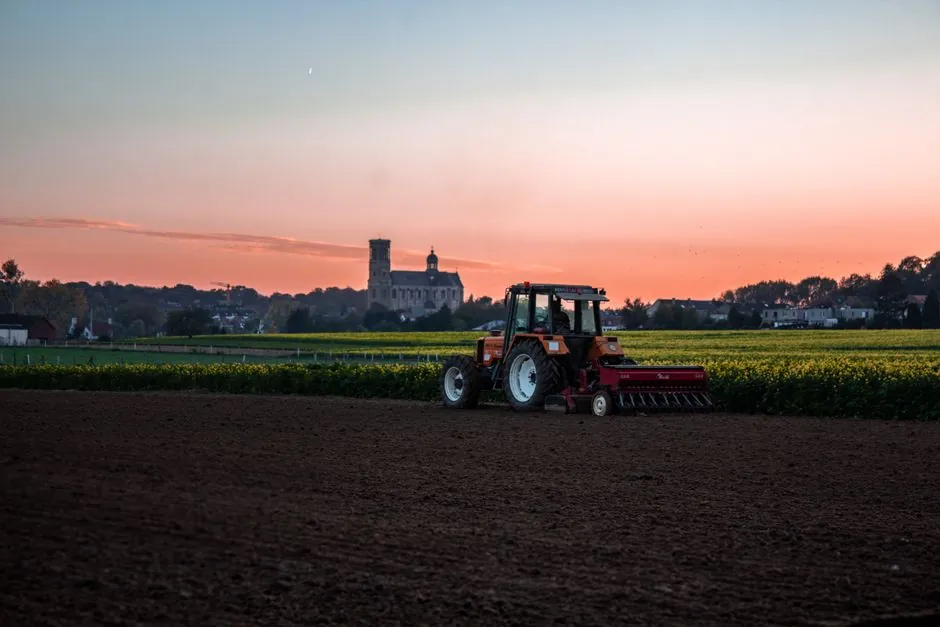
Agricultural machinery OEMs specifying cast iron and steel components, from ploughshares and gear blanks to tractor housings, increasingly anchor their foundry decisions on medium-frequency coreless induction furnaces sized to 1-5 t crucible batches, while larger integrated ironworks use channel units for holding 100 t+ baths [S2].
The global induction furnace market is forecast to reach USD 3.91 billion by 2034 at a 4.49% CAGR (2026-2034) [S3], and the India market alone is projected to add USD 123.4 million in incremental opportunity at 7.3% CAGR through 2030, with channel-type units already valued at USD 145 million in 2024 [S2].
Operating Principle and Why MF Induction Fits Iron-Rich Ag Castings
A medium-frequency induction furnace rectifies three-phase mains AC to DC and then inverts it to a regulated AC that flows through a capacitor bank and induction coil, producing high-density magnetic flux lines that cut the metallic charge and generate large eddy currents for joule heating [S1]. This contactless energy transfer delivers melt rates of roughly 1-3 t/h in 1-3 t coreless units, with melt-loss typically 0.5-1.0% versus 3-5% in cupola practice, a direct metallurgical gain when pouring pearlitic grey iron or ductile iron grade SG-300/SG-400 used in gearboxes and axle housings.
For agricultural machinery, melt cleanliness drives machinability of clutch housings and differential cases, so the electromagnetic stirring inherent to coreless designs (vertical field component) homogenises carbon and sulphur distributions without external purging. Channel furnaces, by contrast, use a single-loop molten-metal channel that acts as a secondary single-turn winding, making them better suited as holding furnaces downstream of a primary melter rather than batch iron-melting workhorses.
Type and Capacity Comparison for Ag-Machinery Foundries
The 2026 India market segments induction furnaces into channel and coreless types, with capacity bands up to 1 t and more than 100 t, and end-use split across steel, copper, aluminium, and zinc [S2]. For a tractor or implement foundry pouring 200-800 kg batches of grey iron or 60-40 brass fittings, a 500 kW to 1.5 MW, 150-1000 Hz medium-frequency coreless furnace with a 0.5-1.5 t crucible is the practical fit; for an integrated steel plant feeding continuous casting of boron steel plough blades, a 5-15 MW channel furnace holding 100-300 t is the comparable scale [S2].
Selection matrix for an agricultural-machinery decision:
Option 1: Coreless medium-frequency (0.15-1.5 MW, 150-1000 Hz, 0.5-3 t crucible). Best for batch melting of iron, steel, and non-ferrous alloys; high power density (300-600 kW/t); cold-start capable in 30-45 min; flexible alloy changeover between runs, but requires refractory relining every 300-600 heats.
Option 2: Channel-type induction (3-15 MW mains or MF supply, 50-300 t bath). Best for holding and superheating at constant level; electrical efficiency 92-96% versus 85-90% for coreless; cannot cold-start, must always be liquid; not a melter of cold charge, so it pairs upstream with a coreless or cupola.
Option 3: Crucible (gas or resistance-fired) for low-volume brass and bronze bushings, typically below 200 kg melt, where capital cost dominates; less relevant to high-throughput iron work. See crucible furnace for that niche.
Decision gates: tonnage/year below ~5,000 t typically points to a single 1-2 t coreless MF unit; tonnage above ~20,000 t and continuous casting downstream warrants a channel holding furnace fed by two or three coreless melters. Ag-machinery foundries rarely exceed the 100 t+ band that anchors the "more than 100 ton" capacity segment [S2].
Selection Criteria Tied to Ag-Machinery Production
Four criteria dominate the spec: power-supply stability, refractory life, alloy range, and automation readiness. India foundries cite energy efficiency, melting capacity, and the metal grade to be poured as the top three gating factors [S5], and a stable three-phase supply with less than 5% voltage imbalance is the minimum for thyristor or IGBT inverter life above 50,000 h.
Power sizing: a 1 t iron melt from cold requires roughly 600-650 kWh/t at 90% electrical efficiency, so a 750 kW MF supply melts a 1 t batch in about 50 min plus 25-30 min of superheat. A 2 t coreless unit fed by a 1.5 MW inverter at 500-1000 Hz produces 2-3 t/h, matching an automated moulding line pouring one flask per 4-6 min, common for gearbox housings and brake drums.
Refractory choice: dry-vibrated silica-alumina (85-90% Al2O3) for iron melts up to 1500-1550 degrees C, with a typical 500-800 heat campaign on the coil grout. For ductile iron with magnesium treatment, a higher-alumina (95%+) or MgO-spinel lining extends life to 800-1200 heats because it resists the MgO-FeO slag attack from FeSiMg inoculation.
Automation: modern coreless units integrate hydraulic tilt, optical or thermocouple-based bath-temperature control, and inverter over-current trip at 130% rated current, which prevents copper-coil damage during scrap-bridge collapse, a leading failure mode in farm-machinery scrap charges (contaminated silage, soil, tramp iron).
Who This Is For and Where It Breaks
Coreless MF induction fits independent and tier-2 agricultural foundries pouring 500-5,000 t/year of grey iron, ductile iron, and low-alloy steel castings such as plough mouldboards, rotary tiller blades, and PTO yokes. It does not fit ultra-low-volume brass job shops (under 100 t/year), where induction capital cost is hard to amortise, nor does it fit operations lacking a stable three-phase grid, where a cupola furnace on coke or a gas-fired crucible unit may be the only economic path. [S2]
Known constraints: cold-start coreless furnaces need scrap preheating to 200-300 degrees C for fast ramp-up, and tramp-element accumulation (Cu, Sn, Cr from agricultural scrap) limits melt reuse to 30-50% returns before dilution. Channel furnaces cannot be drained for alloy change, so they are locked to a single grade, typically one steel or iron specification. Operators must also budget 8-12% of capital for spare inverter modules and water-cooling plates, the two highest-failure subsystems.
For broader context on how induction compares with alternative electric melting routes in a different end-market, see the 2026 spec map for Induction Furnace Selection for Aerospace Components, and for adjacent casting-line decisions on bearings, the 2026 roller bearing selection for steel mills walkthrough covers the spec gates a foundry engineer will already recognise.
Standards, Sourcing Signals, and 2026 Market Context
Melting equipment is generally built to ISO 9001 quality systems with electrical safety to IEC 60204-1, and the inverter power section typically carries CE marking under the EU Low Voltage Directive 2014/35/EU, while induction heating equipment used in hazardous foundry dust environments falls under ATEX 2014/34/EU zone classification when rated for dust zone 21 or 22. Refractory installation commonly references ASTM C401 for plastic and ramming mixes and ISO 2245 for shaped refractory classification, which specifiers should verify against the furnace builder's datasheet rather than assume. [S2]
Two trackable signals for the rest of 2026: first, the Technavio forecast pegs India's induction furnace market opportunity at USD 201.5 million against USD 123.4 million in incremental growth, with channel-type units driving the upside and steel the dominant end-user, which is consistent with the agricultural-machinery supply chain's reliance on local secondary steelmakers [S2]. Second, the global market trajectory toward USD 3.91 billion by 2034 at 4.49% CAGR [S3] confirms a sustained, if moderate, capital cycle in electric melting, and OEM dealer programmes in Latin America and South Asia (for example, the DELMER induction furnace dealer network for Mexico) show that distribution channels for European-built induction melting units are actively being extended into agricultural and precious-metal melting segments [S4][S6].