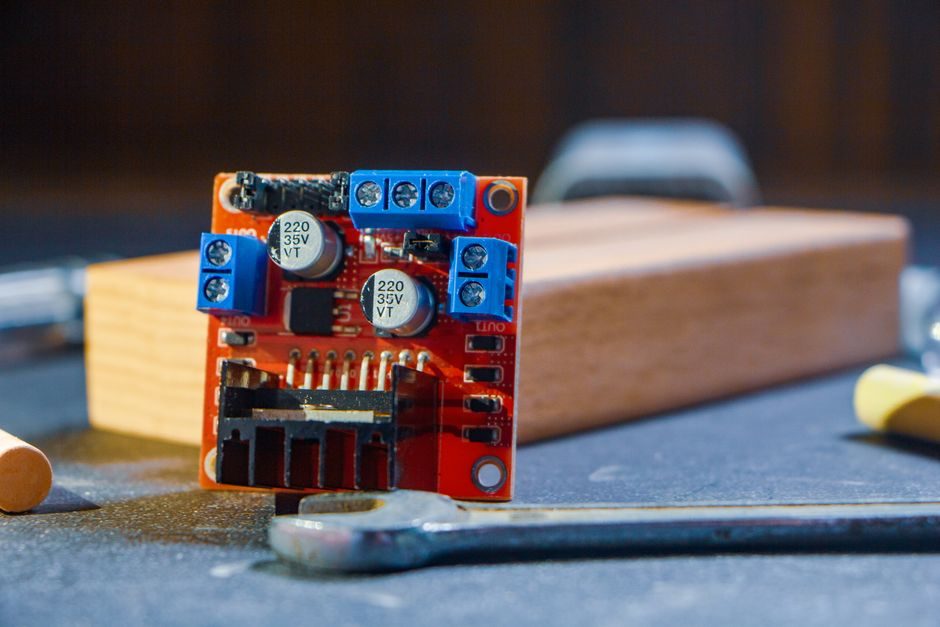
Inductive proximity sensors and load cell modules solve different problems and share almost no overlap in the modern factory — one outputs a switching signal when a metal target enters its face, the other outputs a calibrated voltage proportional to applied force [S1][S2].
The selection mistake I see most often in B2B spec sheets is asking "which is cheaper" before asking "which physical quantity am I actually measuring." Position/presence of ferrous or non-ferrous metal → inductive sensor. Force, weight, tension, compression → load cell module. Cross-wiring these wastes a quarter on hardware and a week on commissioning.
Operating Principle: Eddy-Current Ring vs Bonded Strain Gauge
An inductive proximity sensor builds a high-frequency alternating electromagnetic field from a coil in its active face; when a conductive target enters the field, eddy-current losses in the target absorb energy and the oscillator amplitude drops, triggering a threshold comparator — typical switching frequencies sit in the 1 kHz range and target sensing distance (Sn) is governed by the IEC 60947-5-2 norm-housing convention (M5 = 0.8 mm Sn, M8 = 1.5 mm, M12 = 2/4 mm, M18 = 5/8 mm, M30 = 10/15 mm) [S1].
A load cell module is a metal spring element (aluminum, tool steel, or 17-4 PH stainless) with bonded foil strain gauges arranged in a Wheatstone bridge; applied force micro-deflects the element, the bridge unbalances, and the differential output — typically 2 mV/V at full scale — is read by an electronic load indicator or transmitter [S2][S4]. Mettler-Toledo's industrial weighing portfolio alone lists compression weigh modules, tension weigh modules, S-type load cells, single-point load cells, and bending beam load cells, each with a distinct mechanical installation envelope [S4].
Decision Criteria: 4-Question Pre-Spec Filter
Before opening a vendor catalogue, four engineering gates filter the decision in under five minutes: (1) What is the physical input — position of metal (inductive) or force applied to a structure (load cell)? (2) What is the output type — discrete PNP/NPN switch or analog 4–20 mA / 0–10 V / mV/V? (3) What is the required accuracy class — IP67 presence detection, or OIML C3 / NTEP 5,000 d legal-for-trade weighing? (4) Does the environment impose IP69K washdown, ATEX/IECEx zone, or 150 g shock — which sensors carry the relevant rating out of the box [S1][S4]?
Concrete thresholds worth memorising: inductive sensors rarely need any accuracy spec beyond repeatability (±0.01 mm is typical for M12 at rated Sn) because the output is binary; load cells, by contrast, must specify combined error, creep (typically ≤0.02% FS over 30 min), temperature coefficient of zero (≤0.001% FS/°C industrial grade), and minimum load cell verification interval (nLC) for trade applications [S2][S4].
Head-to-Head Comparison: Inductive Sensor vs Load Cell Module

On cost-per-point, an inductive M12 PNP NO sensor lists in the 8–25 USD range; a complete weigh module with load cell, mounting hardware, and junction box lands at 250–1,500 USD depending on capacity and OIML class [S1][S4]. On lifetime, inductive sensors cite ≥100 million mechanical cycles under no-load switching because there is no moving part and no contact, while load cell fatigue life is rated in full-scale cycles, typically 1×10⁶ at full load for industrial-grade bending beams [S2].
On environment, both can reach IP67/IP69K, but inductive sensors also offer Factor 1 (all-metal, no correction factor reduction for steel vs aluminium), welding-immune (resist strong magnetic fields from resistance welding), and high-pressure-resistant variants (up to 500 bar washdown) — none of which a strain-gauge load cell can match because the gauge bond itself is pressure- and EMI-sensitive [S1]. On measurement quantity, the two are non-overlapping: inductive sensors cannot weigh, and load cells cannot detect approach without mechanical contact.
Who Inductive Sensors Are For — and Who Should Walk Away
Spec an inductive sensor when you need: end-of-travel confirmation on a pneumatic cylinder, gear/sprocket speed monitoring (the Hall or reed variants of magnetic sensor families handle the low-frequency side), part-presence check on a conveyor, or weld-nut detection through non-metallic debris. Lanbao's catalogue breaks the family into 12 functional sub-types — Standard, Extended Distance, Analog Output, Full Metal, Self-Diagnostic, High Pressure Resistant, Rotation Speed Monitor, NAMUR (intrinsically safe for Ex zones), Inductive Power Clamp, High Protective, Factor 1, and Welding Immune — so the application, not the brand, picks the SKU [S1].
Walk away from inductive if: the target is non-conductive (plastics, wood, paper) — pick capacitive or photoelectric instead; the measurement is continuous displacement >Sn range — pick an LVDT or laser distance sensor; the requirement is force/weight measurement in newtons or kilograms — go straight to load cell, do not try to back-calculate force from a position reading [S1][S2].
Who Load Cell Modules Are For — and Their Hard Failure Modes

Spec a load cell module when the requirement is hopper/tank/silo weighing, truck/rail scale weighbridges, batching and dosing, dynamic force on a press, or tension control on a wire/rope/film line. Sensor Techniques' Ahmedabad product line splits the family into bending beam, S-type, single-point, bridge-style, axle pin, and rope tension variants — each matched to a mechanical geometry rather than a brand [S2].
The three hard failure modes every spec must defend against: (a) overload / shock load — derate capacity by 1.5–2× to absorb peak forces, since permanent zero shift follows a single >150% FS event; (b) side load / moment — install a self-aligning weigh module (Mettler-Toledo's compression weigh modules, for example, integrate this as a kit) so the load path is purely vertical [S4]; (c) creep and temperature drift — the spring material choice (17-4 PH vs tool steel vs aluminium) sets the creep behaviour, and a remote-mounted transmitter in a stable thermal environment saves more accuracy than a more expensive cell [S2].
Integration, IO-Link, and Smart Factory Wiring
On the wiring side, the two technologies are now converging on the same industrial bus. Inductive sensors increasingly ship as IO-Link devices (IEC 61131-9) exposing switching threshold, temperature, and operating-hours counters as process data — Lanbao lists IO-Link Masters and IO-Link Hubs as part of its industrial network module portfolio [S1]. Load cells typically terminate in a 4-wire or 6-wire shielded cable into a transmitter that outputs 4–20 mA, HART, PROFIBUS, or EtherNet/IP — the analogue mV/V signal must not run alongside VFD power cables without shielding, and the cable length should be kept under the cell's specified cable length to avoid calibration drift [S2][S4].
Worth noting: an inductive sensor and a load cell module can co-exist on the same machine doing complementary jobs — for example, a load cell under a tank confirms fill weight, while an inductive sensor on the inlet valve confirms the valve is fully closed; neither replaces the other, and the B2B specifier should not look for a single part that does both [S1][S2]. For a wider selection map on industrial weighing, the Truck Scale TCO: 20-Year Cost Stack and the Drivers That Move It article covers how weighbridge load cell choices cascade into operating cost. For the monitoring side that wraps around both sensor types, the Vibration Analyzer Buying Guide 2026 maps the sensor-physics decisions adjacent to these two.
Sourcing and Standards to Write Into the Purchase Spec
For inductive sensors, the binding standard is IEC 60947-5-2 (low-voltage switchgear and controlgear — proximity switches); for ATEX/IECEx intrinsically safe applications, insist on NAMUR output (DIN 19234) and a valid Ex certificate matching the zone [S1]. For load cell modules, the relevant references are OIML R60 (metrological regulation for load cells, with accuracy classes A through D and nLC intervals from 600 to 10,000), and where trade-legal in the US, NTEP Handbook 44 / NCWM publication 14; for hygienic zones, 3-A or EHEDG cleaning-in-place ratings apply [S2][S4].
For a balanced shortlist, the global Mettler-Toledo industrial weighing portfolio and Sensor Techniques' Ahmedabad strain-gauge line cover the load cell side across capacities from a few kilograms to several hundred tonnes, with both compression and tension mountings available off-the-shelf [S4][S5]. On the inductive side, Lanbao's twelve sub-type catalogue and Flying Fairy's dedicated FI3750 inductive sensor IC (exciter coil plus three receiver coils on PCB) show the breadth from discrete housed sensors to silicon-level integration [S1][S3]. The engineering judgement call is whether your application lives in the millisecond-presence domain or the calibrated-force domain — once that gate is decided, the rest of the spec writes itself.