
Thin-bed tile adhesive meeting the C2 (improved cementitious, high-performance) class under EN 12004 — combined with a notched trowel sized to the tile format — is the dominant installation method for industrial-grade ceramic wall and floor assemblies on flat, cured substrates [S1].
China's Technical Committee For Tiling (TCT), seated at 9 Sanlihe Road, Haidian District, Beijing, has run installer training and tile-installation skill competitions since 2009, including thin-bed method classes held during the 16th China (Beijing) International Architectural Decoration and Materials Exposition in March 2009 [S1].
Substrate Preparation: Flatness Tolerance, Moisture, and Curing
Substrate flatness must be checked with a 2 m straightedge before any adhesive is mixed; deviations above roughly 3 mm over 2 m require a levelling compound, because a notched trowel cannot compensate for hollows larger than its notch depth [S1].
Concrete substrates need a minimum 28-day cure prior to tiling, and residual moisture should be checked with a calcium chloride or electronic meter; readings above 75 % RH (relative humidity) at the surface are a common cause of bond failure on dense-bodied industrial tiles [S1].
For deflection-sensitive assemblies — suspended slabs, steel mezzanines, vibration-prone plant floors — the substrate deflection limit is typically L/360 under live load, and any movement joint in the substrate must be carried through the tile field as a soft joint, never bridged with rigid adhesive [S1].
Adhesive Selection: EN 12004 C1/C2, S1/S2 Deformability
Cementitious tile adhesives are classified under EN 12004 into C1 (normal) and C2 (improved) classes, with S1 (deformable, ≥ 2.5 mm transverse deformation) and S2 (highly deformable, ≥ 5 mm) suffixes for movement accommodation; C2TE or C2TE-S1 are the typical industrial-floor and exterior-wall specifications [S1].
Open time of a C2 adhesive is normally 20–30 minutes at 23 °C / 50 % RH, and only as much area should be spread as can be tiled before the adhesive skins over — a quick finger-touch test confirms wet-tack before each tile is bedded [S1].
For chemically exposed floors (acid, alkali, solvent splash), epoxy or polyurethane reactive adhesives classified as R2 under EN 12004 are the proper choice, not modified cementitious; they tolerate pH ranges that attack portland-based binders [S1].
Trowel Geometry and Coverage: Avoiding Hollow-Bond Failures
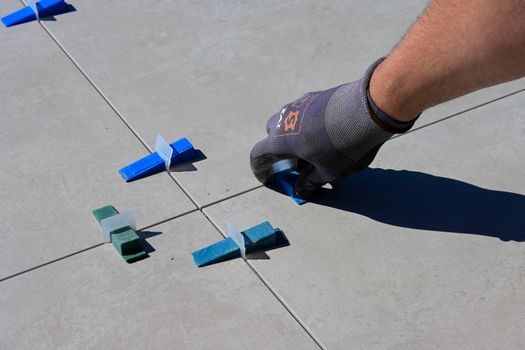
Trowel notch size is dictated by tile back profile and format: 6×6 mm square notch for mosaics, 10×10 mm for tiles up to 300×300 mm, 12×12 mm or 12×20 mm for 300–600 mm formats, and solid-bed buttering-floating for large-format panels above 600 mm [S1].
Trowel angle should be held at roughly 45–60° to the substrate so the notch stands up; a shallower angle collapses the ridge and drops contact coverage below the 80 % minimum required for floors and the 95 % wet-area minimum for showers and chemical-process rooms [S1].
Coverage is verified by periodically lifting a freshly bedded tile: a uniform rib pattern transferred to the back of the tile confirms full adhesive contact, while patchy transfer flags an exhausted open time, wrong trowel angle, or dusty substrate [S1].
Joint Design: Movement, Perimeter, and Field Grout Widths
Movement joints are required at 3–5 m centres in continuous fields, at all inside corners, and at every change of substrate or material; these are filled with compressible backer rod and a polyurethane or MS-polymer sealant, never with cement grout [S1].
Perimeter expansion gaps of 6–10 mm are left where the tile field abuts walls, columns, drains, and equipment pads; these are concealed by coving or skirting and are not optional, because restrained thermal growth will crack grout and shear tiles otherwise [S1].
Use-Case Comparison: Interior Floor, Chemical Plant, Exterior Wall

For an interior light-commercial floor with porcelain tile, a C2TE adhesive, 10×10 mm notched trowel, and 2–3 mm grout joint is the standard, low-cost, fast-cure spec; full-load service is usually available 24 h after grouting [S1].
For a chemical-plant floor with 300×300 mm dense-bodied chemical-resistant tile and concentrated acid/alkali splash, an R2 epoxy adhesive, solid-bed buttering-floating, and epoxy grout with 5–6 mm joints is required — the higher material cost is offset by the bond chemistry the cementitious options cannot deliver [S1].
For an exterior wall assembly on a multi-storey plant building, a C2TE-S1 deformable adhesive, 12×12 mm notched trowel, and 5–8 mm joints with movement joints at every floor slab are the minimum; the S1 deformability absorbs differential thermal movement between the tile skin and the structural wall [S1].
Limitations and Failure Modes: When to Stop, Not Re-Bed
Efflorescence on grout within the first 72 h usually points to mix-water migration, not adhesive failure, and is corrected by re-grouting after a full 28-day cure — installing over a contaminated bed traps moisture and causes white crystalline deposits to reappear [S1].
Tiles that debond with adhesive still stuck to the back of the tile indicate a dusty substrate or exceeded open time; tiles that debond with clean backs and adhesive left on the floor indicate moisture in the substrate or a primer skipped — both cases require the tile and adhesive to be removed back to the substrate before re-bedding, not simply re-adhered [S1].
For reference on adjacent industrial-ceramic surface classes and their spec ranges, the industrial ceramic materials overview maps oxide, nitride, and carbide families against their typical service envelopes. Site layout for setting-out a tile field shares the calibration discipline used in laser level setup, and movement-joint placement follows a placement logic similar to the sprinkler system installation spacing rules on mechanical rooms. Where wet chemistry is involved, industrial adhesive selection for chemical-resistant bedding draws on the same R1/R2 reaction-chemistry split used in the floor spec above.
Field acceptance is gated by three checks: pull-off adhesion test ≥ 0.5 N/mm² at 28 days on a representative substrate, tap-test of every tile for hollow areas (none allowed at field centres, ≤ 5 % at perimeters), and visual inspection of joint width uniformity within ± 0.5 mm of spec; record these on a handover sheet before commissioning the floor to traffic or process load. Track TCT (Technical Committee For Tiling) and EN 12004 / EN 13888 revision activity as the next-year signal for any change in C2/S1/R2 class definitions or grout performance categories.
Spec-level background on the components involved: linear guide.