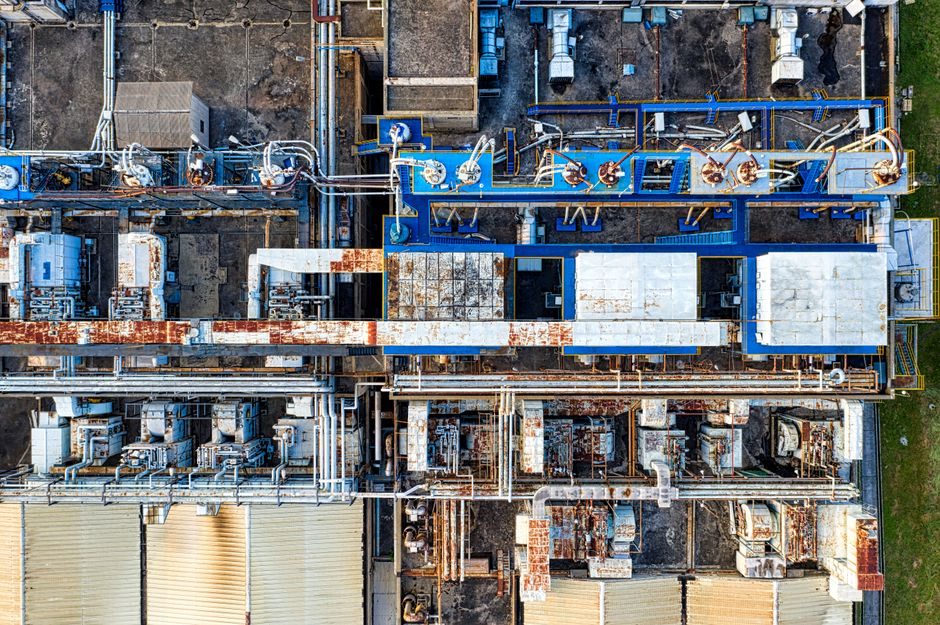
Industrial fasteners in 2026 are produced through a tightly ordered chain of hot forging or cold forming, heat treatment, thread rolling, precision machining, NDT and surface treatment, with material grade and end-service condition dictating which stations run and which are skipped [S3].
Suppliers split into API-certified custom manufacturing centers running captive forging and lab testing [S1], job shops that take customer drawings for non-standard or exotic-metal parts [S2], and high-volume Asian factories offering hot forging, cold forming, heat treatment, thread rolling and NDT under one roof for wind, rail, oil & gas and heavy-truck OEMs [S3].
Process Route: Hot Forging vs Cold Forming vs Machined-from-Bar
Hot forging and cold forming are the two primary near-net-shape routes listed in current JNZC manufacturing flow; precision machining and grinding sit downstream as a finish stage, not as the primary shape-making step [S3]. Cold forming is preferred for high-volume carbon and alloy steel hex bolts, studs and nuts because it preserves grain flow and yields tensile properties without a separate forging press; hot forging takes over for larger diameters, complex heads, or low-volume heavy-section parts where cold-heading forces exceed press capacity [S3].
Machined-from-bar is reserved for non-standard configurations, exotic alloys, or short runs where heading tooling is uneconomic; Eastwood Manufacturing's "if you can draw it, we can make it" position is the standard job-shop framing for this route, with the shop explicitly stocking conventional and exotic metals for unique projects [S2]. For larger OEM volumes, the same part is often quoted both ways — cold-formed for the standard grade and machined for the Inconel or Monel variant — so engineers should not assume the geometry, not the material, is what forces the routing decision [S2].
Process selection also depends on the head style. Hex bolts, flange nuts and wheel nuts dominate cold-formed catalogues; headed bolts, U-bolts, anchor bolts, coupling bolts and main-bearing bolts are predominantly forged because the head geometry or section thickness rules out heading [S3]. For an engineer writing a print, the practical gate is: can the head be formed in one upset stroke, or does the part need multi-station forging? That single question separates the cold-heading RFQ from the hot-forge or screw-machine RFQ.
Heat Treatment, Thread Rolling and Surface Treatment
Heat treatment and thread rolling are listed as discrete stations in the JNZC manufacturing flow, run after the primary shape step and before surface treatment [S3]. Heat treatment — typically quench-and-temper for carbon and alloy steels, or solution-treat-and-age for austenitic and precipitation-hardening stainless — is what sets the strength class (e.g. ASTM A193 grade vs metric property class 8.8, 10.9, 12.9) and is the dominant cost driver after material.
Thread rolling, not cutting, is the default thread-making step for formed fasteners because rolling preserves grain flow across the thread root and improves fatigue life by 20–30% over cut threads at the same strength class; cut threads are limited to large-diameter or low-volume machined parts, and to alloys that crack during cold rolling [S3]. Surface treatment options listed in current catalogues include hot-dip galvanizing for atmospheric corrosion protection, mechanical plating for dimensional control on threaded parts, PTFE/Xylan for low-friction torque-tension, and zinc-nickel for automotive-style corrosion performance [S3].
For corrosion-resistant high-strength fasteners, a common 2026 spec is hot-dip galvanizing to ASTM F2329 with subsequent batch-level torque-tension verification, because galvanizing thickness shifts the nut factor K; the same concern drives the trend toward zinc-nickel or zinc-flake (e.g. Geomet, Delta-Protekt) systems that bake on at lower temperatures and do not require re-tapping [S3].
NDT, Inspection and Lab Capabilities
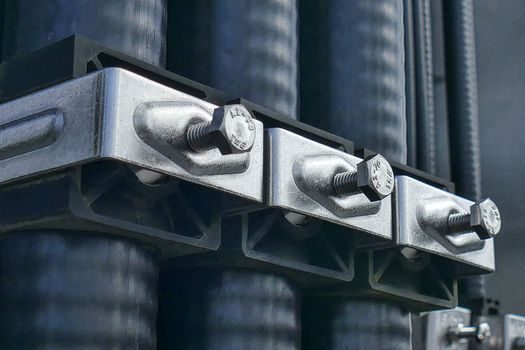
NDT and inspection are listed as standalone gates, not inline steps, in the JNZC process map; physical and chemical testing plus a metrology and measurement center are run as separate functions [S3]. Typical NDT scope for critical-service fasteners includes magnetic particle on the finished part, ultrasonic on bar stock for internal soundness, and visual/dimensional at 100% with sampling for mechanical properties.
For oil-and-gas and pressure-boundary service, the relevant NDT and traceability stack is usually ASTM A193/A194 material, NACE MR0175 / ISO 15156 for sour H₂S environments, and EN 10204 3.1 or 3.2 certification; the lab must be able to issue the mill cert type called out on the print, not just a generic test report [S3]. All-Pro Fasteners runs a certified in-house testing lab as part of its API-certified manufacturing center positioning, and uses that lab capability to back its custom manufacturing guarantee on delivery and spec [S1].
Mechanical property testing typically covers hardness (Rockwell/Brinell conversion per ISO 6508 / ISO 6506), tensile (ISO 898-1 for metric, ASTM F606 for inch), proof load, and impact where the grade requires it; for studs and main-bearing bolts these tests are commonly run per-heat rather than per-lot, so engineers should expect that level of granularity in the cert package for safety-critical parts [S3].
Material Range: Carbon, Alloy, Stainless, Exotic
Eastwood Manufacturing explicitly positions itself on a "conventional materials plus exotic metals" catalog, covering carbon, alloy, stainless and higher-nickel / titanium grades for unique projects [S2]. This mirrors the broader market where the same part geometry is quoted in 304/316 stainless, B8/B8M (ASTM A193) for high-temperature service, B7 for quenched-and-tempered alloy, and L7 / B7M for sour service under NACE MR0175 [S2].
Wind and rail segments add domex and high-strength low-alloy grades with through-thickness Charpy requirements (typically 27 J at -40 °C or -50 °C), while oil-and-gas adds sour-service restrictions on hardness (commonly ≤ 22 HRC) and on cold-work reduction; these end-use conditions are what drive the material callout more than the geometry [S3].
For non-standard configurations, exotic metals are often the bottleneck rather than the forging itself: Inconel 718, Alloy 625, Monel 400 and 17-4PH each have their own hot-working temperature windows, aging cycles and surface-finish requirements, and shops that quote a 48-hour lead time on carbon steel will quote 8–12 weeks on the same part in Inconel because the heat-treat and NDT chain is longer [S2].
End-Use Sectors and What Each Segment Specifies
Current JNZC application coverage lists wind power, hydrogen energy, diesel engines, power and gas turbines, rail and locomotive, heavy trucks, construction and mining equipment, heavy lift, transmission, and oil and gas [S3]. Wind power dominates the high-strength bolting market for tower internals, foundation anchor cages and blade-to-hub connections, with metric property class 10.9 / 12.9 and hot-dip galvanizing being the default specification.
Oil and gas is the segment where material, NDT and traceability scope stack up most aggressively: ASTM A193 B7 studs with B7M / 2H nuts for sour service, ASTM A320 L7 for low-temperature, and full EN 10204 3.2 with NACE MR0175 compliance are common; for subsea and top-side high-pressure, additional NDT such as ultrasonic on the bar stock is often called out [S3]. Rail and locomotive are similar to wind on the property-class side, with additional fatigue and vibration test requirements on stay bolts, cylinder head bolts and main bearing bolts [S3].
Wind-turbine fastener selection in particular is moving toward higher property classes to reduce part count, and toward higher-strength surface systems to extend re-lubrication intervals; the related coverage of wind-turbine blade sourcing shows the same cost-down pressure on the structural side. Hydrogen energy is an emerging application in current catalogues and is treated as a specialty callout rather than a standard line item, with traceability to ISO 15156 and specific sealing-surface finish requirements [S3].
Standards, Traceability and Certification Stack
The relevant standards stack for industrial fasteners in 2026 is layered: ASTM A193/A194 (alloy and stainless bolting for high/low temperature), ASTM A320 (low-temperature), ASTM F1554 (anchor bolts), ASTM A325/A490 (structural), ISO 898-1/-2 (metric mechanical properties), ISO 3506 (stainless), DIN 976 (stud), and ASTM F606 / ISO 6892-1 for testing methods; material traceability defaults to EN 10204 3.1 with 3.2 called out for pressure-boundary or sour-service parts [S3].
On the process side, hot-dip galvanizing defaults to ASTM F2329 / ISO 1461 and zinc-flake systems to EN 13858; on NDT, magnetic particle to ASTM E709 / ISO 10893-1, ultrasonic to ASTM A388 for forged parts, and liquid penetrant to ASTM E165 / ISO 3452-1; on lab testing, ISO 6508 / ISO 6506 for hardness, ISO 6892-1 / ASTM A370 for tensile [S3]. Engineers should pin the standard on the print at the callout level, not at the "fastener to industry standard" level, because revisions and exceptions drive the spec more than the headline grade.
Certification scope differentiates suppliers: API-certified manufacturing centers run Q1 / Q2 programs and tie fastener traceability to the customer's MOC; ISO 9001 is the floor, ISO 14001 and ISO 45001 are common differentiators; AS9100 appears in shops serving aerospace; and Nadcap heat-treat and NDT accreditation is required for shops quoting into major airframers [S1][S3]. For comparison purposes, three supplier tiers can be lined up against capability criteria:
<strong>API-certified custom manufacturer [S1]:</strong> captive manufacturing + certified in-house lab, full cert stack, higher MOQ, shortest spec-to-ship on standard parts.
<strong>Job shop (drawing-based) [S2]:</strong> any material including exotic, low MOQ, longer lead time on exotic alloys, NDT scope usually outsourced.
<strong>Integrated Asian OEM supplier [S3]:</strong> full process under one roof (hot forging + cold forming + heat treatment + thread rolling + NDT + surface treatment), high volume, broad standards coverage, ex-mill pricing, longer inbound logistics to North America.
Supply Chain and Sourcing Signals
Current distributor-tier offerings increasingly bundle fastener supply with VMI, stock-and-release, kitting and drop-shipping services rather than selling individual SKUs; All-Pro Fasteners' positioning on VMI, strategic sourcing, kitting and custom shipping is the standard distributor-plus-services frame [S1]. For high-volume OEM buyers, the decision is typically between integrated mill-direct supply (lowest unit cost, longer transit) and distributor-plus-services (higher unit cost, shorter responsive lead time, integrated MRO) [S1][S3].
The upstream feedstock side is also tightening in 2026. Ferrosilicon grades and spec gates matter for any fastener that takes a zinc or zinc-nickel surface treatment, because Si content in the steel affects the coating adhesion and the matte finish; steel strand types is the upstream reference that drives the wire rod feedstock going into cold heading. On the metals that touch the fastener line, molybdenum automation is the upstream reference for refractory-metal alloy production, which feeds back into the exotic-metal fastener side of the catalogue [S2].
Trackable signals for the next 6–12 months: (1) tightening of EN 10204 3.2 scope for subsea and hydrogen service, (2) growing callouts of zinc-nickel and zinc-flake over hot-dip galvanizing in wind and rail, and (3) the build-out of Nadcap heat-treat accreditation in additional Asian OEM suppliers as wind and aerospace volumes migrate [S3]. Specs to watch on the print are property class + NACE + cert type — those three lines control lead time and price more than any other combination.
For the relevant spec sheets and selection criteria, see additive manufacturing material, multifunction process calibrator, and v process line.