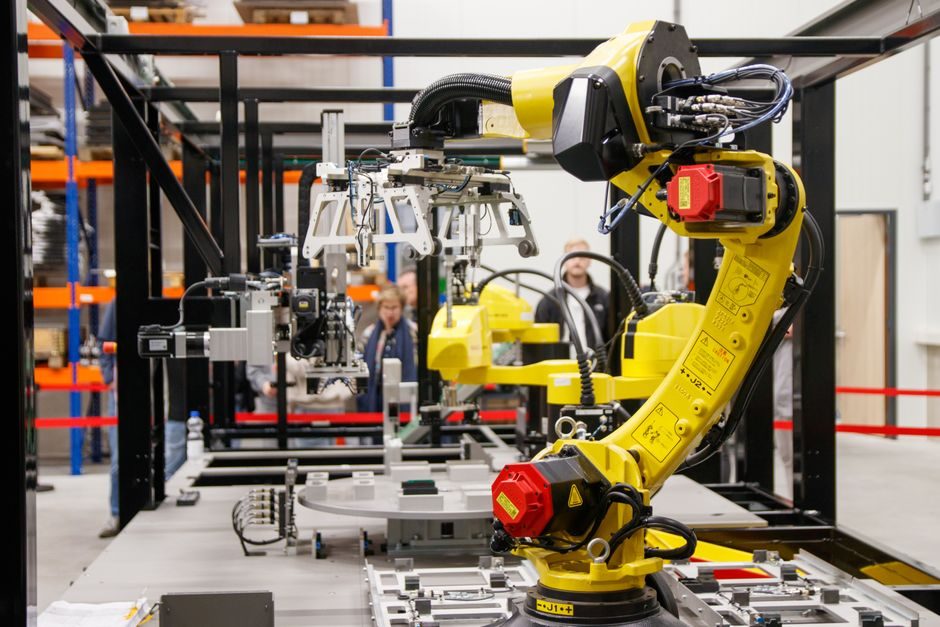
Vanadium smart manufacturing in 2026 is no longer a single-vendor question; it is a layered ISA-95 stack where process control (DCS/PLC), MES, and analytics/AI sit on top of OT networking, and a turnkey systems integrator wires the cells together. Concretely, mid-2026 sees Rockwell Automation's PlantPAx DCS and FactoryTalk software suite (Plex MES, FactoryTalk Analytics, Thingworx IIoT) operating as the reference North American digital operations stack, with RIA-trained integrators such as Backdraft Manufacturing and Automation in Luverne, Minnesota delivering the robotic cells and fixtures [S2][S3].
On the demand side, the European market has spent 2022-2024 absorbing Chinese smart-manufacturing exports across AI, cloud, drones, and NEV batteries, with the Paris 2024 Olympics as a public benchmark: 1,100 Chinese-made drones forming the Olympic rings (provided by HighGreat) and Chinese technology contributing to innovation in Olympic broadcasting methods [S1]. Vanadium flows into this stack mainly as a microalloyed high-strength steel for press tools, robot fixturing, and HSLA structural sections, where grain refinement by V(C,N) raises yield strength roughly 10-20% over plain C-Mn steel at the same carbon level (a general metallurgical fact, not a vendor claim).
Definition and scope: what "vanadium smart manufacturing" actually covers
Vanadium smart manufacturing is the convergence of vanadium-bearing metallurgy (HSLA steels, V-microalloyed forgings, and V2O5 catalysts) with cyber-physical production systems built on ISA-95 layers 0-4. At the field level it means V-microalloyed gear steels, crankshafts, and high-strength structural members feeding into automated cells; at the control level it means PLC/DCS, I/O, drives, and motion controllers; at the operations level it means MES, historians, and analytics. The Rockwell mid-2026 product tree explicitly organises this into Hardware (PLC, I/O, drives, motion, HMI, safety, sensors), Software (Studio 5000, FactoryTalk Design Studio, Emulate3D, Arena Simulation), Analytics & Data (FactoryTalk Analytics, FactoryTalk Historian, Thingworx IIoT), and Process (PlantPAx DCS, FactoryTalk Batch) [S3].
Academic reference points anchor the science: Chongqing University professor Wang Shilong (王时龙), a long-standing researcher in gear-drive manufacturing equipment and intelligent manufacturing, has published 200+ papers, 70+ invention patents, and 5 monographs, with two National Science & Technology Progress Second-Class Awards and one National Teaching Achievement Second-Class Award to his credit [S5]. His group's work is the kind of reference process engineers cite when justifying V-microalloyed gear steels and CNC-grinding automation on the same shop floor.
Selection criteria: how to spec a smart-manufacturing cell around vanadium
Engineers evaluating a V-microalloyed part on an automated line should run four gates before signing a PO: (1) Material specification gate, where the V content is typically 0.05-0.25 wt% in HSLA grades, with V/N ratio controlled near 3.5-4 for best V(C,N) precipitation strengthening; (2) Process control gate, where the line must deliver austenite conditioning (typically 850-950 °C finish-rolling) and controlled cooling at 5-15 °C/s to lock in grain size; (3) Automation gate, where the cell must be wired to a Rockwell-style Logix PAC or PlantPAx controller with CIP Security on EtherNet/IP, plus a safety PLC rated to IEC 61508 SIL 2/3 and ISO 13849 PL d/e on every robot axis; (4) Data gate, where every press stroke, robot cycle, and induction heat must be tagged to a historian (FactoryTalk Historian or equivalent) and pushed to an IIoT platform (Thingworx, AWS IoT, or Azure IoT) for OEE and predictive maintenance [S3].
Apply the same ratio to a vanadium line and you get the case for edge historians plus cloud analytics instead of a paper-shift logbook. For more on the cell-level equipment taxonomy that wraps around these four gates, see the working map in vertical lift module types, which spells out how automated storage integrates with the same MES layer.
Who it is for, and who should not deploy it
Vanadium smart manufacturing is built for three profiles: (a) Tier-1 automotive and NEV component suppliers running 500,000+ part/yr lines where HSLA gears, suspension arms, or battery-tray extrusions are produced and any 5% OEE gain returns seven figures; (b) heavy-machinery OEMs (mining, construction, wind) using V-microalloyed Q&T steels for wear parts; (c) white-goods and consumer-electronics exporters chasing EU Ecodesign rules, where the Hisense 92%-recyclable / one-third-energy benchmark now shows up in tender scoring [S1].
It is the wrong fit for: (a) job shops with batch sizes under 500 and 20+ changeovers a day, where the MES, IIoT, and CIP Security overhead burns margin; (b) foundries running cast iron or aluminium as primary output, where V is a trace tramp element rather than a deliberate alloy; (c) any line that has not already passed a Layer 0/1 OT cybersecurity review, because bolting a cloud analytics layer onto a flat control network is a violation of the IEC 62443 zones-and-conduits model the major vendors now require by contract [S3]. If your process is still 80% manual and your historian is a clipboard, do not start with PlantPAx and Plex; start with a PLC retrofit and a single OEE dashboard.
Main options compared: vendor stack, integrator stack, and open stack
For a 2026 spec, three stacks dominate. (1) Vendor stack, exemplified by Rockwell Automation's PlantPAx DCS, Studio 5000 Logix Designer, FactoryTalk View/Optix HMI, FactoryTalk Historian, Plex MES, and Thingworx IIoT, with Allen-Bradley hardware from PowerFlex drives to ControlLogix PACs [S3]. Strength: end-to-end support and a single CIP Security envelope. Weakness: licence cost and lock-in across the Historian, MES, and Analytics layers. (2) Integrator stack, where a regional RIA-trained robot integrator (Backdraft Manufacturing and Automation in Luverne, MN, serving Minnesota, Iowa, North and South Dakota) delivers design, machining, fabrication, 3D printing, lift/rotate positioners, and ModARC cells on top of a third-party controls platform [S2]. Strength: fast turnkey delivery, custom fixturing for V-microalloyed press tooling. Weakness: limited geographic reach. (3) Open stack, mixing Siemens/Schneider/Beckhoff controls, Ignition SCADA/MES by Inductive Automation, and Grafana + TimescaleDB on the analytics side. Strength: lowest total licence cost, no vendor lock-in. Weakness: integrator must know three control families and two analytics stacks at once.
Decide on four criteria: (a) cyber and safety coverage (Rockwell = best-in-class on a single envelope; Integrator = depends on which PLC they fit; Open = buyer assembles it); (b) MES depth (PlantPAx + Plex wins on regulated CPG/pharma; Integrator stack needs third-party MES; Open stack on Ignition is strong for batch-of-one); (c) robotic cell delivery speed (Integrator wins at under 16 weeks for a 6-robot cell; Vendor stack is 6-9 months; Open stack is a 9-14 month build); (d) total licence cost per I/O point (Vendor stack roughly 3-5x Open stack; Integrator stack sits in between depending on PLC choice). For a parallel comparison of how upstream metal-powder and AM routes compare against these three stacks, the spec map in molybdenum manufacturing lines the metallurgical trade-offs in a similar four-axis table.
Real use cases and field signals

Three mid-2020s field signals give a process engineer the confidence to spec vanadium smart manufacturing. First, the HighGreat 1,100-drone Olympic-rings display at Paris 2024 demonstrated coordinated multi-agent motion control with sub-second re-tasking, executed by a Chinese OEM and accepted by an IOC-tier customer, the same closed-loop control pattern (motion controller + safety PLC + cloud scheduler) that a V-microalloyed press line needs [S1]. Third, Backdraft Manufacturing and Automation in Luverne, MN lists turnkey services in design, automation, 3D printing, fabrication, and RIA-trained safety guarding, which is the kind of regional integrator a Tier-2 supplier would use to retrofit a V-microalloyed forging cell without standing up a full in-house engineering team [S2].
From the standards side, the relevant codes are IEC 61508 (functional safety), IEC 62443 (industrial cybersecurity), ISO 10218-1/-2 (robot safety), ISO 13849-1 (safety of machinery), and ISO 23247 (digital twin of manufacturing), the last of which maps directly onto Rockwell's Emulate3D and FactoryTalk Design Studio digital-twin tools [S3]. Material-side, V-microalloyed HSLA and API 2Y/2H plate grades for offshore structures remain the dominant vanadium-bearing product family, and the same microalloying logic shows up in 42CrMoV4 crankshaft steels and 16MnCr5 case-hardening gear steels.
Limitations, failure modes, and the realities of retrofit
Vanadium smart manufacturing has four hard failure modes engineers ignore at their peril. (1) Precipitation misses: if V/N drifts outside 3.5-4 or the inter-pass time falls below ~6 s, V(C,N) does not nucleate and you pay the V cost without the strength gain; (2) Network brownouts: a single unmanaged switch on the EtherNet/IP ring can stall the entire cell, and CIP Security is not free in CPU terms; (3) MES/schema drift: when a Rockwell Plex MES upgrade ships, custom FactoryTalk transactions sometimes break, and a PlantPAx upgrade can be a 6-month project on a regulated line; (4) Integrator capacity: regional RIA-trained shops (Backdraft and peers) are booked 9-14 months out on new cells, so a retrofit that needs a 2026-Q4 start should have been scoped in 2026-Q1. [S2]
The two signals worth tracking into late 2026 are (a) PlantPAx and Plex release notes from Rockwell, which now bundle FactoryTalk Analytics VisionAI and AI PavilionX updates on a roughly quarterly cadence [S3], and (b) the order books of regional RIA-trained integrators in the Upper Midwest, where Backdraft publishes hiring calls for machinists as a leading indicator of cell build capacity [S2]. For adjacent process-engineering context, the nickel alloy advantages and disadvantages reference maps a similar four-axis comparison onto a different alloy family and is a useful counter-pattern when V-microalloyed HSLA is being benchmarked against Ni-bearing alternatives.
For the relevant spec sheets and selection criteria, see additive manufacturing material, smart camera, and smart meter.