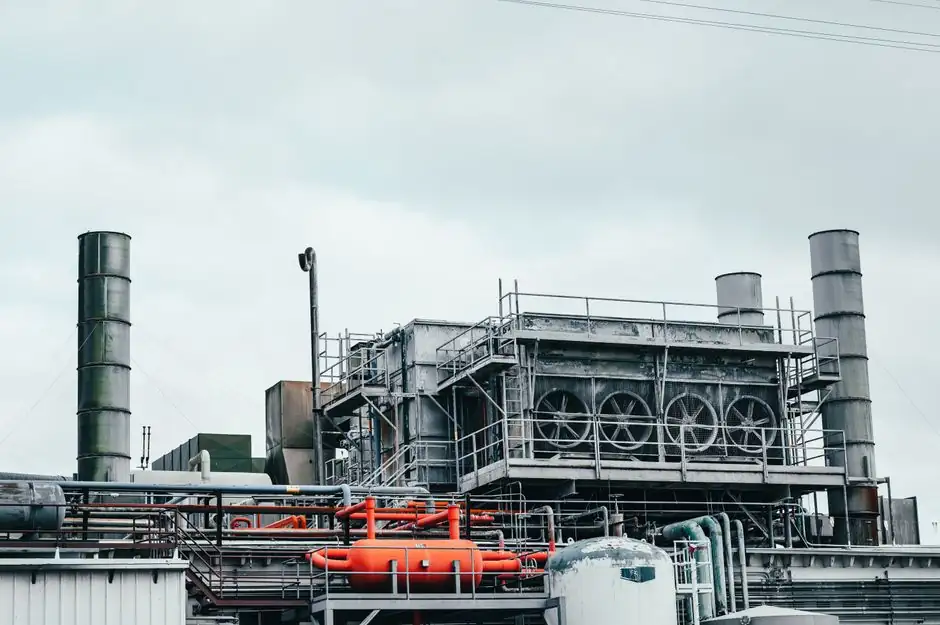
The industrial refrigeration system market is valued at USD 26.49 billion in 2026 and is forecast to reach USD 32.41 billion by 2031, expanding at a 4.12% CAGR [S4]. The top five manufacturers, Danfoss, Johnson Controls, GEA, Mayekawa Mfg., and Emerson, together hold approximately 20% of the market, with the remaining ~80% spread across Bitzer, Dorin, EVAPCO, Frick India, Howden, Ingersoll-Rand, Kirloskar Pneumatic, LEWA, M&M Systems, Rivacold, and regional specialists [S1].
By equipment class, compressors commanded 36.18% of 2025 market share while controls and automation are projected to grow at a 4.93% CAGR through 2031, the fastest of any equipment group [S4]. Rack systems represented 45% of system-type revenue in 2025, and installations above 1 megawatt of cooling capacity held a 39.73% share of the capacity segment in 2025 [S4][S9].
Refrigerant Mix: Ammonia 42.41%, CO2 Catching Up
Ammonia (NH3) accounted for 42.41% of the 2025 industrial refrigeration refrigerant market share, the largest single-refrigerant position [S4]. Carbon dioxide (CO2) systems are projected to advance at a 4.51% CAGR through 2031, propelled by the F-Gas and Kigali compliance timelines listed by regulators and by a documented +0.80% impact on overall CAGR from tightening deadlines [S4]. Ultra-low-charge NH3 and CO2 system adoption adds another +0.70% to the forecast CAGR, with early deployments concentrated in Europe, North America, and Australia [S4].
On the commercial side, hydrocarbon refrigerants (isobutane R-600a, propane R-290) are projected to grow at a 10.4% CAGR through 2030, the highest among refrigerant families tracked in the adjacent commercial segment [S3]. The shift away from high-GWP HFCs and HCFCs is reinforced by environmental rules in the EU and parts of North America, and is reshaping OEM product roadmaps. Specifiers working on new build or retrofit projects can reference the industrial refrigerant and gas-handling component map for material compatibility context on piping and vessel linings that carry these refrigerants.
Top 5 OEM Share: 20% Combined, Long Tail Holds the Rest
Danfoss, Johnson Controls, GEA, Mayekawa Mfg., and Emerson collectively control about 20% of the industrial refrigeration system market, leaving roughly 80% to a fragmented long tail of regional and application specialists [S1]. GMI's tracked OEM list includes Bitzer SE, Dorin S.p.A, Emerson Electric Co., EVAPCO Inc., Frick India Limited, GEA, Howden Group, Ingersoll-Rand Plc, Johnson Controls, Kirloskar Pneumatic Co. Ltd., LEWA GmbH, M&M Systems Inc., Mayekawa Mfg. Co. Ltd., Rivacold Srl, and Danfoss at the global level [S1].
In the broader commercial refrigeration segment, Haier Inc., Daikin, and Johnson Controls are identified as the star players by combined market share and product footprint, while startups such as SECOP GmbH, Elanpro, and Norlake are flagged for niche gains in specialised refrigeration niches [S3]. The Ali Group, Daikin Industries, Dover, Epta, and Haier Group also surface as named competitors in adjacent commercial-refrigeration tracking [S6]. Process engineers evaluating industrial camera and monitoring systems for cold-storage facilities should treat these OEM rankings as the supply-side baseline, because controls-platform interoperability (Modbus, BACnet, Ethernet/IP) often hinges on which compressor or condensing-unit vendor is already on site.
Regional Split: Asia Pacific 41.22%, MEA Fastest Growth

Asia Pacific generated 41.22% of 2025 industrial refrigeration revenue, the largest single regional share [S4]. The Middle East and Africa region is forecast to log the quickest regional CAGR at 5.23% through 2031, ahead of every other tracked geography [S4]. In the commercial segment, Asia Pacific is also projected to record the highest CAGR at 7.0% through 2030, against a global 5.6% commercial-refrigeration CAGR [S3].
North American growth in commercial refrigeration is being driven by new cold-chain logistics buildouts, frozen and packaged food uptake, and tighter food-safety rules; transportation refrigeration alone held a 32.1% share of commercial-refrigeration product revenue in 2024 [S3]. Americold Realty Trust's USD 127 million acquisition of a 10.7-million-cubic-foot cold storage facility in Houston, Texas in March 2025, adding 35,700 pallet positions on a 16-acre expansion footprint, is a concrete downstream signal of that build-out [S1].
Application Mix: Food & Beverage 34.39%, Data Centres Rising
Food and beverage processing led industrial refrigeration applications with a 34.39% revenue share in 2025 [S4]. Data centres and electronics cooling are projected to grow at a 4.82% CAGR through 2031, supported by green-hydrogen plants (+0.30% CAGR impact) and immersion-cooled data-centre demand for heat-reuse chillers (+0.50% CAGR impact) [S4]. End-uses named in the broader market tracking include cold storage, food processing, food retail, and large-scale HVAC, with rack systems as the dominant system architecture at 45% in 2025 [S9].
The commercial segment breaks down by end use into supermarkets and hypermarkets as the dominant channel, with food service applications also leading, while transportation refrigeration holds 32.1% of product-type share and multi-door cabinets dominate the door-type sub-segment [S3]. Cold-chain warehouse automation contributes a +0.90% uplift to industrial refrigeration CAGR forecasts, and AI-enabled predictive maintenance adds a further +0.60%, with both effects concentrated in Asia Pacific and North America [S4].
Supply-Side Constraints: Rare-Earth Magnets and Vertical Integration
Component shortages, especially rare-earth magnets used in variable-speed drives, are extending lead times and pushing leading vendors toward vertical integration [S4]. Steel and copper cost volatility is described as a direct input to hardware pricing, which is one reason suppliers are repositioning portfolios toward controls and digital services where margins are less exposed to commodity swings [S4].
Controls and automation revenue is expected to expand at a 4.93% CAGR through 2031, the fastest of any equipment group tracked, and that growth is tied to embedded IoT and AI-based monitoring on installed refrigeration skids [S1][S4]. The European HYCOOL project, which combines solar thermal energy with conventional refrigeration to cut carbon intensity, illustrates the direction of hybrid-system R&D among the major OEMs [S1]. Specifiers weighing industrial buzzer and alarm integration on new refrigeration packages should plan for Modbus/TCP or BACnet gateways as default, since controls-revenue growth is outpacing hardware growth and the controls tier increasingly defines vendor lock-in.
Spec Comparison: Industrial vs Commercial Refrigeration 2025-2031
Industrial and commercial refrigeration are tracked on overlapping but distinct baselines, and the table below lines them up against four decision criteria: 2025-2026 market size, forecast CAGR, dominant refrigerant, and leading OEMs by named share. [S3]
Industrial refrigeration: 2026 market size USD 26.49 billion [S4]; CAGR 4.12% to 2031 [S4]; dominant refrigerant ammonia at 42.41% share in 2025 [S4]; leading OEMs Danfoss, Johnson Controls, GEA, Mayekawa, Emerson, top 5 combined at ~20% [S1]. Commercial refrigeration: 2025 market size USD 51.26 billion growing to USD 67.31 billion by 2030 [S3]; CAGR 5.6% to 2030 [S3]; fastest-growing refrigerant hydrocarbons at a 10.4% CAGR [S3]; star OEMs Haier, Daikin, Johnson Controls [S3]. The two segments overlap on Johnson Controls but otherwise serve different capacity and refrigerant regimes, with industrial systems skewed above 1 MW and ammonia-heavy, commercial systems skewed to HFC/HFO/CO2 and hydrocarbons at retail scale.
Decision Criteria for Specifying Industrial Refrigeration Packages
For projects above 1 MW of cooling capacity, the 39.73% capacity-segment share of large installations makes ammonia-based screw or reciprocating compressor packages the default reference, with Bitzer, Howden, and Frick historically dominant in this tier [S1][S4]. For 100 kW to 1 MW systems, the highest projected CAGR of 5.11% through 2031 signals where vendor R&D is concentrated, and where CO2 transcritical or cascade packages are most likely to be cost-competitive [S4].
Specifiers should weight lifecycle cost over upfront cost, because predictive-maintenance-enabled ammonia or CO2 systems are explicitly described as trimming unplanned downtime, which dominates total cost of ownership on perishable-inventory sites [S4]. Compliance-driven retrofit work, where F-Gas and Kigali deadlines bite hardest, is concentrated in Europe and North America with spillover to Asia Pacific and is the primary near-term demand driver for ultra-low-charge systems [S4]. Adhesives, gaskets, and insulation on refrigerant piping and cold-store envelopes should be cross-referenced against operating temperature, and an industrial adhesive selection guide can help narrow chemistry options for sub-zero service.
Track three signals over the next two reporting cycles: (1) any OEM M&A or vertical-integration move tied to rare-earth magnet supply for variable-speed drive compressors, (2) updates to F-Gas and Kigali phase-down schedules that shift the ammonia/CO2 vs HFC payback crossover, and (3) data-centre heat-reuse chiller order intake from hyperscalers, since this application is the highest non-food growth vector at a 4.82% CAGR through 2031 [S4].