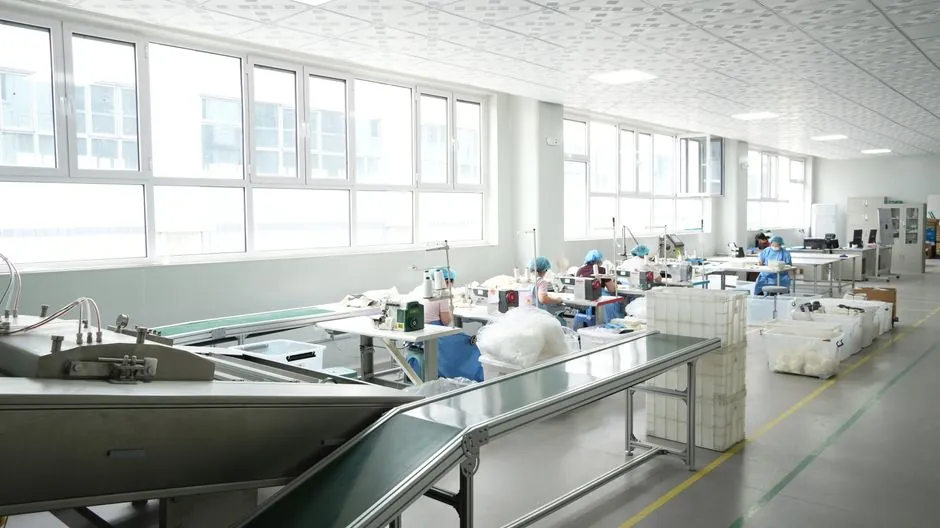
Industrial valve production line design in 2026 runs on three concrete pillars: body material range from grey and ductile cast iron through WCB carbon steel to duplex 2507, seat options from EPDM and PTFE through Stellite overlays on pressure-seal bonnets, and mandatory hydrostatic and seat-leakage tests against API 6D, API 600 and the European Pressure Equipment Directive 2014/68/EU [S1][S2][S3].
Grand View Research sized the global industrial valves market at roughly USD 80.4 billion in 2025, with Asia Pacific holding the largest regional revenue share and oil and gas remaining the dominant application segment, a market shape that pushes most new lines toward API-spec gate, globe and trunnion ball capacity [S2]. For a line builder, that translates into body sizes from 1/2″ to 36″, pressure classes from 150 to 1500, and dual certification (API plus PED) as the default export configuration.
Body Material and Casting Stage Specifications
Industrial valve production line design starts at the foundry: grey cast iron and ductile cast iron handle general service, while carbon steel (WCB, A105), alloy steel (WC6, WC9, C5 chrome-moly) and stainless grades (CF8M, 2205, 2507 duplex) cover higher pressure and corrosive service [S1][S2][S3]. A typical 2026 layout pairs hot forging presses for small-bore bodies with precision casting lines for large-bore trunk valves, then routes blanks to multi-axis CNC lathes and vertical machining centers that hold flange and sealing-surface tolerances inside the bands defined by ASME B16.34 and the corresponding API specifications [S3]. Disc and stem components in butterfly lines are routinely specified in 304 or 316 stainless to prevent oxidation, with seat materials chosen from EPDM, PTFE and Viton for soft-seated service [S1]. The combination determines the line's metallurgy island, melt batch size and post-casting heat-treatment capacity.
Seat and Sealing System Options Across Service Classes
Seat selection is the line's most temperature-sensitive decision: EPDM and PTFE begin to lose dimensional stability under sustained high temperature and can be damaged by flashing, cavitation or abrasive particulates, so metal-seated product paths are the default for power-generation, refining and high-temperature petrochemical service [S2]. Common 2026 hard-facing choices include full Stellite overlay on wedge and seat sealing surfaces, optional Stellite seats on triple-offset butterfly designs (BOV303), and PTFE/RTFE, Monel or combined PTFE-plus-stainless-steel seats on high-performance butterfly lines (BPV302) for fire-safe and high-temperature isolation [S2]. The trade-off is precise: Stellite extends cycle life and erosion resistance at the cost of higher spindle torque, which then dictates the actuator sizing island of the line. Engineers comparing PTFE vs Stellite seats should weigh the upper temperature limit of PTFE (commonly around 200 to 260 °C depending on grade) against Stellite's tolerance of much higher continuous service temperatures and abrasive media, with the resulting actuator torque swing commonly spanning a 1.5× to 3× ratio between the two ends.
Machining, Assembly and Actuator Integration
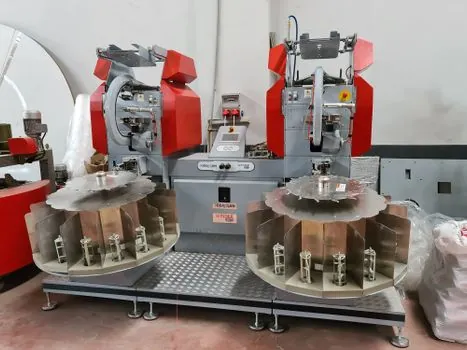
After casting, the precision machining division takes over: multi-axis CNC lathes, vertical machining centers and automatic lapping equipment process sealing surfaces, spherical components and flange connecting ends, holding dimensional tolerance inside the international pipeline standard bands [S3]. For U-type butterfly valves, the machining stage must deliver a smooth 0° to 90° rotation range with minimal friction so operating torque stays low and the actuator is not oversized [S1]. The actuator island is typically built in-house rather than outsourced, covering electric, pneumatic and manual gear units with adjustable torque, signal feedback and protection grades, which removes third-party integration risk and lets the line tune the actuator to each seat/hardfacing combination [S3]. This staging also supports the automatic molding line selection for hardware manufacturing decisions upstream, where casting yield and feeder placement set the throughput ceiling for the rest of the line.
Hydrostatic and Seat-Leakage Test Stations
Every modern valve line ends at a dedicated test center: hydrostatic shell tests for body integrity, bidirectional seat leakage detection for soft- and metal-seated assemblies, fire-safe verification per API 607 / ISO 10497 where specified, and actuator linkage performance inspection [S3]. Rated test pressures align with the body classes the line builds, most commonly PN10, PN16, CLASS 150, CLASS 300, CLASS 600, CLASS 900, CLASS 1500 and the corresponding ASME B16.34 groupings, and a fully open butterfly should produce minimal turbulence with straight-line flow for optimal system performance [S1][S2]. For low-emission service, the test cell also has to handle soft-graphite or low-leakage packing systems that target fugitive-emission classes defined under API 624 / ISO 15848-1, which is now a frequent line-build requirement for hydrocarbon and chemical customers [S2]. A practical rule for line sizing: the test station should match the bottleneck station of the line, because hydrostatic cycling at 1.5× the rated cold pressure on every unit is what gates shipment.
Standards Mapping and Certification Stack
A 2026 export-grade valve line carries a layered certification stack: ISO 9001 for the quality system, ISO 45001 for occupational health and safety, API 6D for pipeline valves (ball, check), API 600 for gate and globe, CE marking under the European Pressure Equipment Directive 2014/68/EU, and fire-safe accreditation to API 607 / ISO 10497 where soft-seated units go into hydrocarbon service [S2]. Forged- and cast-body pressure-seal gate and globe designs (e.g. GTP002, GLP107) sit on top of this stack, with a Stellite overlay on the sealing surface and a self-sealing bonnet that is pressure-energized rather than gasket-dependent, which raises both the allowable pressure class and the test pressure the line must be able to deliver [S2]. Lines that also supply actuation typically add ATEX 2014/34/EU coverage for explosive-atmosphere gear, especially when the EU absorbs the largest single slice of export volume; EG Valves reports roughly 80% of output going to the EU, North America, Latin America and the Middle East combined [S2].
Throughput, Footprint and Capacity Planning Inputs
Capacity planning starts from a stated annual output, not a market aspiration: EG Valves reports a 27,500 m² facility, about 300 staff including 30 engineers, and roughly 90,000 pieces per year, which works out to an order-of-magnitude benchmark of 300 pieces per m² per year when a line is dedicated to a narrow product mix [S2]. Footprint allocation typically follows the mass-flow rule, with raw material and forging/casting taking the largest share, machining next, and assembly and test absorbing the balance, while the industrial valve production capacity planning numbers must also account for actuator in-house assembly, paint and packaging cells. When the line is mixed across gate, globe, ball, butterfly and check valves, the practical throughput drops because changeover time between product families dominates; this is the single biggest reason Chinese OEMs with a focused product mix tend to publish higher per-person output than plants running a broad catalogue on shared equipment [S3]. A line builder should therefore lock the SKU matrix and pressure-class matrix before finalizing takt time, otherwise the test station, not the machining center, becomes the real bottleneck.
Selection Criteria: Who This Line Architecture Is For
This production architecture fits OEMs targeting export-grade oil and gas, power generation, chemical, water and mining customers that demand dual API/PED certification and hard-seating capability [S2]. It is less suitable for very small job shops that only run cast-iron wafer butterfly valves for municipal water, where the certification overhead, Stellite hardfacing cell and in-house actuator island cannot be amortized across the order book [S1]. Buyers comparing Chinese OEM valve lines should weigh four decision criteria: (1) certification breadth (ISO 9001 + API 6D + API 600 + PED vs ISO 9001 only), (2) material range (WCB through duplex 2507 vs WCB only), (3) seat options (Stellite + PTFE + low-emission packing vs PTFE only), and (4) test capability (hydrostatic + bidirectional seat + fire-safe vs hydrostatic only) [S2][S3]. A line that fails two of those four will struggle to win process-industry RFQs outside its home region regardless of price, and the industrial valve manufacturing equipment guide spec map lays out the equipment-side counterpart to this checklist.
Trackable near-term signals to watch: any new API 600 / API 6D audit cycle outcomes for Chinese OEMs shipping into the EU, the next Grand View Research update to the USD 80.4 billion 2025 industrial valves market figure, and the next revision of ISO 15848-1 low-emission classes that will reset the fugitive-emission test envelope for soft-seated valves in hydrocarbon service [S2].
For component-level specifications, see molding line, automatic molding line, and conveyor sorting line.