
Specifying an industrial wireless module starts with three non-negotiables: protocol band (sub-GHz vs 2.4 GHz), EMC/safety certification scope, and operating-temperature window. Get any one wrong and the BOM cost you saved on the module evaporates inside a six-month field return cycle.
The 2026 market is dominated by three radio families — LoRa/SX1262-class sub-GHz, Bluetooth 5.x LE, and 5G NR RedCap — with Wi-Fi HaLow (802.11ah) and Zigbee still holding retrofit niches. Each family maps cleanly onto a different duty cycle, payload size, and battery-life target, and the shortlist is built on those three axes, not on brand preference.
Protocol Band and Physical-Layer Trade-Offs
2.4 GHz modules — BLE 5.4, Zigbee 3.0, Thread/Matter — push 2 Mbps PHY rates and sub-millisecond latency, but free-space range with a chip antenna collapses to 30–80 m once a steel cabinet attenuates the link by 18–25 dB.
5G NR RedCap (Release 17/18) closes the gap: 150 Mbps peak, 10 ms latency, and 1.61 GHz–6 GHz band support, with module pricing falling toward the $40–60 band in 2026 — still roughly 4× a comparable LoRa module but justifiable when the application needs video or firmware OTA larger than 1 MB. For battery-pumped field instruments the radio choice almost always reduces to LoRa or BLE; anything else is a power-budget mistake.
Receiver Sensitivity, Output Power, and Link Budget
A SX1262-class LoRa receiver sits at −137 dBm at SF12/BW125 kHz; a BLE 5.4 SoC (nRF52840 class) quotes −103 dBm at 1 Mbps. That 34 dB sensitivity gap is the single largest reason sub-GHz wins on outdoor pipe-rail and tank-farm duty, and the single largest reason 2.4 GHz wins on indoor conveyor and AGV duty where antenna co-existence is dense.
For a +20 dBm TX, 3 dBi antenna, and 137 dBm floor, the link budget lands at 143 dB plus antenna gains minus path loss — a number that converts directly to roughly 3–5 km urban non-line-of-sight at 868 MHz with a 1.5 m AGL whip. Push the same budget to 2.4 GHz and the same terrain delivers 200–400 m. Engineers who spec 2.4 GHz modules for outdoor tank farms are almost always fixing a real link with a $300 outdoor directional antenna, when a $9 sub-GHz module would have closed the gap on its own.
Operating Temperature, Enclosure, and Industrial Hardening

Industrial-grade modules are graded −40 °C to +85 °C junction, with a storage window of −55 °C to +125 °C. Anything rated 0–70 °C is consumer-grade and will fail inside an unenclosed motor cabinet within two summer cycles. Conformal coating (Humiseal 1A33 or 1B73) plus a fully filled shielding can adds roughly 8–12% to the unit cost and is the minimum bar for IP65 dust/moisture exposure. [S2]
For Zone 2 / Class I Div 2 hazardous areas the certification stack compounds: ATEX 2014/34/EU (EN 60079-0, EN 60079-11 for intrinsic-safety radios), IECEx, and North American UL 121201 / CSA C22.2 No.213. A "module-only" certificate is not enough — the integrator must hold the system-level certificate covering antenna, cable gland, and enclosure. Buying a non-certified module and assuming the end-product cert covers the radio is the most expensive spec error in this category, and it surfaces at the end of a six-month project, not at the BOM review.
Power Budget and Sleep Current
Battery duty separates the credible module vendors from the rebranded consumer parts. SX1262 in deep-sleep draws 0.2–1.5 µA; an nRF52840 System OFF is 0.3 µA; an NR RedCap module in PSM/eDRX can hit 5–15 µA. A 19 Ah lithium-thionyl pack (Saft LSH20) at 50 µA average draw delivers 43 years of theoretical life — but only if the host MCU and sensor stack are inside the same micro-amp envelope.
If your sensor sampling rate is below 1 Hz, your radio sleep current is the dominant energy variable, not the TX pulse. Spec the module for sleep current first, sensitivity second, output power third — in that order. Vendors who publish sleep numbers as "typical 2 µA" without a junction-temperature footnote should be deprioritised; the typical figure at 25 °C can double at 85 °C junction and that doubles your battery-replacement visit count.
Antenna, Connector, and Mechanical Footprint
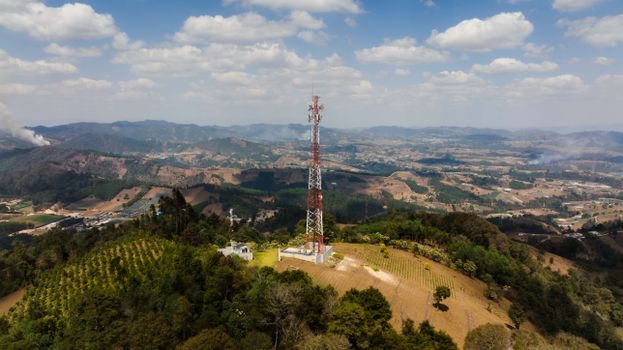
The four standard RF connectors in industrial modules are: U.FL/IPEX MHF (1.6 mm, 6 GHz max, board-mount), SMA female bulkhead (chassis-mount, weatherproof), RP-SMA (Wi-Fi convention), and MMCX (low-profile, vibration-prone). For fixed outdoor plant, a chassis-mount SMA with a weatherproof gasket and a fiberglass collinear ($15–40) is the only honest answer; U.FL jumpers fail at the joint within 12–24 months in high-vibration plants.
Footprint is the silent spec killer. The market has consolidated around two dominant form factors: the Ebyte/Santec 16×27 mm DIP and the Nordic/Quectel 10×15 mm castellated edge. Pin-compatible second-source is rare, so locking into a single vendor's footprint raises the design-in risk. Cross-check the industrial camera or industrial buzzer ecosystem of the same vendor — buying radio + sensor + actuator from one supplier shortens the EMC paperwork by roughly four weeks.
Protocol Gateway, TCO, and Lifecycle
The radio module is half the cost; the protocol gateway, cloud seat, and OTA infrastructure are the other half — and the half buyers underestimate. A LoRaWAN module at $6.50 needs a gateway ($180–650), a network server (free TTN, or $0.40/device/month on a commercial stack), and an application server. A 5G RedCap module at $45 needs a data plan ($1–4/month per device), a private 5G core, or a public APN. Run the five-year TCO before you run the unit cost. [S1]
Lifecycle matters more than BOM cost in industrial buyers. Nordic promises 10+ years on nRF52/nRF53; Semtech SX1262 is on a confirmed production run past 2030; Quectel publishes PCN 12 months ahead of EOL. A module on a vendor's "last-time-buy" list at 30% off is not a bargain — it is a 24-month timer on your entire fleet. When you compare a Protocol Gateway Price & Cost Guide 2026: Spec Bands and TCO Drivers line item against a module line item, the right ratio is roughly 1:6 to 1:10 over a ten-year window; anything tighter means you are under-investing in the gateway.
Selection Shortlist by Application

Outdoor tank farms, irrigation, and pipeline SCADA → sub-GHz LoRa (SX1262/SX1276) at 868/915 MHz, IP65 enclosure, SMA bulkhead, ATEX/IECEx if hydrocarbon duty. Indoor conveyor, AGV, and tooling fixtures → BLE 5.4 SoC (nRF52840/nRF5340) with chip antenna, 0–70 °C OK if inside a cabinet, meshed via Bluetooth Mesh 1.1 if the cell count exceeds 40. High-bandwidth remote telemetry, video, OTA-heavy fleets → 5G NR RedCap (RG255C, BG95-S5) with eDRX/PSM, $40–60 module, public or private APN. Retrofit lighting/HVAC/thermostat duty where Wi-Fi already exists → Zigbee 3.0 or Thread/Matter module, $4–8, 100 mW peak. [S1]
Skip sub-GHz if your deployment is indoors, payload is over 1 KB/event, and the cabinet density is high — the sensitivity advantage evaporates and the 1% EU868 duty cap becomes a real throughput ceiling. Skip 5G RedCap if your device count exceeds 500 per site and your per-device OPEX budget is under $0.50/month — the data plan alone wipes out the LoRa OPEX advantage. For 2026 builds in brownfield plants, a thermostat selection criteria: a spec-driven engineer's reference for 2026 project that pairs BLE-modulated thermostats with a LoRaWAN backbone is the dominant retrofit pattern, not a single-radio design.
Closing: the next trackable signals to watch are the Q4 2026 release of Bluetooth 6.0 channel-sounding modules (cm-level ranging, expected sub-$5) and the 2027 Wi-Fi 8 / 802.11bn certification wave for industrial 6 GHz radios. Both will shift the indoor/AGV shortlist, not the outdoor sub-GHz and RedCap lineups which are now stable on published roadmaps through 2030.