
Inferential acceptance procedures can produce decision errors of p<0.05 for false rejection and p<0.10 or p<0.20 for missed deviations, while online analyzers measure material continuously under defined process conditions [S1][S2].
The comparison covers statistical inference, online sampling, inline measurement, atline analysis and offline laboratory analysis, with the correct choice determined by required accuracy, response time, sample condition and control-loop consequences.
Accuracy Is More Than Statistical Confidence
A measurement system can be precise without being accurate. In the documented example, repeated readings of a 200 mg reference tablet were 205.54, 205.43 and 205.03 mg: the readings agreed closely with one another but remained about 5 mg above the true value [S3].
Accuracy decomposes into bias, linearity and stability, while precision decomposes into repeatability and reproducibility. Bias compares measurements with a reference, linearity tests performance across the measurement range, and stability tracks drift over time [S3].
The distinction matters for inferential measurement because a narrow confidence interval does not remove systematic bias. Bradley and Brand evaluated an acceptance procedure with a type 1 error of p=0.05 and type 2 error of either p=0.20 or p=0.10. For effect sizes d=0.20, 0.50 and 0.80, the resulting values were approximately 15% or 6.25% larger than the entered effect sizes, depending on the type 2 error rate [S1][S5].
Compare Measurement Architecture by Decision Needs
Inferential procedures estimate whether an observed change is meaningful; online analysis performs a direct measurement using a representative process sample [S1][S2]. The two methods therefore answer different questions, and substituting one for the other without validation creates an avoidable control risk.
For a screening model, statistical inference offers a fast decision when historical distributions, effect sizes and acceptable error probabilities are established. For a closed-loop composition control, a direct online analyzer is the stronger architecture because it measures the property relevant to the process and supports continuous feedback [S2][S4].
Online analysis extracts a representative sample from the process line and introduces it to the measurement zone under conditions that closely resemble the process [S2]. Atline analysis removes a sample and transfers it to a nearby analyzer, while offline analysis sends a sample to a laboratory. The latter two approaches offer more control over analysis, but introduce delay and may miss transient changes [S2].
Inline analysis places the analyzer directly in the process line so sample material flows continuously through the measurement zone. Malvern Panalytical describes inline analysis as suited to lean-phase flow with low particle concentrations, and online analysis as suited to dense-phase flow with high particle concentrations [S2]. These operating descriptions apply to particle-size measurement and should not be transferred without qualification to every analyte.
Use Inferential Measurements for Screening, Not Automatic Truth
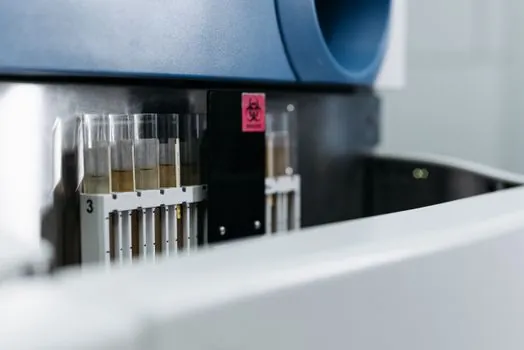
Inferential acceptance procedures are appropriate when the output is a decision such as pass, hold or investigate. Bradley and Brand describe them as approximations in which a decision can be made, rather than direct physical measurements [S1][S5].
A Monte Carlo procedure set the type 1 error at p=0.05 and the type 2 error at either p=0.20 or p=0.10 for effect sizes of d=0.2, 0.5, and 0.8, producing resultant values approximately 15% and 6.25% larger than the entered effect sizes, respectively [S1].
The acceptance boundary depends on the decision objective. A type 1 error falsely rejects the null hypothesis, while a type 2 error fails to reject it when the alternative should be supported. Reducing the type 2 error from p=0.20 to p=0.10 reduced the approximation error from approximately 15% to 6.25% enlargement of the effect size while the type 1 error remained fixed at p=0.05 [S1][S5].
Use inferential measurement for early warning, batch disposition support, anomaly ranking and process adjustment recommendations. Do not present its output as a calibrated concentration when customers, emissions records or safety decisions require traceable composition evidence. For an inferential model with direct analyzer reference data, a gas analyzer can provide an independent comparison stream during validation.
Use Online Analyzers When the Control Loop Requires Direct Evidence
Online and inline analysis support continuous monitoring and real-time process control because the measurement occurs near the process condition rather than after laboratory transport [S2]. Energy Tech describes its online analyzer products as no-contact and non-destructive process measurements [S4].
Direct analyzer selection depends on the measured property and application. An online water analyzer applies to aqueous process streams, an ammonia analyzer addresses ammonia concentration, and a hardness analyzer addresses water hardness. These are distinct measurement tasks, so analyzer method, range, sample condition and output uncertainty must match the application rather than being selected from resolution alone.
Inline instruments suit continuous flow through the measurement zone, while online instruments can use a controlled side stream and may return the analyzed sample or discard it [S2]. Inline installation reduces sample-delivery ambiguity but brings fouling, pressure drop, pipe compatibility and maintenance exposure into the process line. Online extraction isolates the instrument, yet adds sample conditioning, representativeness and transport delay.
Atline analysis can serve multiple lines sequentially when rapid response is not required or laboratory-style control is needed. Offline analysis offers the highest control over laboratory conditions, but its delay makes it unsuitable for detecting short process excursions [S2].
Validate Accuracy Against a Reference Method

Do not accept agreement between two inferential outputs as proof of accuracy. A validation program should compare the model or analyzer with a traceable reference, cover the operating range and include repeated measurements, known changes and representative process disturbances. [S2]
Start with a gauge linearity and bias study, or a type 1 gage study, to assess closeness to a true value. Use a crossed, nested or expanded gage R&R study to assess repeatability and reproducibility [S3]. At minimum, record bias, linearity, repeatability, reproducibility, stability and the combined uncertainty used for control limits.
For inferential systems, define type 1 and type 2 error limits in operational units, not only as p-values. The published Monte Carlo case tested p=0.05 type 1 error with p=0.20 and p=0.10 type 2 error at d=0.20, 0.50 and 0.80 [S1]. Adapt those values to the cost of false action versus missed action, then confirm performance on the actual process.
For direct analyzers, challenge installation and sample conditioning using at least low, nominal and high process conditions, plus representative upset conditions. Compare online results with validated laboratory or atline samples and investigate bias before accepting the analyzer for feedback control [S2][S3].
Account for Cost, Latency and Lifecycle Constraints
Inferential measurement usually offers lower hardware complexity than a direct online analyzer because it estimates a property from measured variables, but it carries model and data costs. The direct analyzer requires capital for the instrument, sample system and installation, plus recurring expense for reagents, calibration, consumables, fouling control and maintenance. [S2]
Latency changes the economic comparison. Atline and offline measurements can support occasional checks and sample-preparation workflows, while online and inline analysis supports continuous monitoring [S2]. An inferential system can provide fast output if its input sensors and model execution are continuous, so response time must be measured across the entire signal chain.
The total-cost decision should include false decisions, analyzer availability, calibration burden, maintenance labor, energy or reagent consumption and the consequence of process drift. An hydrazine analyzer, for example, is appropriate only where the required property is hydrazine; an inferential surrogate may monitor a correlated trend, but the surrogate should not be relabeled as a direct hydrazine measurement without validation.
Select by Use Case and Acceptance Evidence

Choose an inferential measurement when the required output is a classification or early-warning decision, representative reference data exist, the false-action and missed-event costs are acceptable, and model drift can be monitored. Choose an online analyzer when continuous concentration evidence, closed-loop control, emissions reporting or product release depends on the measured property. [S2]
Choose inline analysis when continuous flow and rapid response outweigh installation and maintenance exposure. Choose online side-stream analysis when direct measurement is required but isolation, conditioning or sample return is preferable. Choose atline analysis for frequent checks with controlled preparation, and offline analysis for laboratory-controlled measurements, intensive sample preparation or non-continuous product qualification [S2].
No statistical approximation removes the need to define what accuracy means. Document the reference method, range, repeat count, bias, uncertainty, response time, drift and error criteria. Where inferential output supports a safety or regulatory decision, direct analyzer evidence or a validated laboratory method should establish the release value.
Track false-action rate, missed-event rate, bias, calibration status, analyzer availability and model drift after commissioning. Re-run the comparison whenever the process range, sample matrix, sensor configuration or analyzer installation changes.