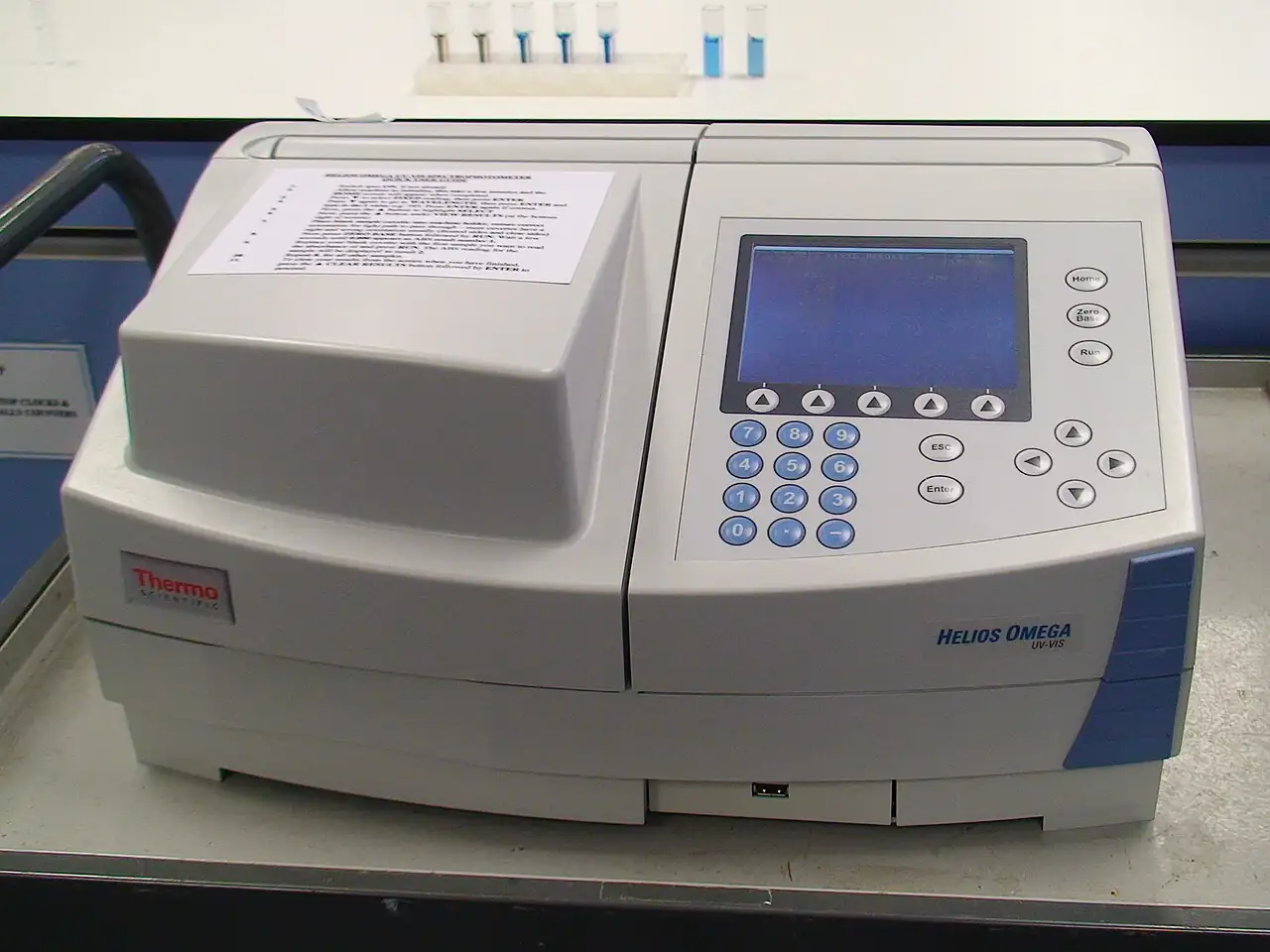
An online hydrazine analyzer is a continuous wet chemistry monitor that measures residual hydrazine, N2H4, the oxygen scavenger dosed into boiler feedwater and condensate, at single digit ppb through mg/L concentrations. Plant documents list it as an online hydrazine monitor and the control room calls it a hydrazine meter, but the measurement is one specific thing: residual scavenger converted to a defensible number every 5 to 15 minutes on a conditioned flowing sample. A dedicated instrument exists because hydrazine residual is a control variable, not a curiosity: underfeed lets dissolved oxygen attack feedwater heaters and economizers, overfeed wastes chemical and raises the ammonia that attacks copper alloys, and in once-through service the scavenger itself decomposes into the ammonia that carries the pH program. The analyzer closes the loop between the dosing skid and the chemistry it was bought to hold.
Procurement engineers meet these analyzers in power station chemistry rooms, in industrial boiler houses running all volatile treatment, and in closed hot water loops where hydrazine protects against oxygen ingress year round. The decision this page settles is narrow and practical: which method, colorimetric or amperometric, carries the ppb duty; which stream and which alarm band the cabinet must cover; how the hot pressurized sample is conditioned before the cell sees it; and what reagent, standard, and service logistics ownership actually costs per year. The answer lands as an RFQ line set: stream, range, method, sample conditions, outputs, interlock to the dosing pump, and the standards the measurement traces to.
This page treats the hydrazine analyzer as a purchasing object: the PDAB colorimetric chemistry and the amperometric cell behind the residual number, the ranges and cycle times of the shipping families, the sample conditioning discipline that makes the reading honest, and how all of it is written into an RFQ. It is written for engineers who issue purchase specifications, not for readers who want a brochure summary.
Chapter 1 / 06
What a Hydrazine Analyzer Is and What Is Being Decided
A hydrazine analyzer is a small automated chemistry line with a photometer or an electrolytic cell at the end of it. Conditioned sample arrives from the cycle, reagent is metered in or the sample passes a sensing electrode, and the cabinet converts the developed signal into a residual hydrazine concentration reported on 4 to 20 mA and Modbus. The reaction being supervised is written in one line: hydrazine plus oxygen yields nitrogen and water, with a stoichiometric mass ratio close to 1 to 1, so the dosing skid feeds scavenger at slightly above oxygen demand and holds the remainder as residual. That residual is the controlled variable. All volatile treatment reducing programs hold it in the 10 to 100 ppb class on drum boilers, while once-through and supercritical units ride a trace residual because most of the injected hydrazine decomposes to ammonia inside the boiler, and that ammonia is what carries the pH program downstream.
Residual is a control variable because both directions of error cost money and equipment. Underfeed leaves dissolved oxygen active in the feedwater train, and oxygen pitting in economizers and condensate lines is a tube failure mechanism with a long written history. Overfeed wastes chemical directly and indirectly: excess hydrazine decomposes to ammonia, and ammonia bearing condensate attacks the copper alloys still installed in many condensers and feedwater heater bundles. Plants with copper alloy feedwater trains therefore cap residual deliberately, and the cap is enforced with a measurement, not with a dosing calculation. The analyzer closes the loop that the metering pump alone cannot see: the pump meters what it is told, and only the residual reading says what the chemistry actually did with it.
What is being decided in this purchase is five commitments at once. First, the stream commitment: economizer inlet feedwater, deaerator outlet, condensate return, or a closed loop header, because the stream sets both the range and the sample conditions. Second, the range commitment: a 10 to 100 ppb control band needs a low range instrument, while closed loop dosing control may need mg/L spans, and mixing both on one cabinet compromises one of them. Third, the method commitment: colorimetric PDAB chemistry with its reagent logistics, or an amperometric cell with its service schedule. Fourth, the sample chain commitment: boiler feedwater arrives hot and pressurized, and a sample conditioning system must cool it below about 40 deg C and let it down to a few bar before the wet end sees it. Fifth, the operations commitment: reagent bottles and standards have shelf lives, consumption rates, and delivery schedules, and an analyzer whose consumables are exotic in the plant's geography is a future outage. A quotation that answers only the range line is a box price, not a measurement.
The instrument lives among the cycle chemistry siblings, and this page does not replace them. A silica analyzer guards the neutral species that volatilizes with steam and deposits on turbine blades; a sodium analyzer marks cation slip when a condenser tube leaks or a polisher exhausts; neither sees a scavenger residual. A dissolved oxygen meter measures the other side of the same reaction, the oxygen the hydrazine was dosed to remove, and the two readings together close the mass balance on the program. A phosphate analyzer carries the drum boiler treatment program, and an ammonia analyzer tracks the decomposition product that both feeds pH and threatens copper alloys. Farther upstream, a residual chlorine analyzer and a TOC analyzer watch raw water and makeup organic load, and the workhorse proxy for everything ionic is a conductivity meter on cation exchange, flanked by a pH meter and an ORP meter on the same panel. All of these share one sample conditioning system in a chemistry room, which is why the panel is bought as a system and the hydrazine channel is one instrument on it. The catalog umbrella is the online water analyzer family, a taxonomy term rather than a measurement equivalence, and the laboratory referee for this species is the bench spectrophotometer running the same colorimetric chemistry by hand.
Compressed to one sentence, the decision is whether a defensible continuous ppb hydrazine number is bought as a system, stream and range matched to the program, method matched to the maintenance culture, sample chain matched to the boiler, and reagent logistics matched to site reality, or as a cabinet part number connected to the nearest hot line. The chapters that follow supply the chemistry, the hardware families, the datasheet rows, the selection logic, and the failure modes needed to write it the first way.
Chapter 2 / 06
How Residual Hydrazine Measurement Works
The colorimetric method rests on one condensation reaction. Para-dimethylaminobenzaldehyde, PDAB, in acidic medium condenses with hydrazine to form a yellow azine complex whose absorbance peaks at about 455 to 460 nm; the photometer reads that absorbance through a fixed path length, and the Beer Lambert relation in words says absorbance scales linearly with concentration when path length and chemistry are held constant. The wet end holds them constant by metering a fixed sample volume with a peristaltic pump, adding a fixed reagent volume, letting color develop for a fixed time at a stabilized temperature, and reading the cell against a zero reference taken between determinations. Everything else in the cabinet exists to keep those four fixed quantities fixed. The method earns its dominance at ppb because absorbance at these wavelengths is stable, the chemistry is specific enough for the high purity matrices of feedwater and condensate, and the list of plausible interferents in those matrices is short and known.
The optical bench is deliberately simple: a lamp or LED at the measuring wavelength, a filter, a flow cuvette, and a detector, often with a reference channel that watches the source so lamp aging divides out of the reading. Auto zero between determinations is not a luxury feature; it is the drift correction that keeps a ppb span credible over months, and a datasheet that does not state the zeroing scheme is silent on the main error source. Reagent arrives in bottles consumed on a months scale, and the peristaltic tubing that moves sample and reagent is a wear item with a defined service interval, typically 3 to 6 months across the family. Sample temperature is stabilized or compensated because development kinetics shift with temperature; a swing of a few deg C across the day shows up as a slow undulation on the trace when the cabinet does not control it, and that signature is worth recognizing on any historian plot.
The amperometric method skips the reagent. Hydrazine is electroactive and oxidizes at a noble metal working electrode held at an applied potential; the faradaic current is proportional to hydrazine concentration in a flowing cell, and the analyzer reads it continuously or on a short cycle. The attractions are real: no PDAB bottles, no development time, seconds class response rather than a 5 to 15 minute cycle, and a simpler wet end. The costs are equally real: the working electrode fouls in service, the cell needs electrolyte and surface service on a schedule, and the low ppb margin erodes as the electrode ages. Both methods ship today, and the honest summary is that colorimetry dominates at ppb steam cycle duty while amperometric cells hold ground where reagent logistics are painful and the control band sits higher.
The family numbers, stated as ranges rather than promises: low range colorimetric spans run about 0 to 200 ppb, extended ranges reach about 0 to 5 mg/L for closed loop and commissioning duty, cycle time runs 5 to 15 minutes per determination, and accuracy lands at 2 to 5 percent or a few ppb, whichever is larger in the working band. Detection at the bottom of the span is honest only on a healthy wet end with fresh reagent, which is why the verification schedule in chapter 6 is part of the specification and not an operational afterthought. Response time to a process step is the cycle time plus transport delay from the tap, and both terms belong in the commissioning record rather than in a footnote.
Calibration runs against check standards on a programmed interval, with the zero corrected automatically between determinations. Verification is layered against the laboratory: grab samples run by the PDAB reference family of ASTM D1385 on a bench spectrophotometer, monthly to quarterly, keep the online number honest, and the correlation belongs in the chemistry file. Two disciplines protect the data: trend the slope and intercept of every automatic calibration, because drift there is a maintenance signal weeks before it is a data problem, and verify the zero after any wet end service, because a disturbed zero after a tubing change is the classic wrong reading that looks perfectly authoritative. A datasheet quoting accuracy without stating the calibration and verification regime behind it is quoting a number, not a capability.
Chapter 3 / 06
Analyzer Types, Construction, and Duty Boundaries
The single stream colorimetric cabinet is the reference construction and the form most steam plants buy. One conditioned stream feeds a wet end of peristaltic metering, reagent bottles, a development cell, and a photometer, packaged in an IP54 class wall or floor enclosure on 100 to 240 VAC; the SWAN AMI Hydrazine family is the reference execution of this architecture, and its datasheet lines, range, cycle time, reagent volume, outputs, are the format competing quotations should be made to answer. Nothing in the wet end changes state between determinations except the metering itself, so the trace is a steady stair with one point per cycle, and the response to a residual step is one cycle time plus transport delay. For a single important stream this is the honest purchase, and everything else in this chapter is a variation on it.
Multi stream versions sequence several points through one wet end with a solenoid valve on each line, and the latency arithmetic is the same as every wet chemistry monitor: four streams at a 10 minute cycle update each point every 40 minutes, which suits cycle chemistry trending and starves a fast dosing loop. Plants that need both buy the dedicated single stream on the line that trims dosing and let a sequenced cabinet carry the survey points. Carryover rinse between streams is the hidden cost: a high residual point bleeds into the next determination unless the plumbing flushes between selections, and sequenced cabinets earn or fail their keep on this detail alone, which is why the solenoid valve seat and the flush sequence belong in the maintenance plan from day one.
The amperometric execution earns its place on closed hot water loops and on sites where reagent delivery is unreliable. Residuals there run higher, mg/L class rather than ppb, the electrode margin is comfortable, and the absence of bottles outweighs the service schedule; the Waltron 9072 and 3044 hydrazine analyzer families serve boiler and feedwater duty of this class among others, and the RFQ rows in this chapter apply to them unchanged. Dosing commissioning is another natural duty: the instrument watches what the metering pump actually delivered through the loop while the program is set up, then settles into trend duty for the rest of its life. What the amperometric cell should not be asked to carry is the low ppb action band on a once-through unit; that is colorimetric territory, and the datasheets that blur this line are the ones to file under rework.
The comparison table compresses the families into the form a specification meeting argues from; values are the common spans of the established families and must be confirmed against the model datasheet before order.
Family
Method and cycle
Range class
Duty it wins
Single stream colorimetric cabinet
PDAB photometry, 5 to 15 min cycle, auto zero
0 to 200 ppb class low range
Feedwater and condensate residual control
Extended range colorimetric
Same chemistry, dilution or longer path
Up to about 0 to 5 mg/L
Closed loop dosing and commissioning
Multi stream sequenced cabinet
Shared wet end, solenoid switched streams
Per stream ranges at commissioning
Chemistry room survey of 2 to 6 points
Amperometric cell cabinet
Electrochemical oxidation, continuous or short cycle
ppb to mg/L by cell class
Reagent free duty and closed hot water loops
Duty boundaries keep the families honest against each other and against the rest of the panel. The colorimetric cabinet wins the ppb steam cycle duty outright. The sequenced cabinet wins cost per point wherever update latency is acceptable. The amperometric cell wins where bottles are the problem and the range is friendly. None of the four measures oxygen, ammonia, silica, or sodium, and the selection chapter places each of those sibling measurements where it belongs rather than leaving the boundaries to a supplier's interpretation.
Chapter 4 / 06
Key Specification Parameters
The datasheet rows below decide whether a quoted analyzer matches the duty; values are stated as the common industrial spans of the established families and must be confirmed against the model datasheet before order.
Attribute
Typical range or options
What it decides
Measuring method
PDAB colorimetric, or amperometric cell
Reagent logistics, service culture, ppb fitness
Range
0 to 200 ppb low range class; extended to about 5 mg/L
Alarm band placement and dosing authority
Accuracy
2 to 5 percent or a few ppb, family class
Margin against the program action band
Cycle time
5 to 15 min per determination
Latency from a chemistry event to an alarm
Sample flow
20 to 100 mL/min, steady
Conditioning hardware and fast loop sizing
Sample temperature
15 to 40 deg C window
Cooler sizing and shelter needs
Calibration
Automatic zero between runs, check standard interval
Traceability and drift visibility
Reagent set
PDAB reagent, zero, standard; months shelf life
Consumption rate and delivery logistics
Outputs and protocol
4 to 20 mA, Modbus, high and low residual alarms
DCS integration and dosing interlock
Enclosure and power
IP54 class typical; 100 to 240 VAC
Siting in the chemistry room or shelter
The range and accuracy rows deserve a paragraph because they are quoted optimistically. The low ppb floor of a datasheet belongs to a fresh wet end, new tubing, fresh reagent, clean cell, in a temperature stable shelter; the honest planning number for a cabinet two years into service is the range floor with stated accuracy, not the detection floor with asterisks. Buy margin for the stream that matters: a 10 to 100 ppb control band sits comfortably inside a 0 to 200 ppb span on a healthy instrument, but a once-through unit riding a trace residual with a 2 to 5 ppb action band demands the premium end of the span and a disciplined verification cadence. State each stream with its own range and alarm bands in the RFQ; one span for a whole multi stream cabinet compromises either the fast stream or the wide one.
The sample chain rows decide uptime more than the analyzer does, and the table below states the practical spans with the reasoning that connects them.
Sample chain parameter
Practical span
Logic
Sample cooling
Cooled below about 40 deg C at the analyzer
Development kinetics, reagent stability, and tubing ratings are temperature bounded
Pressure letdown
Line pressure reduced to a few bar at the wet end
Steady flow at the cell and safe tubing and drains
Fast loop
High flow to the panel, low consumption at the cell
Heat traced runs, tracing drained through a steam trap
Freeze protection without flooding the shelter
Waste drain
Drain sized for continuous flow, reagent bearing
Spent sample carries acid and reagent to drain
The conditioned line deserves its own instrumentation, because the reading assumes conditions that only instruments can prove. A temperature transmitter and a pressure transmitter on the conditioned line confirm the two variables the chemistry and the flow regulation depend on, and a flow meter with local indication catches the silent starvation a pinched line produces before it becomes a bad data month. Integration closes the specification: each stream carries its own 4 to 20 mA output or a mapped Modbus register set, with high and low residual alarms routed to the chemistry monitor or DCS, and with the low alarm interlocked to raise the scavenger metering pump and the high alarm to hold it back. Diagnostic states, reagent low, sample fault, calibration failed, must page the same way the measurement does; an analyzer that alarms only on its own front panel is a liability dressed as an instrument.
Chapter 5 / 06
Selection Decision Factors and RFQ Language
The selection sequence runs as a checklist, and each line eliminates a class of quotations before price comparison begins.
Name the stream and the program: economizer inlet feedwater on an all volatile reducing program, deaerator outlet, condensate return, or a closed loop header, with the target residual band written down before any datasheet opens.
Fix the range against that band with margin: a 10 to 100 ppb program takes a 0 to 200 ppb class span; a trace residual once-through program takes the premium low end; a closed loop takes mg/L spans.
Fix the method against site logistics: colorimetric PDAB for ppb duty where reagent delivery is routine, amperometric where bottles are the problem and the range is friendly.
State the alarm bands and the interlock intent: low residual raises the dosing pump, high residual holds it back, and the trim loop must be slower than the analyzer cycle.
Characterize the sample at the tap: temperature, pressure, flow available, distance to the cabinet, and the conditioning hardware each tap needs.
Demand the verification evidence: automatic zero scheme, check standard interval, response time at duty flow, and reagent consumption at the offered stream count.
Fix the integration: outputs per stream, protocol, alarm routing, diagnostic paging, and data logging if chemistry reports are audited.
Add the siting lines: enclosure rating, power, drain capacity, freeze protection, and a first year spares kit of reagent, standard, and tubing.
Against the neighboring measurements the hydrazine channel holds specific ground, and the comparison belongs here in the selection chapter rather than in a page title. A silica analyzer is the sibling purchase on the other side of the steam purity problem: silica volatilizes and coats turbines, hydrazine never leaves the water phase in surviving form, and a plant running both knows both halves of the story. A sodium analyzer detects condenser leakage and polisher slip; it says nothing about scavenger residual, and residual says nothing about cation slip. A dissolved oxygen meter measures the other side of the same reaction, and the pair together say whether the program is winning. An ammonia analyzer watches what excess hydrazine becomes at temperature, which is exactly the overfeed signature the residual alarm is set to prevent on copper alloy trains. A phosphate analyzer belongs to the drum treatment program, a residual chlorine analyzer to the raw water and cooling side, and a TOC analyzer to the organics the makeup train admits. A conductivity meter on cation exchange is the cheap continuous proxy that integrates every ionic contribution and resolves none of them, a pH meter verifies the program the residual feeds, and an ORP meter reads the oxidizing state the scavenger exists to suppress. The online water analyzer page is the catalog umbrella over the whole family, the spectrophotometer is the laboratory referee running the reference colorimetry, and the metering pump is the actuator the whole measurement exists to trim. Nothing on the list substitutes for the residual channel, and the residual channel substitutes for nothing on the list.
The application map below compresses the practice into the form a project file carries.
Application
Construction to specify
Check before order
Drum boiler AVT(R) program
Single stream colorimetric on economizer inlet, alarms to dosing
Residual band placement and pump trim authority
Once-through and supercritical trace residual
Premium low range colorimetric, tight validation cadence
Most residual decomposes to ammonia; pair with ammonia monitoring
Condensate return protection
Single stream on deaerator outlet or polisher outlet
Transport delay from the tap at duty flow
Closed hot water loop
Amperometric cell or extended range colorimetric
mg/L band, temperature swings, service access
Dosing skid commissioning
Fast method near the pump discharge header
Correlation of pump stroke to measured residual
The RFQ block should be written once and reused: quantity and family; stream count with each point named, its range, and its alarm bands; method with the reasoning stated so suppliers can challenge it honestly; accuracy and detection at the tightest stream with the calibration regime behind them; response time to a residual step at the offered flow; reagent and standard consumption estimate with shelf life and storage conditions; sample conditions at each tap with the conditioning hardware offered; outputs, protocol, alarm routing, and the dosing interlock intent; wetted materials of the wet end; enclosure rating and power; and the verification method and frequency against the laboratory. A quotation returned without the response time measured at duty flow, or without the reagent logistics answered in bottles per quarter, is incomplete at any price.
Chapter 6 / 06
Installation, Standards, Failure Modes, and Maintenance
Installation is a conditioning exercise before it is an instrument exercise. The sample conditioning system that feeds the analyzer brings each feedwater or condensate sample down from line conditions through a cooler to below about 40 deg C and a regulator to a few bar, with isolation, a fast loop to keep transport delay short, and a drain arrangement that lets the section be serviced. Taps must be representative: economizer inlet for feedwater residual, deaerator outlet or condensate polisher outlet for return protection, each routed so events reach the cell rather than age in tubing. A solenoid valve at the analyzer inlet isolates the wet end for service, a flow meter with local indication on the conditioned line proves the sample alive, and a temperature transmitter plus a pressure transmitter complete the condition record the chemistry assumes. In freezing exposures the shelter traces its sample lines and drains the tracing through a steam trap, and that trap belongs on the winter inspection round, because a failed one announces itself as a frozen and split sample line after the first hard cold snap.
Commissioning earns the trust the datasheet claims. Run the first check standard and record the slope and intercept, verify the automatic zero, and confirm the reagent consumption rate against the datasheet at the actual stream count. Step the analyzer with a check standard at duty flow and record the true response time, cycle time plus transport delay; if this instrument was bought to trim dosing, that step response is the number that matters, not the catalog floor. Verify every alarm path, reagent low, sample fault, calibration failed, by forcing it once, and verify the 4 to 20 mA scaling end to end into the DCS, including the low residual interlock that raises the metering pump and the high residual state that holds it back. A commissioning record with those six lines turns the first chemistry audit into a formality.
The standards frame is method, sampling, and guidance based. ASTM D1385 is the PDAB colorimetric reference method family for hydrazine in water, the chemistry the online cabinet automates and the basis laboratory verification of grabs traces to. ASME PTC 19.11 governs how steam and water samples are taken, transported, and conditioned, which is as decisive for the number as the analyzer itself. The residual limits the measurement defends come from cycle chemistry guidance, with EPRI and VGB instructions carrying the action levels, trace residual bands on once-through plant and the 10 to 100 ppb class on drum programs, that the alarm setpoints are built from. Citing method, sampling practice, and guidance together in the RFQ tells the supplier the buyer knows the number is a chain, not a box.
Failure modes follow a short and predictable list. Reagent exhaustion is the dangerous one: as PDAB reagent runs out or ages past shelf life, the developed color weakens and the computed residual walks toward zero, reading exactly like good chemistry, so reagent low alarms must be wired and the consumption rate confirmed at commissioning. Photometer drift shows as slow baseline movement between automatic zeros; the auto zero absorbs it until it cannot, and a trended slope catches it early. Sample temperature swings outside the compensation band add a daily undulation to the trace. Bubbles at low flow read as transient steps, remedied with vertical runs and a trap. Particulate carryover into the cell scatters light and biases absorbance, which is what the upstream filtration in the conditioning train exists to prevent. On amperometric cabinets, electrode fouling shows as falling span between services, and the maker's service kit restores it; on sequenced cabinets, a leaking solenoid valve seat cross contaminates a low residual stream with the previous high residual point, which is the classic false alarm on chemistry panels. And the wrong zero after wet end maintenance is the failure every technician has met: it looks authoritative, and only a forced check standard exposes it.
Maintenance is deliberately boring and budgeted in consumables. Weekly: reagent and standard level check, alarm review, and the logged slope of the last automatic calibration. Monthly: response spot check with a check standard, cuvette and wet end cleanliness, drain inspection. Quarterly: full calibration with fresh standard, tubing replacement on the peristaltic pumps at or before the 3 to 6 month interval, and a grab verification against the laboratory. Spares held on site: one reagent set and one standard within shelf life, one tubing kit, one cuvette or cell seal set, and the electrode service kit on amperometric cabinets. The throughline of this page is that an online hydrazine monitor is a small chemistry plant that produces data: fed with conditioned sample, live reagent, and a validation schedule, it holds its stated class for years, and starved of any of the three it produces numbers that look exactly as authoritative as good ones.
FAQ
What hydrazine residual range should the analyzer cover?
Match the range to the program the plant runs. Drum boiler all volatile treatment programs hold hydrazine residual in the 10 to 100 ppb class, so a low range colorimetric analyzer spanning roughly 0 to 200 ppb covers the control band with margin for excursions. Closed hot water loops and dosing commissioning work at higher residuals, where extended ranges to a few mg/L fit. State each stream with its own range and alarm bands in the RFQ rather than one span for the whole plant.
Which method carries ppb feedwater duty, colorimetric or amperometric?
Both methods ship today, and colorimetric dominates at ppb. PDAB colorimetry develops a yellow azine complex read at about 455 to 460 nm, giving low ppb detection with well understood interference behavior, at the cost of reagent bottles and peristaltic tubing that must be managed. The amperometric cell oxidizes hydrazine at a working electrode with minimal reagent logistics, but the electrode demands periodic service and loses margin as it fouls. For steam cycle residuals, colorimetric is the default answer.
What sample flow and temperature does the analyzer need?
A steady 20 to 100 mL per minute at 15 to 40 deg C is the family window, delivered by a sample conditioning system that cools and depressurizes the hot line first. Flow stability matters as much as the number itself: the wet end meters fixed volumes, so a wandering flow shifts the reagent to sample ratio and the answer with it. Bubbles read as steps, so vertical runs and a bubble trap are standard practice.
How is the analyzer calibrated and checked?
Established cabinets run an automatic zero between determinations to correct photometer drift and accept a check standard on a programmed interval to verify slope. Verification is layered against the laboratory: grab samples run by the PDAB reference method family of ASTM D1385 on a bench spectrophotometer, on a monthly to quarterly cadence, keep the online number honest. Record the slope and intercept of every automatic calibration and trend them; drift is a maintenance signal before it is a data problem.
What does reagent exhaustion look like in the data?
A flatline, which is the dangerous failure. As PDAB reagent runs out or ages past shelf life, the developed color weakens and the computed residual walks toward zero, reading exactly like good chemistry. The analyzer cannot tell an empty bottle from a clean sample, so reagent low alarms must be wired and the consumption rate confirmed at commissioning. Count reagent bottles as consumables with a delivery schedule, not as a one time purchase.
Can the analyzer trim the dosing pump directly?
Yes, and that is the point of the residual measurement. The analyzer reports 4 to 20 mA and Modbus to the DCS, with high and low residual alarms that the control scheme interlocks to the scavenger metering pump: low residual raises stroke or speed, high residual backs it off. Keep the trim loop slower than the analyzer cycle time, five to fifteen minutes per determination, or the loop chases its own tail.
Which standards govern the measurement?
ASTM D1385 is the PDAB colorimetric reference method family for hydrazine in water that the online chemistry automates, and laboratory verification of grabs traces to it. Sampling practice follows ASME PTC 19.11 for steam and water sample handling, which decides whether the number means anything as much as the analyzer does. The residual limits themselves come from cycle chemistry guidance, with EPRI and VGB instructions carrying the action levels the alarms defend.