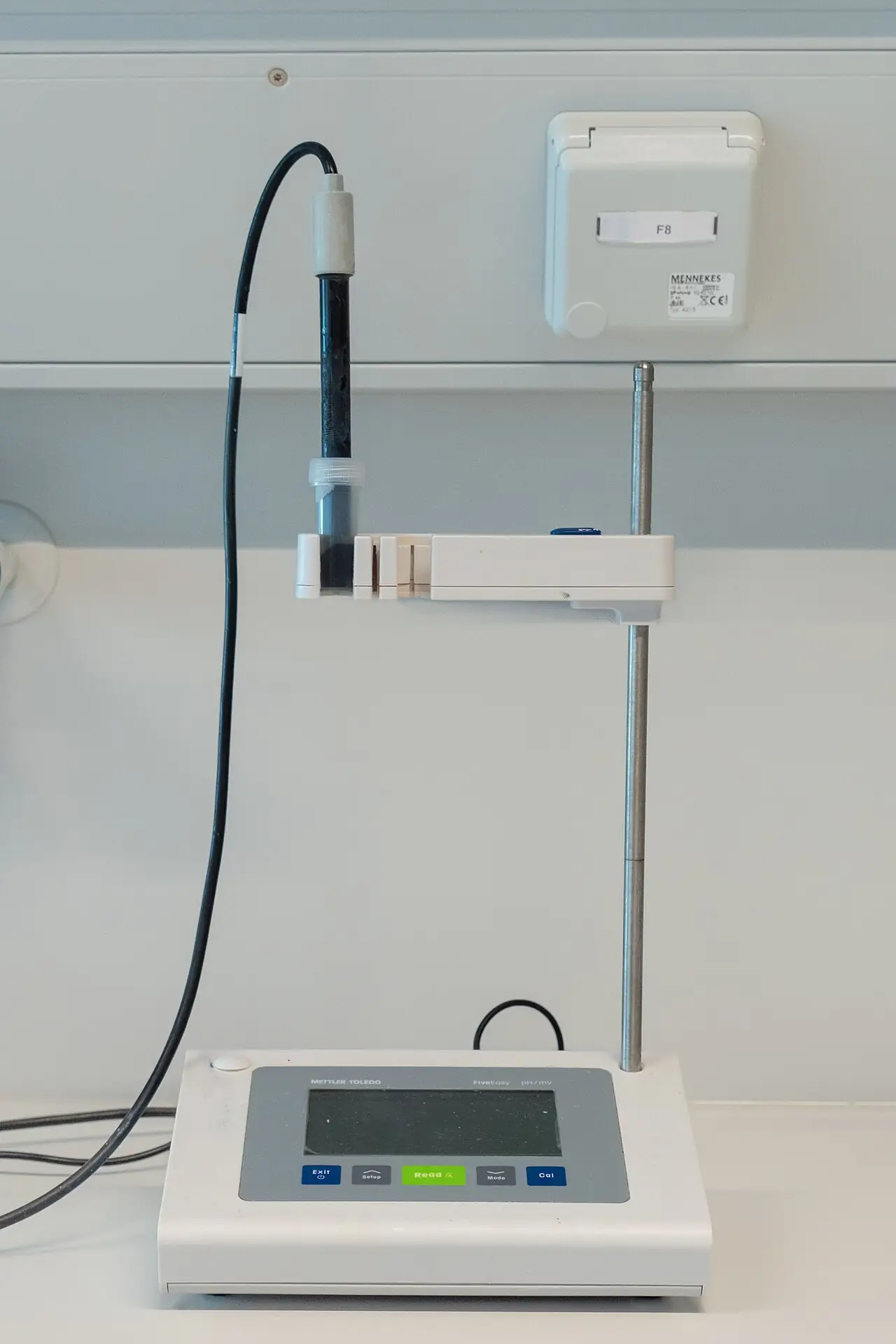
An ammonia analyzer is an online wet chemistry or electrochemical instrument that measures the ammonia nitrogen content of a water stream continuously and reports it to a control system. What it actually quantifies is the sum of dissolved free ammonia, NH3, and ionized ammonium, NH4+, and the reporting convention matters: regulatory limits and most instrument ranges are written as NH4-N, nitrogen as ammonium, in milligrams per liter, so a conversion is required whenever a permit, a datasheet, and a chemistry textbook are open on the same desk. Multiply an NH4-N value by 1.29 to express it as the ammonium ion and by 1.22 to express it as free ammonia; an analyzer quoted in one basis and operated in another is off by a fifth before the first calibration. Established families cover ranges from 0.01 to 1000 mg/L with detection down to a few micrograms per liter on photometric versions.
Procurement engineers meet the online ammonia monitor, sold variously as an ammonium analyzer or an NH3 analyzer, on wastewater aeration control where ammonia based blower trimming saves 10 to 25 percent of aeration energy against dissolved oxygen control alone, on effluent discharge compliance against total nitrogen limits in the 1 to 10 mg/L class, on river and reservoir source water watch, and on condensate and demineralizer polishing protection. The decision this page settles is which measurement method, gas sensing electrode or colorimetric or direct ion selective probe, matches the sample cleanliness and the reporting duty, what the sample conditioning chain must deliver, and what the reagent logistics cost per year. The answer lands as an RFQ line set: species and reporting basis, range, method, sample conditions, reagent consumption, outputs, and the evidence trail behind the number.
This page treats the ammonia analyzer as a purchasing object: the chemistry behind gas sensing electrode and indophenol blue or salicylate colorimetry, the honest detection limits and cycle times of each family, what the sample conditioning chain and the reagent cabinet really demand, how the measurement is validated against the laboratory, and how all of it is written into an RFQ. It is written for engineers who issue purchase specifications, not for readers who want a brochure summary.
Chapter 1 / 06
What an Ammonia Analyzer Is and What Is Being Decided
The instrument is a small chemical plant with a signal output. Sample is extracted from the process, conditioned to a steady flow and temperature, dosed with one to three reagents or passed over an electrode, and the resulting color or potential is converted to a concentration every few minutes. The two species it sums, free NH3 and ionized NH4+, sit in an equilibrium that swings with pH: below pH 8 essentially everything is ammonium, and above pH 11 essentially everything is dissolved ammonia gas, which is precisely the shift the electrode methods exploit. The analyzer reports total ammonia nitrogen on one of three bases, NH4-N by regulatory convention, NH4+ ion, or NH3, and the basis line belongs in the first row of the datasheet because the three numbers differ by 20 to 30 percent at the same water.
What is being decided in this purchase is four commitments at once. First, the method commitment: a gas sensing ammonia electrode tolerates dirtier samples with minimal reagent, photometric indophenol blue or salicylate chemistry reaches the lowest detection limits but demands a clean filtered sample and a reagent supply chain, and a direct ion selective probe needs neither reagents nor a sample system but carries interference and drift behavior that suits trend duty more than compliance duty. Second, the stream commitment: how many points feed one cabinet and with what sequencing interval. Third, the sample chain commitment: filtration degree, flow, temperature stability, and transport delay from tap to cell. Fourth, the operations commitment: reagent delivery cadence, tubing service, check standard schedule, and the validation discipline against the laboratory that keeps the reported number defensible. A quotation that answers only the range line is a box price, not a measurement.
The control value is what pays for the instrument. In activated sludge plants, ammonia based aeration control trims blower output to the actual pollutant load rather than to a fixed dissolved oxygen setpoint, and reported savings of 10 to 25 percent of blower energy against dissolved oxygen control alone are the norm rather than the exception; the ammonia signal closes the loop that a dissolved oxygen meter can only support, since oxygen tells you the state of the tank while ammonia tells you the state of the work. On the compliance side, total nitrogen limits in the 1 to 10 mg/L class leave no room for weekly grab samples: the permit argument needs a continuous record with calibration history. Source water watch for rivers and reservoirs and condensate polishing protection close out the application set.
The instrument lives among analytical siblings, and the RFQ should name the boundaries. A pH meter is the cheapest continuous proxy in the train: nitrification consumes alkalinity and moves pH, but it says nothing about species or mass, and it cannot substitute for an ammonia number any more than an ORP meter can, whose redox millivolts summarize the whole oxidation state of the basin without isolating ammonium. A conductivity meter reads ionic strength and misses the ammonia question entirely. A turbidity meter reports effluent solids, a downstream quality variable. In the laboratory, the spectrophotometer is the referee: the same indophenol chemistry run on a bench with a cuvette validates the online number with a delay of minutes to hours. A gas analyzer measuring NH3 slip at a stack or an SCR outlet works on a flue gas matrix and shares vocabulary but no hardware with this page. A moisture analyzer belongs to solids water content work and is mentioned only to fix the family boundary.
Compressed to one sentence, the decision is whether a defensible continuous ammonia nitrogen number is bought as a system, method matched to sample cleanliness, stream count matched to the cabinet, reagent logistics matched to site reality, and validation matched to the permit, or as a cabinet part number connected to the nearest hose. The chapters that follow supply the chemistry, the hardware families, the datasheet rows, the selection logic, and the failure modes needed to write it the first way.
Chapter 2 / 06
How the Measurement Chemistry Works
The gas sensing ammonia electrode is a pH measurement wearing a raincoat. The sample stream is dosed with sodium hydroxide to push pH above 11, which converts essentially all ammonium to dissolved free ammonia; the ammonia gas diffuses through a hydrophobic membrane into a small volume of internal electrolyte, where it dissolves, shifts the internal pH, and that shift is sensed electrochemically. The membrane is the whole trick: it passes gas and rejects ions, so color, suspended solids, and most ionic interferences that would wreck a direct electrode never reach the sensing element. The cost of reagent is one bottle of caustic, response settles in a few minutes, and family ranges run 0.01 to 1000 mg/L as NH4-N. The membrane is also the maintenance item: fats and oils coat it, and service life of 6 to 12 months is the budget line.
The colorimetric families measure light absorption of a dye built from the ammonia itself. In the indophenol blue chemistry, the Berthelot reaction, the sample is dosed with hypochlorite and phenol or, in the modern mercury free variant, salicylate, under alkaline conditions; ammonia chloraminates, condenses, and oxidizes to an indophenol dye, the reaction is accelerated by heating, and a photometer reads the blue color at 640 to 700 nm. Two to three reagent bottles, a reaction heater, and a photometer cell turn a cloudy question into a stable absorbance number with detection down to about 0.002 mg/L NH4-N on established analyzers. The demand is a clean sample: solids scatter light and consume reagent, so filtration and settling ahead of the cell are not optional, and a stream whose solids a turbidity meter would flag needs a stronger sample treatment than a clarifier effluent does.
The direct ion selective electrode is the third chemistry and the cheapest to operate: an ammonium sensitive membrane immersed in the basin or in a bypass, no reagents, no digestion, continuous signal. Its weakness is selectivity. Potassium and, to a lesser degree, sodium perturb the ammonium response because their hydrated ions behave similarly at the membrane, so potassium correction is applied where the probe drives control, and drift over weeks is the expected behavior rather than the exception. The honest role of the ISE probe is trend and control input in aeration basins, where the loop needs speed and rough proportionality; it is not a compliance instrument, and plants that treat it as one are borrowing trouble at reporting time.
Timing decides whether the number can close a loop. A photometric determination cycles in roughly 5 to 15 minutes from dose to readout, a gas sensing electrode settles in minutes, and a direct probe responds in seconds, but the governing delay is usually the sample transport: the time for water to travel from the process tap to the analyzer cell. A fast loop, a high velocity recirculation line that keeps fresh sample moving past the analyzer takeoff, is the standard cure, with total transport delay held below roughly 5 minutes so the control system is trimming blowers against this hour's load rather than the previous hour's memory. Loop tuning that ignores transport delay is the most common reason an ammonia based aeration strategy disappoints.
The sample chain is a real subsystem and it belongs in the purchase. The sample conditioning system delivers filtered, flow regulated, temperature stable water to the analyzer: filtration to 20 to 100 micron ahead of the cell, constant sample flow in the 0.2 to 1 L/min band, pressure reduced from line conditions to something the tubing tolerates, and temperature held steady because both chemistries have temperature dependent reaction rates and slopes. Flow must be confirmed, not assumed: a cheap paddle wheel flow meter on the fast loop or a dedicated flow meter on the analyzer feed catches the silent starvation that a peristaltic pump failure produces. The fast loop returns to the process at a lower pressure point so the sample is always new.
Chapter 3 / 06
Analyzer Types, Construction, and Duty Boundaries
The wet chemistry cabinet is the compliance workhorse. Construction is a wall or floor enclosure, IP54 to IP66 by site, containing a sample handling section, a reagent dosing section with peristaltic or solenoid metering pump drives feeding 0.5 to 3 L reagent bottles, a reaction and measurement section with heater and photometer or electrode module, and a controller with display and communications. Power is 110 or 230 VAC with 24 VDC options; outputs are 4 to 20 mA plus Modbus or PROFIBUS plus relays for alarms and interlocks. The Hach Amtax sc and the Endress+Hauser CA80AM are the reference constructions of this family, photometric analyzers with bottle racks, automatic calibration, and a service calendar, and the smaller NH6000sc class compresses the same chemistry into a lighter duty package for single streams.
The gas sensing electrode panel analyzer trades the lowest detection limits for reagent economy and sample tolerance. One caustic bottle does the work of two or three photometric reagents, the membrane rejects the solids and color that would blind a photometer, and the analyzer itself is a smaller cabinet: dosing pump or solenoid valve feed, temperature stabilized flow cell with the electrode, and a millivolt to concentration converter. Its natural duties are the dirtier intermediate points in a wastewater train, reject and return liquors, digester supernatant, sidestream treatment, where a photometric analyzer would spend its life fighting filters. The price is the membrane service interval and a detection floor of roughly 0.01 mg/L, which is irrelevant on wastewater and disqualifying on clean water polishers.
The ion selective immersion probe is the third configuration: a probe in a basin or a bypass tee, a holder, and a two wire or digital transmitter, with no sample system, no reagents, and no cabinet. It is bought for speed and simplicity in control duty, positioned mid basin or in the aeration mixed liquor channel, cleaned and calibrated on a weekly discipline. Multi parameter variants host the ammonium membrane beside other sensors on one platform, which is how many aeration trains are actually instrumented: ammonium and nitrate probes alongside the dissolved oxygen instrumentation, all feeding the blower controller. The probe never carries the permit number; it carries the control loop.
The comparison table compresses the families into the form a specification meeting argues from; values are the common spans of the established families and must be confirmed against the model datasheet before order.
Method family
Chemistry and reagents
Range and detection class
Sample and service demands
Colorimetric wet chemistry cabinet
Indophenol blue or salicylate with hypochlorite, heater, photometer at 640 to 700 nm; 2 to 3 bottles
0.002 to 80 mg/L NH4-N class, vendor typical
Clean filtered sample, 20 to 100 micron filtration; monthly reagent and tubing service
Tolerates dirtier samples; membrane 6 to 12 months; caustic handling
Direct ion selective probe
Ammonium membrane, no reagents, immersion or bypass mounting
0.1 to 500 mg/L class with potassium correction
Weekly cleaning and calibration; trend and control duty, not compliance
Laboratory spectrophotometer reference
Same indophenol or salicylate chemistry on the bench, cuvette photometry
Method detection to low microgram per liter class
Grab sample, minutes to hours delay; validates the online number
Duty boundaries keep the families honest against each other. The photometric cabinet owns the compliance measurement wherever the sample can be made clean and the detection limit matters: effluent monitoring against milligram per liter and sub-milligram permits, source water watch, polisher outlet. The electrode panel owns the dirty sidestream and recycle points where reagent logistics and filter plugging decide uptime. The probe owns the aeration control loop where speed beats absolute accuracy. And a plant that buys a photometric cabinet for a digester filtrate line has bought a filter maintenance contract; a plant that buys a probe for the outfall has bought a permit violation argument. Match the family to the point, not to the preference.
Chapter 4 / 06
Key Specification Parameters
The datasheet rows below decide whether a quoted analyzer matches the duty; values are stated as the common industrial spans of the established families and must be confirmed against the model datasheet before order.
Attribute
Typical range or options
What it decides
Species and reporting basis
NH4-N default; NH4+ or NH3 stated on request
Whether analyzer, permit, and chemistry textbook agree
Measuring range
0.01 to 1000 mg/L by family; 0.02 to 80 typical photometric
Coverage of both sidestream peaks and permit level lows
Detection limit
About 0.002 mg/L photometric; about 0.01 mg/L electrode
Usability at sub-milligram permit levels
Cycle time
5 to 15 min per determination, photometric families
Loop speed against process and transport delay
Sample flow and pressure
0.2 to 1 L/min constant; reduced to a few bar maximum
Sample conditioning chain sizing and tubing life
Sample temperature
5 to 45 deg C typical window, family dependent
Reaction rate stability and shelter requirements
Reagent set
1 bottle electrode, 2 to 3 bottles photometric, 0.5 to 3 L each
Annual reagent volume, storage, and delivery cadence
Outputs and protocol
4 to 20 mA, Modbus, PROFIBUS, relays, alarm contacts
Integration to blower control, SCADA, and permit records
Enclosure and power
IP54 to IP66; 110/230 VAC, 24 VDC options
Siting outdoors, in shelters, or in classified areas
Calibration and validation
Automatic check standard weekly; lab validation monthly
Defensibility of the reported number at audit time
The reagent row deserves a paragraph of its own because it is the row that becomes an operating budget. A photometric analyzer consumes its reagents per determination, not per calendar: a two stream analyzer cycling every 10 minutes runs roughly 100,000 determinations a year, and bottle consumption of a set every 1 to 3 months is the working planning number on established families, so the annual purchase is four to twelve reagent sets plus standards plus spares. Salicylate chemistry is preferred over the older phenol formulations for the mercury free waste stream, and caustic and hypochlorite for the electrode and chloramine steps are commodity chemicals with their own handling rules. Shelf life of 3 to 12 months by reagent, refrigeration requirements, and the supplier's standing order cadence belong in the RFQ answers, because an analyzer waiting on a courier is an analyzer producing flat lines.
The sample chain rows decide uptime more than the analyzer does, and the table below states the practical spans with the reasoning that connects them.
Sample chain parameter
Practical span
Logic
Filtration ahead of cell
20 to 100 micron, self cleaning preferred
Photometer cells and electrode membranes die by solids
Sample flow at analyzer
0.2 to 1 L/min, held constant
Dosing ratios and reaction times assume steady flow
Transport delay
Below 5 min tap to cell via fast loop
Control loop must not chase stale sample
Temperature stability
Held within a few deg C, monitored
Reaction rate and electrode slope move with temperature
Pressure at the analyzer
Reduced and monitored, typically 1 to 3 bar
Tubing, valves, and cell ratings; leak detection
Flow confirmation
Paddle wheel or dedicated indication with alarm
Starved sample reads a confident wrong number
Waste handling
Drain to effluent or neutralization per site rules
Spent reagent with salicylate is the easy case
Integration rows close the specification. The 4 to 20 mA outputs feed the SCADA or the blower controller directly, relays carry the high and low alarms plus reagent and fault states, and Modbus or PROFIBUS carries the diagnostic depth: reagent level, tube hours, last calibration, current check standard recovery. Where the aeration strategy runs closed loop, the interlock path matters, whether the trim acts on the blower guide vanes through the plant control system or stages a chemical dose through a metering pump. Companion instruments share the panel in practice: a temperature transmitter value documenting the sample condition, a pressure transmitter confirming the regulated feed, and on the process side an electromagnetic flowmeter on the return activated sludge line closing the mass arithmetic that turns a concentration into a load. Compliance installations add data logging with tamper evident history, because the permit argument is won with records, not with instantaneous values.
Chapter 5 / 06
Selection Decision Factors and RFQ Language
The selection sequence runs as a checklist, and each line eliminates a class of quotations before price comparison begins.
State the duty honestly: compliance measurement, aeration control, source watch, or polishing protection, because the family choice follows the duty, not the budget line.
Fix the reporting basis, NH4-N unless the permit says otherwise, and require the quotation to state basis, range, and detection limit in that basis.
Characterize the sample: solids and fat load, salinity, temperature and pressure at the tap, chlorination state, and the distance to the analyzer.
Choose the method family with the chapter 3 table: photometric for clean low level points, electrode for dirty sidestreams, probe for basin control speed.
Fix the stream count and sequencing: number of points, determination interval per stream, and the worst case reporting latency that results.
Specify the sample chain: filtration degree, fast loop, flow 0.2 to 1 L/min, transport delay below 5 minutes, and flow confirmation with alarm.
Fix the reagent logistics: bottle set size, monthly consumption estimate, shelf life, storage conditions, and the standing delivery arrangement.
Add the evidence lines: automatic check standard interval, laboratory validation method and frequency, and the compliance logging the record must survive.
Against the neighboring instruments the ammonia analyzer holds specific ground, and the comparison belongs here in the selection chapter rather than in a page title. The pH meter and the ORP meter are the cheap continuous proxies on the same train, and they earn their panel positions: alkalinity consumption and redox state corroborate nitrification health, but neither isolates ammonium, and no calibration turns a proxy into a species measurement. The dissolved oxygen meter is the partner, not the competitor, of ammonia based aeration control: oxygen holds the basin condition while the ammonia signal trims the blower energy to the load, and the 10 to 25 percent savings claims are built on that pairing. A conductivity meter on the same effluent records the ionic backdrop but says nothing about the nitrogen species the permit counts, which is why it rides along on the panel without ever answering this question. The spectrophotometer is the laboratory referee whose monthly comparison keeps the online number honest. A gas analyzer on stack NH3 slip answers a flue gas question with different hardware. A moisture analyzer answers a solids question with no connection to this duty. A turbidity meter watches the outfall solids that carry the ammonia fraction away. On the hydraulic side, an electromagnetic flowmeter on return sludge and a paddle wheel flow meter on the fast loop are the two flow numbers that turn concentrations into loads and confirm the sample is alive; where the plant prefers one metering standard, a single flow meter per stream with 4 to 20 mA output serves both roles.
The application map below compresses the practice into the form a project file carries.
Application
Construction to specify
Check before order
Effluent compliance, 1 to 10 mg/L TN permits
Colorimetric cabinet, salicylate chemistry, check standard, data logging
Detection limit margin at the limit; lab validation frequency
Aeration blower control
ISE probe mid basin or fast loop photometric analyzer, paired with DO instrumentation
Transport delay below 5 min; blower control interlock path
Sidestream and digester filtrate
Gas sensing electrode panel analyzer with coarse filtration
Membrane service interval against fat load; caustic supply
Drinking water source watch
Low range photometric with 2 stream sequencing
Detection limit near 0.01 mg/L; source water variability
The RFQ block should be written once and reused: quantity and configuration; species and reporting basis; range and detection limit in that basis; method family named; stream count and sequencing interval; sample conditions at the tap, flow, pressure, temperature, solids load; the sample conditioning chain with filtration degree and transport delay requirement; reagent set sizes, estimated monthly consumption, shelf life, and waste handling; outputs, relays, protocol, and interlock path; enclosure rating and power; calibration and validation regime with the laboratory reference method named; and the compliance logging requirement. A quotation returned without the reporting basis and the reagent consumption answered is incomplete at any price.
Chapter 6 / 06
Installation, Standards, Failure Modes, and Maintenance
Installation is a plumbing and shelter exercise before it is an instrument exercise. The analyzer cabinet belongs in a conditioned space or a heated shelter with freeze protection, because reagents, photometer stability, and drain arrangements all assume livable temperatures; outdoor cabinets exist and work, but the site pays for them in heat tracing and service visits. The drain for spent reagent and rinse water must be engineered, gravity to an effluent point or a neutralization sump per site rules, with salicylate chemistry the easy case since it avoids mercury compounds. The sample conditioning system takes its tap upstream of any chlorination dosing point, since chlorine destroys the chemistry the analyzer depends on, and delivers the filtered, regulated, temperature stable feed the datasheet specifies, with a pressure transmitter and a temperature transmitter confirming conditions and a flow meter confirming motion on the line. The fast loop runs continuously and returns to a lower pressure point; isolation valves and a bypass make service possible without shutting the plant down.
Commissioning earns the trust the datasheet claims. Measure the actual transport delay with a step change at the tap and a stopwatch at the display, because the number the loop tuning uses is this one, not the catalog cycle time. Run the first check standard and record recovery, run the first grab sample against the laboratory spectrophotometer, and file both as the baseline the validation schedule refers back to. Verify every alarm path, reagent low, sample flow low, calibration failed, by forcing it once, and verify the 4 to 20 mA scaling end to end into the control system. A commissioning record with those five lines turns the first audit from an argument into a formality.
The standards frame is method based and short. EPA 350.1 is the automated colorimetric phenate reference for ammonia in water, EPA 350.2 the manual colorimetric and electrode companion, ISO 7150-1 the manual spectrometric method for ammonium in water quality work, and EN ISO 11732 the flow analysis, CFA and FIA, method that most online analyzers trace their chemistry to. A datasheet that cites the method standard alongside the range statement is telling you the chemistry has a pedigree; one that cites neither is telling you something else. The permit language usually names its own method, and the online analyzer is then validated against it, not substituted for it.
Failure modes follow a short and predictable list. Reagent exhaustion is the silent killer: the analyzer keeps producing numbers, they just flatten toward whatever the photometer last believed, so low level and low flow alarms must be enabled and wired, and the flatline signature taught to operators. Pump tube rupture or wear on the peristaltic metering pump drives shows as short stroking and starved chemistry, caught by tube hour counters and quarterly replacement. Membrane fouling by fats and oils on gas sensing electrodes shows as sluggish response and eventual low readings, remedied by cleaning or membrane replacement on the 6 to 12 month schedule. Photometer drift is compensated by automatic zeroing between determinations on established families, and a drifting zero is a diagnostic alarm, not a calibration knob. Potassium and sodium interference on direct probes is corrected in software where potassium is measured, and flagged where it is not. Biofilm in sample lines is managed with a chlorinated flush delivered through a solenoid valve on a schedule, plus line replacement, because a biofilm layer selectively consumes and releases ammonia and turns the sample into a reactor.
Maintenance is deliberately boring and budgeted in consumables. Weekly: reagent level check, alarm review, and a glance at the check standard recovery logged by the analyzer. Monthly: grab sample comparison against the laboratory spectrophotometer and review of the trend. Quarterly: peristaltic tubing replacement, sample filter service, and reagent line inspection; every 6 to 12 months: membrane replacement on electrode families, photometer cell cleaning, and a full calibration with fresh standards. Spares held on site: one reagent set, one tubing kit, one membrane, one filter element. The throughline of this page is that an online ammonia monitor is a chemical plant that produces data: fed with clean sample, fresh reagent, and a validation schedule, it holds its stated class for years, and starved of any of the three it produces numbers that look exactly as authoritative as good ones.
FAQ
Should the analyzer report NH4-N, NH4+, or NH3?
State NH4-N, nitrogen as ammonium, unless your permit or control strategy names another basis, because most regulatory limits and instrument ranges are written that way. The three numbers describe the same water with different multipliers: multiply an NH4-N value by 1.29 to express it as the ammonium ion and by 1.22 to express it as free ammonia. An analyzer quoted in one basis and read in another is wrong by more than 20 percent at every point, so the basis belongs on the first line of the RFQ.
When is a gas sensing electrode better than colorimetric chemistry?
Choose the gas sensing ammonia electrode when the sample is dirty or fat laden, sidestreams, digester filtrates, recycle liquors, because its hydrophobic membrane rejects the solids and color that blind a photometer, and its single caustic reagent simplifies logistics. Choose colorimetric when the duty is a clean, low level stream, effluent or source water, since photometric detection near 0.002 mg/L NH4-N is far below the electrode floor of roughly 0.01 mg/L. The families overlap in the middle, and reagent logistics then decides.
How much reagent does an online ammonia analyzer consume?
Plan on a bottle set every 1 to 3 months on established photometric families, with 0.5 to 3 L bottles, two to three reagents, plus calibration standards, so roughly four to twelve sets per year depending on stream count and cycle time. Electrode families consume a single caustic bottle instead. Shelf life runs 3 to 12 months by reagent, salicylate versions avoid mercury compounds in the waste, and refrigerated storage extends life. An analyzer waiting on a courier produces flat lines, so fix the delivery cadence in the purchase.
Can an ion selective probe replace a wet chemistry analyzer?
Not for compliance duty, but yes for control duty. The ammonium ion selective probe responds in seconds, needs no reagents or sample system, and is the right instrument for aeration blower control where speed and proportionality matter. Its potassium and sodium interference and its weeks scale drift make it the wrong instrument for a permit number. Plants that run both assign the probe to the basin loop and the wet chemistry analyzer to the outfall record, with the laboratory spectrophotometer validating both on grab samples.
Why did the readings go flat and stay there?
Reagent exhaustion is the classic cause, and it is silent: the analyzer keeps reporting numbers that stop tracking the process. Enable and wire the reagent low, sample flow low, and calibration failed alarms, and teach operators the flatline signature. The second suspect is a starved sample line, a worn peristaltic pump tube or a blocked filter, which the flow indication catches. Diagnose in that order, check reagent and flow first, before touching calibration; a calibration adjustment on a starved analyzer just launders the fault into the record.
Where should the sample tap be located?
Upstream of any chlorination or chemical dosing point, because chlorine destroys the chemistry the analyzer depends on, and close enough that a fast loop holds transport delay below roughly 5 minutes. Tap well mixed flow, not a stagnant pocket or a scum corner, install filtration of 20 to 100 micron ahead of the analyzer feed, reduce pressure to the tubing rating, and return the fast loop to a lower pressure point so the sample is always fresh. Confirm motion with a flow meter and alarm on its loss.
What maintenance schedule should be budgeted?
Weekly reagent level and alarm review with the automatic check standard recovery; monthly grab sample validation against the laboratory spectrophotometer; quarterly peristaltic tubing and filter replacement; every 6 to 12 months membrane replacement on electrode families, photometer cell cleaning, and a full calibration with fresh standards. Hold one reagent set, one tubing kit, one membrane, and one filter element as site spares. These consumables are the operating cost of a defensible number and belong in the purchase case from day one.