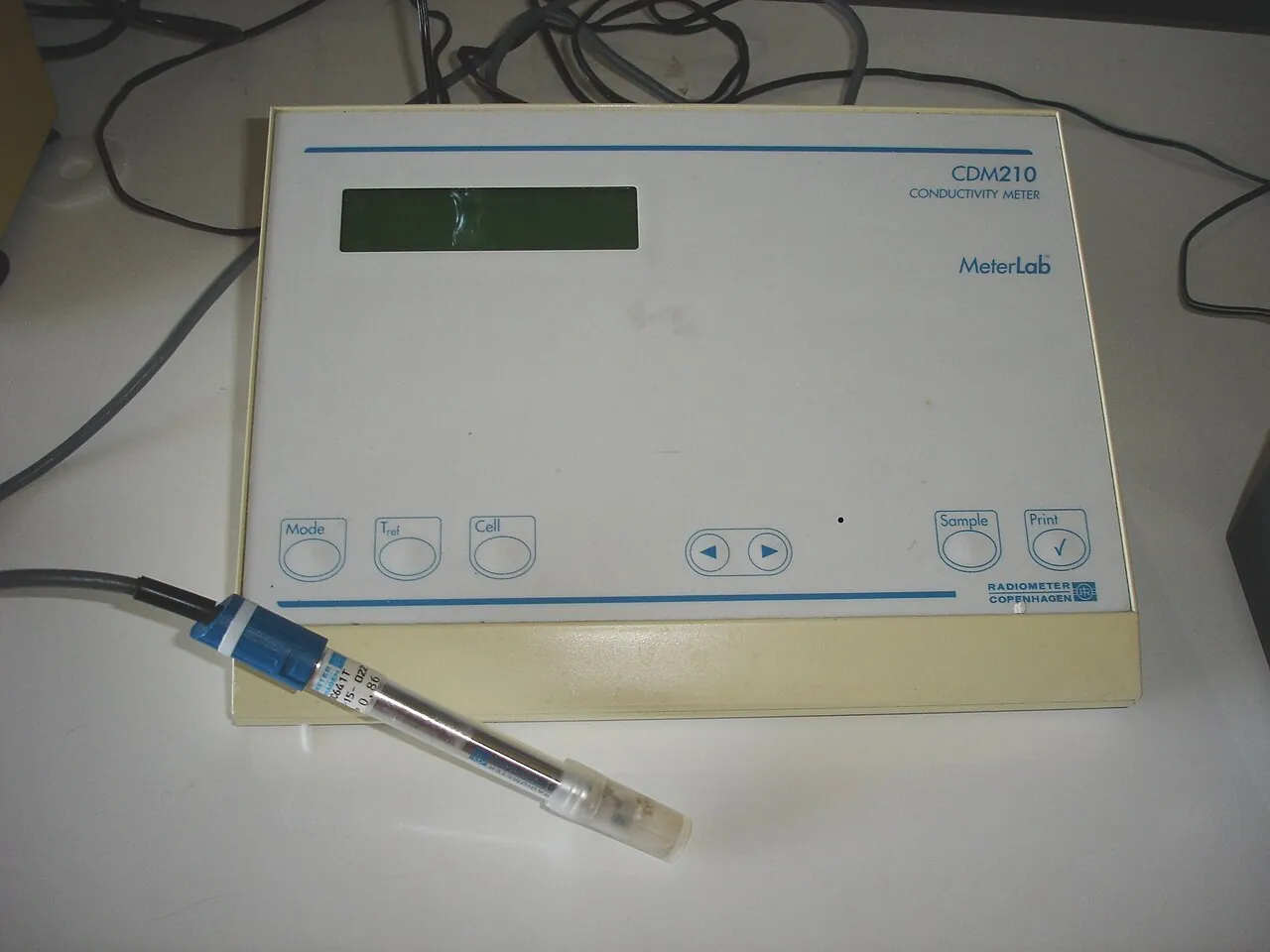
An online hardness analyzer measures the calcium and magnesium content of water, reported as total hardness, and on many instruments calcium hardness alone, expressed as calcium carbonate equivalent. Plant documents list it as a water hardness analyzer, and the control room logs it as a hardness monitor, but the measurement is one specific thing: an automated EDTA titration or an ion selective measurement run on a conditioned flowing sample every 3 to 15 minutes. The instrument exists because softener breakthrough is silent in every other reading a plant keeps: when a sodium zeolite softener exhausts, it swaps sodium for calcium in nearly equal ionic charge, and the water's conductivity barely moves while its scaling behavior transforms. The analyzer is the instrument that sees the change before the heat exchanger pays for it.
Procurement engineers meet these analyzers at softener outlets feeding boiler makeup, at reverse osmosis trains needing scale protection on the front end, at cooling tower makeup lines where cycles of concentration are set by hardness, and on high purity polishing trains where the last micromoles of calcium decide whether the next inspection finds scale. The decision this page settles is narrow and practical: which parameter, total or calcium or both; which method, photometric EDTA titration or ion selective electrode; which range and units the RFQ must state; and how the sample is conditioned, the reagents are managed, and the alarm is wired to regeneration logic. The answer lands as an RFQ line set, and every chapter below feeds it.
This page treats the hardness analyzer as a purchasing object: the EDTA chemistry and the ion selective method behind the number, the ranges and cycle times of the shipping families, the sample conditioning discipline that makes the reading honest, the softener breakthrough logic the measurement exists to drive, and how all of it is written into an RFQ. It is written for engineers who issue purchase specifications, not for readers who want a brochure summary.
Chapter 1 / 06
What a Hardness Analyzer Is and What Is Being Decided
A hardness analyzer is a small automated chemistry line with a photometric titration cell or an electrode flow cell at the end of it. Conditioned sample arrives from the process, reagent is metered in, and the cabinet converts the developed signal into a hardness concentration reported on 4 to 20 mA, relays, and Modbus. The chemistry it automates is chelometric: EDTA binds dissolved calcium and magnesium ion for ion, an indicator dye announces the endpoint, and the titrant volume consumed is the hardness. The parameter is always expressed as calcium carbonate equivalent, mg/L as CaCO3 in most of the world, whatever the underlying mixture of calcium and magnesium actually is, because that convention lets a softener, a boiler, and a cooling tower all reason about the same number.
One boundary must be drawn before anything else, because the word collides. The encyclopedia carries a separate hardness tester page for the metals family: Rockwell, Brinell, and Vickers machines that press indenters into steel and read resistance to deformation. This page measures water hardness only, the dissolved calcium and magnesium of a water stream expressed as CaCO3. The two parameters share nothing but the word hardness; they are measured by different physics, bought by different departments, and never interchangeable. Every sentence below is about the water parameter.
What is being decided in this purchase is why the number is worth a cabinet. The primary duty is softener breakthrough detection: a sodium zeolite softener exchanges sodium for calcium and magnesium until its resin exhausts, and when it does, hardness arrives where soft water should be. The failure is quiet because the exchange is nearly conductivity neutral, so the plant's cheapest continuous instrument, a conductivity meter on the outlet, reads essentially the same value before and after breakthrough while scale begins to form in everything downstream that heats or evaporates the water. The analyzer detects the excursion directly and feeds two decisions: an alarm that stops hard water reaching storage and boilers, and a regeneration trigger that brings the softener back based on measured exhaustion rather than on a timer set by worst case assumptions. The same measurement protects reverse osmosis trains, where hardness with concentration polarization feeds carbonate scale on membrane surfaces, and cooling tower makeup, where the permissible cycles of concentration are arithmetic on the hardness number.
The instrument lives among the water chemistry siblings on one conditioned panel, and this page does not replace any of them. A silica analyzer guards the volatilizing species that deposits on turbine blades; a sodium analyzer marks condenser leaks and polisher slip; a phosphate analyzer carries the drum treatment program; a hydrazine analyzer watches oxygen scavenger residual; an ammonia analyzer tracks the product that both feeds pH and threatens copper alloys. A TOC analyzer and a residual chlorine analyzer watch the makeup and raw water side of the plant, a dissolved oxygen meter owns the aeration basin, and a turbidity meter watches suspended solids on the same raw water. Around the hardness channel specifically, a pH meter belongs on the same panel because the EDTA chemistry is pH critical, an ORP meter rounds out the oxidation state picture, and the bulk ionic proxy for everything is the conductivity meter, which, as chapter 2 makes precise, is exactly the instrument that cannot see the sodium for calcium exchange. The catalog umbrella over the whole family is the online water analyzer page, a taxonomy term rather than a measurement equivalence, and the shared plumbing that feeds them all is the sample conditioning system, which is half the engineering of any online chemistry measurement.
The consequences the measurement defends are concrete. Hardness that slips through makeup polishing scales economizer tubes, deposits where the boiler feed pump moves the flow, and salts up cooling tower fill; the polished makeup targets sit at or below 0.5 to 1 mg/L as CaCO3 on industrial drum boilers and at the detection floor on high pressure utility trains. Steam plant readers will also recognize the hardware cousin in the condensate pot that seals impulse lines on steam service taps: it is not part of the analyzer chain, but its discipline, small bore lines carrying hot pressurized water handled with letdown and freeze protection, is exactly the discipline a hardness sample line needs. Compressed to one sentence, the decision is whether a defensible continuous hardness number is bought as a system, parameter and method matched to the stream, range and units stated without ambiguity, sample chain and reagent logistics matched to the site, or as a cabinet part number connected to the nearest convenient line. The chapters that follow supply the chemistry, the hardware families, the datasheet rows, the selection logic, and the failure modes needed to write it the first way.
Chapter 2 / 06
How Hardness Measurement Works
The reference method is chelometric titration, and its logic is worth thirty seconds. Ethylenediaminetetraacetic acid, EDTA, is an anion that binds calcium and magnesium one to one with enormous stability constant, so as titrant is added to the sample it complexes every free hardness ion present. An indicator dye is chosen that also binds the metals with weaker affinity: eriochrome black T for total hardness, held at pH 10 with an ammonia buffer, is wine red while magnesium remains bound to it and turns blue the moment the last metal is taken by EDTA; murexide, at higher pH, performs the same service for calcium alone. The online analyzer detects that transition photometrically, tracking the dye color through the titration instead of trusting an operator's eye, and computes hardness from the titrant volume to the endpoint, the titrant standardization, and the metered sample volume. The arithmetic is exactly the laboratory titration of Standard Methods 2340 C, automated and repeated on a cycle.
Automation is the difference between a method and an instrument. The wet end meters a fixed sample volume with a peristaltic pump or a syringe, doses the buffer and indicator, steps titrant in small increments while the photometer watches the cell, and stops at the color transition with the endpoint computed by curve fit rather than by first glance. The buffer chemistry is pH critical: eriochrome black T only behaves below and above its transition if the sample sits near pH 10, and a sample that drifts acidic, from carbon dioxide pickup or a process upset, shifts the endpoint and biases the answer, which is why commissioning should verify the buffered cell pH with a pH meter at least once and the procedure should repeat the check after any chemistry change. Temperature matters more gently, shifting titration kinetics and dye equilibria, and cabinets either stabilize it or compensate it; the 5 to 40 deg C sample window in the family datasheets is that statement in numerical form.
The ion selective route measures instead of titrating. A calcium ion selective electrode, a membrane cartridge with a calcium selective ionophore, develops a potential against a reference electrode that follows the Nernst relation, in words a tenfold change in calcium activity moves the potential about 30 mV per decade for a divalent ion. The sample is conditioned with a buffer that fixes ionic strength and pH so that activity tracks concentration, and the instrument reads calcium hardness continuously or on a short cycle. What the calcium electrode does not see is magnesium, so total hardness by this route is either computed by assuming a calcium to magnesium ratio measured elsewhere or measured by a second method; on softened and polished waters, where the surviving hardness is almost entirely calcium, the distinction matters little, and on raw waters it matters a great deal. The electrode's service life, its reference junction care, and its drift between calibrations are the honest costs of the reagent free operation.
Colorimetric methods occupy the third position: a metal indicator is added in excess, the color developed is proportional to hardness over a limited band, and a photometer reads it without a titration. The attractions are speed and simplicity; the limitation is the working band, which suits process waters comfortably and low micromole polishing duty poorly, because the color blank begins to rival the signal. A small number of instruments also report hardness by inference from other measurements, but an inference is not a hardness analyzer in the sense of this page, and a buyer who needs a defensible number for a permit or a boiler code calculation should buy a direct measurement.
Calibration and verification close the loop. Titrant is standardized against a primary standard calcium solution; the wet end is zeroed on reagent water meeting ASTM D1193; and span is verified with a check standard in the working band. The family performance numbers are honest as a family: accuracy of 2 to 5 percent of reading in the working band, detection limits near 0.5 to 2 micromol/L for the high purity versions, and cycle times of 3 to 15 minutes per determination for the titration machines. Verification is layered against the laboratory: grab samples run by the reference titration of Standard Methods 2340 C or ASTM D1126 on the bench, monthly to quarterly, keep the online number honest, and the correlation belongs in the plant chemistry file. A datasheet quoting an accuracy without stating the calibration and verification regime behind it is quoting a number, not a capability.
Chapter 3 / 06
Analyzer Types, Construction, and Duty Boundaries
The single stream titration cabinet is the reference construction and the form most plants buy. One conditioned stream feeds a wet end of metering pump or syringe, reagent bottles, a photometric titration cell, and a controller, packaged in an IP54 to IP65 wall or panel enclosure on 100 or 230 VAC, reporting 4 to 20 mA, relays, and Modbus. The Hach EZ4000 series is the reference execution of this architecture for online volumetric hardness, and its datasheet lines, parameter, range, cycle time, reagent consumption, sample conditions, outputs, are the format competing quotations should be made to answer. The trace is a stair with one point per cycle, and the response to a breakthrough event is one cycle time plus transport delay from the tap, arithmetic that belongs in the commissioning record rather than in a footnote.
The steam plant execution is built to a different maintenance culture. The Waltron 3051 hardness analyzer family serves boiler and high purity makeup duty with the same EDTA logic in an industrial cabinet, engineered for installations where the panel lives beside the polishing train and the technician pool is a utility plant crew. Multi stream versions sequence two or more points through one wet end with a solenoid valve on each line, and the latency arithmetic is the same as every wet chemistry monitor: four streams at a 10 minute cycle update each point every 40 minutes, which suits softener trending on a bank of vessels and starves a fast interlock. Plants that need both buy the dedicated single stream on the line that trips regeneration and let a sequenced cabinet carry the survey points, and carryover rinse between streams becomes the hidden cost that decides whether the sequenced cabinet was worth it.
The ion selective panel versions earn their place where reagent logistics are painful and the stream is soft water with calcium dominant. Softener outlet protection is the natural duty: the water is already low in magnesium, the range is friendly, and the electrode's continuous or short cycle output fits regeneration logic better than a 10 minute titration stair. What the electrode should not be asked to carry is the low micromole polished makeup band or a raw water with mixed calcium and magnesium and a real total hardness requirement; those are titration duties, and datasheets that blur the line are the ones to file under rework. High purity versions of the titration family, spanning roughly 0.05 to 500 micromol/L as CaCO3, exist precisely because the polished makeup band demands them, while process versions of the same chemistry span 1 to 5,000 mg/L as CaCO3 for raw water and cooling duties.
Duty boundaries keep the families honest against each other and against the panel. The titration cabinet owns every duty where a defensible total hardness number is required: breakthrough alarm, regeneration trigger, permit reporting, boiler code arithmetic. The ion selective cabinet owns calcium on soft and polished waters where total hardness equals calcium to within the plant's tolerance. Laboratory grab analysis owns validation and the awkward streams, not continuous protection. The method table below compresses the map; the selection chapter places each sibling measurement where it belongs rather than leaving the boundaries to a supplier's interpretation.
Family
Method and cycle
Range class
Duty it wins
Single stream EDTA photometric titrator
EBT total or murexide calcium, endpoint by photometer, 3 to 15 min
Process 1 to 5,000 mg/L as CaCO3; high purity 0.05 to 500 micromol/L
Softener breakthrough alarm and regeneration trigger
Multi stream sequenced cabinet
Shared wet end, solenoid switched streams
Per stream ranges at commissioning
Survey of a softener bank at trending latency
Ion selective electrode panel
Calcium ISE with ionic strength buffer, continuous or short cycle
Soft water bands, calcium dominant
Reagent free outlet protection and RO feed watch
Colorimetric hardness monitor
Indicator in excess, photometer reading, no titration
Mid band process waters
Simple trending where a limited band suffices
Chapter 4 / 06
Key Specification Parameters
The datasheet rows below decide whether a quoted analyzer matches the duty; values are stated as the common industrial spans of the established families and must be confirmed against the model datasheet before order.
Attribute
Typical range or options
What it decides
Parameter
Total hardness, calcium hardness, or both channels
What the alarm actually protects and the chemistry behind it
Range
0.05 to 500 micromol/L high purity; 1 to 5,000 mg/L as CaCO3 process
Breakthrough band placement and detection honesty
Units and basis
mg/L as CaCO3 standard; ppm, mol/m3, German degrees dfH; CaO on some plants
Whether the number is comparable across documents
Method
EDTA photometric titration, calcium ISE, or colorimetric
Reagent logistics, cycle time, and total versus calcium capability
Accuracy and detection
2 to 5 percent of reading; detection near 0.5 to 2 micromol/L family
Margin against the action band at the tightest stream
Cycle time
3 to 15 min per determination, titration family
Latency from breakthrough event to alarm
Sample flow
20 to 200 mL/min, steady
Conditioning hardware and fast loop sizing
Sample temperature and pressure
5 to 40 deg C; 0.2 to 6 bar at the inlet
Cooler and letdown scope in the sample chain
Reagent set
EDTA titrant, EBT or murexide indicator, pH 10 buffer
Consumption rate, shelf life, and delivery logistics
Outputs
4 to 20 mA, relays for regeneration, Modbus
DCS integration and the softener interlock path
Enclosure and power
IP54 to IP65 wall or panel; 100 or 230 VAC
Siting beside the polishing train or in the analysis room
The range and units rows deserve a paragraph because they are where quotations become incomparable. Express everything as CaCO3 equivalent in the RFQ, state conversions in writing, and refuse unit ambiguity: one German degree of hardness is 17.848 mg/L as CaCO3, one mol/m3 equals 100 mg/L as CaCO3, and some older utility plants still report as CaO, which reads 1.78 times lower than the same water expressed as CaCO3. A breakthrough alarm set at 0.5 mg/L as CaCO3 on polished makeup and a raw water survey at 400 mg/L as CaCO3 are different instruments in the same family, and one span for both compromises one of them. Buy the range that brackets the action band with margin: the number that matters is not the span ceiling but the accuracy and detection floor at the alarm point, because a breakthrough alarm at 0.5 mg/L is only as good as the instrument's honest floor below it.
The sample chain rows decide uptime more than the analyzer does, and the table below states the practical spans with the reasoning that connects them.
Sample chain parameter
Practical span
Logic
Pressure letdown
Line pressure reduced to 0.2 to 6 bar at the wet end
Steady flow at the cell and tubing pressure ratings
Temperature control
5 to 40 deg C at the analyzer
Titration kinetics and dye equilibria are temperature bounded
Bubbles across the photometer read as endpoint noise
Waste drain
Drain sized for continuous spent sample flow
Titrated sample carries buffer and dye to drain
Integration closes the specification. The measurement exists to act: the relay or Modbus path from a high hardness alarm should trip or advance softener regeneration logic, and the RFQ must state that intent so the supplier's controller matches the plant's sequence of vessels, staggered or duty standby, rather than assuming one. Each stream carries its own 4 to 20 mA output or mapped register set, with alarm states, reagent low, sample fault, calibration failed, routed to the same monitoring the measurement reads into; an analyzer that alarms only on its own front panel is a liability dressed as an instrument. Where the panel serves several analyzers, the sample conditioning system is shared infrastructure, and the hardness channel's flow and pressure requirements must be reconciled with the silica and sodium channels on the same fast loop, which is a specification exercise, not an installation improvisation.
Chapter 5 / 06
Selection Decision Factors and RFQ Language
The selection sequence runs as a checklist, and each line eliminates a class of quotations before price comparison begins.
Name the stream and the consequence: softener outlet feeding boiler makeup, RO feed protection, cooling tower makeup, or polished makeup, with the action band in mg/L as CaCO3 written down before any datasheet opens.
Fix the parameter: total hardness wherever a defensible CaCO3 number is required, calcium alone where the water is soft and calcium dominant and reagent free operation earns its keep.
Fix the method against site logistics: EDTA photometric titration for the breakthrough and permit duties, ion selective for outlet protection where bottles are the problem and the band is friendly.
Fix the range and units: state everything as CaCO3 with the conversion written out, and bracket the alarm point with accuracy and detection margin rather than span ceiling.
Characterize the sample at the tap: temperature, pressure, flow available, distance to the cabinet, and the conditioning hardware each tap needs, including filtration for photometric duty.
State the interlock intent: which relay or register trips or advances regeneration, and which sequence of softener vessels the controller must respect.
Demand the verification evidence: cycle time at duty flow, response time to a step, reagent consumption, and the calibration regime behind the quoted accuracy.
Add the siting lines: enclosure rating, power, drain capacity for spent titrated sample, reagent storage temperature, and freeze protection for exposed lines.
Against the neighboring measurements the hardness channel holds specific ground, and the comparison belongs here in the selection chapter rather than in a page title. The conductivity meter is the proxy it must be understood against: it integrates every ionic contribution, sees a sodium softener's exchange as nearly neutral, and therefore reads steady through the exact event the hardness analyzer exists to catch; it remains the right continuous instrument for everything ionic in aggregate, and the two channels are complements, not rivals. A pH meter belongs on the same panel because the EDTA chemistry itself is pH critical and because softened water chemistry reasoning starts with pH, with an ORP meter beside it wherever disinfectant or scavenger chemistry is also supervised. A silica analyzer, a sodium analyzer, a phosphate analyzer, a hydrazine analyzer, and an ammonia analyzer carry the steam cycle story that hardness only begins, and a TOC analyzer plus a residual chlorine analyzer carry the makeup water story; a dissolved oxygen meter owns aeration, and a turbidity meter owns suspended solids on raw water. The online water analyzer page is the umbrella over the family rather than a substitute for any channel. At the far end of the consequence chain sit the machines the alarm protects: hardness that gets past polishing scales the economizer and the passages a boiler feed pump feeds, and on the condensate side the same small bore sampling discipline that a condensate pot brings to impulse lines applies to the sample runs that feed this panel. Nothing on the list substitutes for the hardness channel, and the hardness channel substitutes for nothing on the list.
The application map below compresses the practice into the form a project file carries.
Application
Construction to specify
Check before order
Sodium softener outlet, boiler makeup
Single stream EDTA titrator, alarm to regeneration logic
Alarm band vs detection floor; cycle time vs storage volume
Polished makeup, high purity train
High purity titration family, 0.05 to 500 micromol/L class
Verification cadence and grab correlation at the floor
RO feed scale protection
Titration or calcium ISE on the cartridge filter outlet
Range covers raw water swings; filtration ahead of photometer
Cooling tower makeup
Process range cabinet, 1 to 5,000 mg/L class, trend to cycles logic
Units basis against the water balance spreadsheet
Softener bank survey
Multi stream sequenced cabinet on the survey points
Latency per stream and carryover rinse between vessels
The RFQ block should be written once and reused: quantity and family; stream count with each point named; parameter per stream, total or calcium; range and units expressed as CaCO3 with conversions written out; method with the reasoning stated so suppliers can challenge it honestly; accuracy and detection at the alarm point with the calibration regime behind them; cycle time and measured response at duty flow; reagent consumption estimate with shelf life and storage conditions; sample conditions at each tap, temperature, pressure, and available flow, with the conditioning hardware offered; outputs, protocol, and the regeneration interlock intent; wetted materials of the wet end; enclosure rating and power; and the verification method and frequency against the laboratory. A quotation returned without the detection floor at the alarm point, or without reagent logistics answered in bottles per quarter, is incomplete at any price.
Chapter 6 / 06
Installation, Standards, Failure Modes, and Maintenance
Installation is a sampling exercise before it is an instrument exercise. Place the tap after the softener outlet and before the storage or deaerator, close enough that a breakthrough event reaches the cell within one cycle plus transport delay rather than aging in tubing; on RO trains, sample at the cartridge filter outlet where the membrane sees the water. Let hot or pressurized lines down through the sample conditioning system to the 0.2 to 6 bar and 5 to 40 deg C window before the wet end, and route the spent titrated sample to a drain sized for continuous flow, because the cabinet produces a small steady waste stream carrying buffer and dye. Reagent storage is an installation line: the EDTA titrant, indicator, and buffer have shelf lives measured in months, and a cabinet mounted over a boiler house wall at 50 deg C ambient is cooking its own consumables. The line discipline steam plants already practice around the condensate pot on impulse runs, insulation, letdown, freeze protection, and no dead legs, applies unchanged to these sample lines, and a line that freezes or scales is a data outage disguised as an instrument fault.
Commissioning earns the trust the datasheet claims. Verify the wet end chemistry once by hand: buffer a grab of the actual sample, confirm pH near 10 with a pH meter, and watch one automated titration against a bench EDTA titration of the same water. Run the first check standard, record the computed endpoint and the titrant standardization, and log both as the baseline the maintenance plan trends. Step the instrument with a check standard at duty flow and record the true response time, cycle time plus transport delay, because that is the number the regeneration interlock is timed against. Verify every alarm path, reagent low, sample fault, calibration failed, by forcing it once, and verify the relay action into the softener sequence end to end, including the case where two vessels alarm together. A commissioning record with those six lines turns the first chemistry audit into a formality.
The standards frame is method, water, and reagent based. Standard Methods 2340 fixes the hardness determination and its calcium carbonate reporting basis, with 2340 C the EDTA titration the online cabinets automate; ASTM D1126 is the corresponding ASTM titration method for calcium and magnesium in water. ISO 6058 and ISO 6059 carry the same EDTA chemistry as international method standards for calcium and for total hardness respectively, the references a global RFQ cites when the laboratory referee must speak the same language as the online number. ASTM D1193 grades the reagent water the zero depends on, and ASTM D1293 is the pH method context for the buffer verification the chemistry requires. Citing method, water, and pH practice together in the RFQ tells the supplier the buyer knows the number is a chain, not a box.
Failure modes follow a short and predictable list. Reagent exhaustion or expiry is the dangerous one: as titrant weakens or indicator degrades, the computed endpoint walks and the reported hardness drifts, often low, reading exactly like well behaved soft water; reagent low alarms must be wired and the consumption rate confirmed at commissioning. Sample starvation and bubbles starve the metering and scatter the photometer, producing steps and stalls that a flow indication upstream would have caught. Photometer fouling, from turbidity the filtration train should have removed or from dye staining of the cell, biases the endpoint slowly and is the scheduled cleaning item that prevents it. Electrode drift on ion selective versions shows as falling span between calibrations and is the service kit's job. Deposition in the sample lines, hardness doing to its own measurement what it was bought to prevent, is the failure with the best irony and the easiest prevention: a conditioning train kept clean. Temperature excursions outside the compensation band add a daily undulation to the trace. And the wrong zero after wet end service is the failure every technician has met: it looks authoritative, and only a forced check standard exposes it.
Maintenance is deliberately boring and budgeted in consumables. Weekly: reagent and standard level check, alarm review, and the logged result of the last automatic calibration where the cabinet runs one. Monthly: response spot check with a check standard, cell and wet end cleanliness, drain inspection. Quarterly: full calibration with fresh standard, tubing replacement on the metering pumps at the vendor interval, and a grab verification against the laboratory reference titration. Spares held on site: one reagent set and one standard within shelf life, one tubing kit, one cell or seal set, and the electrode service kit on ion selective cabinets. The throughline of this page is that an online hardness monitor is a small chemistry plant that produces decisions: fed with conditioned sample, live reagent, and a validation schedule, it holds softener breakthrough inside the band where treatment is cheap, and starved of any of the three it produces numbers that look exactly as authoritative as good ones while the economizer quietly scales.
FAQ
Is this hardness analyzer the same instrument family as a hardness tester for metals?
No, and the distinction matters when searching and specifying. A hardness tester presses a Rockwell, Brinell, or Vickers indenter into a metal and reads resistance to deformation. This page covers water hardness only: dissolved calcium and magnesium in a water stream, expressed as calcium carbonate equivalent. The two parameters share the word hardness and nothing else, and no instrument, method, or standard crosses between them.
Why not just watch the softener with a conductivity meter?
Because the event you are guarding is nearly invisible to conductivity. A sodium zeolite softener exchanges sodium for calcium and magnesium in nearly equal ionic charge, so outlet conductivity barely moves when the resin exhausts and hardness breaks through. The conductivity meter remains the right continuous proxy for total ionic load, but the hardness channel is the only online measurement that sees the exchange directly, before scale forms in everything downstream that heats or evaporates the water.
Should I specify EDTA titration or an ion selective electrode?
State the duty first. EDTA photometric titration gives a defensible total hardness as CaCO3 and owns breakthrough alarm, regeneration trigger, and reporting duties, at the cost of reagent bottles and a 3 to 15 minute cycle. The calcium ion selective electrode runs reagent free with continuous output and wins on soft, calcium dominant waters where reagent logistics are painful. On raw waters with mixed calcium and magnesium, or polished streams near the detection floor, titration is the honest answer.
What range and units should the RFQ state?
Express everything as CaCO3 equivalent and write the conversions out: one German degree is 17.848 mg/L as CaCO3, one mol/m3 is 100 mg/L as CaCO3, and CaO based reporting reads 1.78 times lower. Family spans run from 0.05 to 500 micromol/L for high purity duty to 1 to 5,000 mg/L as CaCO3 for process duty. Bracket the alarm point with accuracy and detection margin; the span ceiling flatters the datasheet, while the floor at the alarm band decides whether the alarm means anything.
Where should the sample point and drain go?
Tap after the softener outlet and before storage or the deaerator, or at the cartridge filter outlet on RO trains, with a fast loop so breakthrough reaches the cell within one cycle plus transport delay. Condition the sample into the 5 to 40 deg C and 0.2 to 6 bar window before the wet end, filter ahead of photometric cells, and route spent titrated sample to a drain sized for continuous flow carrying buffer and dye. Reagent bottles belong in a cool location, not on a hot boiler house wall.
How is the analyzer calibrated and verified over time?
The wet end is zeroed on ASTM D1193 reagent water and spanned with a standard calcium solution, with the EDTA titrant itself standardized against a primary standard. Verification is layered against the laboratory: grab samples run by the Standard Methods 2340 C or ASTM D1126 reference titration, monthly to quarterly, keep the online number honest. Trend every calibration and check result; drift in the slope or the zero is a maintenance signal weeks before it becomes a bad data month on the historian.
What does reagent exhaustion look like in the data?
A quiet walk, which is what makes it dangerous. As EDTA titrant weakens with age or the indicator degrades, the photometric endpoint shifts and the computed hardness drifts, typically low, so an exhausting softener and an exhausted reagent bottle can look identical on the trend. Wire the reagent low alarm, confirm consumption at commissioning, and treat reagent as a consumable with a delivery schedule rather than a one time purchase. A forced check standard after any bottle change exposes a disturbed zero immediately.