
On a refinery platform, a substation switch room, or a downstream tank-farm MCC, a single torn insulation sleeve on a 1,000 V screwdriver can turn a controlled task into an arc-flash exposure point, which is why the tool standard and the working voltage must be decided before the toolbox is opened [S4].
The oil and gas envelope is unusually demanding: 480 V to 13.8 kV motor control, 4.16 kV to 34.5 kV distribution, 600 V DC UPS and battery rooms, plus 24 V and 120 V instrument loops where a non-rated handle still fails a job. Insulated tools in this environment are specified to IEC 60900, ASTM F1505, or the equivalent VDE/ANSI/ASME regime, individually tested at 10 kV to carry a 1,000 V rating (a 10:1 safety margin), and are layered on top of de-energization, lockout/tagout (LOTO), absence-of-voltage verification, and arc-rated PPE rather than replacing them [S3][S5]. For the broader equipment class, see the insulated tools reference, and for the mechanical and electrical context in which they are used, see construction tools and construction machinery and equipment.
Voltage Rating, Working Limits, and the 10:1 Test Ratio
Most professional insulated hand tools are marked for 1,000 V AC and 1,500 V DC, and to reach that mark each tool is individually dielectric-tested at 10,000 V during manufacture, a 10:1 ratio between test voltage and use voltage that UL, IEC 60900, and ASTM F1505 all enforce [S3][S4]. That 1,000 V AC figure is the maximum allowable working voltage between the conductive tip and the user, not the system voltage of the bus being worked on, so a 480 V MCC bus and a 4.16 kV switchgear cubicle can both legitimately be approached with a 1,000 V rated kit provided the tool is not bridging two phases and the worker is outside the restricted approach boundary defined by NFPA 70E and OSHA 1910.335 [S3].
Three practical filters should be applied before a tool leaves the crib. First, match the tool to the task voltage plus a margin: 1,000 V AC / 1,500 V DC covers the vast majority of downstream and midstream electrical work, but live-line work above 1,000 V requires dedicated hot sticks rather than insulated hand tools, an industry distinction the OSHA 1910.269 subpart V and the corresponding [S5] reference on live-line tools make explicit. Second, verify the marking is on the tool, not the box: standard comfort grips, dipped vinyl handles, and plastic-coated shafts are not automatically rated insulation, and a bright orange handle proves nothing on its own [S4]. Third, confirm the standard: IEC 60900 governs the international market, ASTM F1505 covers the U.S. complete-tool-system scope (screwdrivers, pliers, wrenches, sockets, torque tools), and VDE/IEC 60900 is the typical European dual mark [S3][S5].
Construction Method: Injection-Molded vs Dipped, and Dual-Layer Visibility
Insulation is applied two ways, and the difference shows up in the failure mode. Injection-molded insulation is a formed plastic layer bonded over the base tool, usually a single color, with consistent wall thickness and tight dimensional control around the working end; dipped tools are coated in a dielectric liquid (historically vinyl or rubber) and cured, which leaves a dual-layer covering that is thicker but inherently variable because the dip drains unevenly during cure [S3]. Most professional-grade insulated hand tools have moved from dipped vinyl to injection-molded insulation over the last decade, because the injection path produces more uniform dielectric coverage and a tighter fit at the working end, which matters when the tool has to reach into a crowded terminal block on a refinery UPS panel [S3].
Where a dual-layer construction is used, ASTM requires contrasting colors, typically orange and yellow, so a worker can see at a glance if the outer layer has been cut through to the inner layer, and a tool that has lost its contrast or shows a bright stripe through the orange should be pulled from service [S3]. On the inspection side, three checks belong on every shift: visual scan for cuts, nicks, and discoloration along the insulation; a feel check for soft spots, swelling, or delamination at the bond line; and a dielectric retest on the documented cycle (commonly every 6 to 12 months for field tools, immediately after any known incident or drop) [S1][S4]. For the related question of non-sparking, non-magnetic tool kits used in EX-rated tank-farm and LNG work, the [S5] reference and the construction tools entry point to the right adjacent standard family.
Standards, Marks, and the Complete-Tool-System Rule
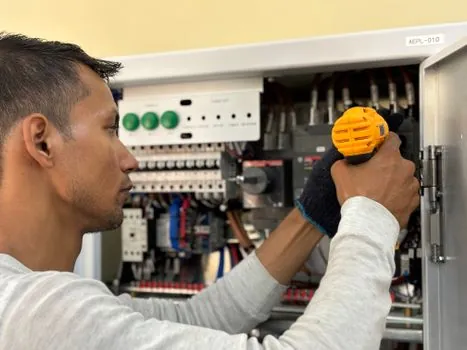
ASTM F1505 is the U.S. complete-tool-system standard, and its scope is explicit: insulated screwdrivers, pliers, wrenches, socket sets, and torque tools are all in scope, and a "system" only stays compliant if every component on a job carries the same rating and the same standard mark [S5]. Mixing a 1,000 V rated IEC 60900 screwdriver with an unmarked comfort-grip ratchet on the same task breaks the system, even if the ratchet is only used to back off a fastener that has already been de-energized, because the moment a worker holds a non-rated handle in a hand that is also touching a live surface, the protection layer is gone [S4]. The other governing standards to look for in the mark block are IEC 60900 (international), VDE (Germany, often combined with IEC 60900), ANSI/ASME (design criteria), and the ISO standards that the IEC 60900 family references; UL is the dominant U.S. third-party certifier and the 10 kV individual test is its core requirement [S3][S5].
Two consequences follow for oil and gas procurement. First, write the standard into the kit spec, not just the voltage: a line item that says "1,000 V insulated screwdriver" without naming IEC 60900 or ASTM F1505 will be filled with anything orange, and the kit as a whole is only as strong as its weakest unmarked handle. Second, treat the kit as a serialized asset: tag each tool, record the test date, and retire any tool whose dielectric retest fails or whose insulation is visibly compromised, because in an audit the missing record is treated the same as a missing tool [S1][S4][S5].
Task-Matched Kit Composition for Refinery, Platform, and Tank-Farm Work
A practical oil and gas insulated kit is built around the equipment the team actually services, not around a generic catalog bundle. The core loadout for refinery and downstream electrical maintenance covers insulated screwdrivers (slotted and Phillips in the sizes that match the MCC and UPS hardware), insulated nut drivers, insulated combination pliers, insulated side cutters, long-nose pliers, an insulated cable cutter, an adjustable wrench, a ratchet with insulated sockets, and at least one insulated torque tool for terminations where the torque value is specified and a standard handle will not give a controlled result [S4][S5]. The kit should also include the consumables that turn a good kit into a usable one: voltage detector, insulated gloves class-rated to the task, arc-rated face shield or hood, and a lockout/tagout pouch, because a 1,000 V rated tool by itself is not PPE [S1][S4].
For platform and LNG work, add non-sparking, non-magnetic (NSNM) tools to the inventory where ATEX/IECEx zone classification requires it; these are a separate category and are not substitutes for the 1,000 V insulated kit. For substation and switchyard work above 1,000 V, replace insulated hand tools with approved live-line tools (switch sticks, hooks, rescue hooks) per the [S5] utility guidance, and keep the insulated hand tools reserved for the secondary cabinets and battery rooms where the 1,000 V AC / 1,500 V DC rating is the controlling envelope. The 480 V to 13.8 kV motor and distribution scope, the 600 V DC UPS and battery scope, and the 24 V to 120 V instrument loop scope are the three working envelopes that a single 1,000 V rated kit will cover, provided the worker is outside the restricted approach boundary and the job has been released through LOTO and absence-of-voltage verification [S3][S4]. For a parallel spec walk on electrical safety accessories that sit beside insulated tools, see the lighting equipment and electric lamps and lamps and light fittings reference frames, which matter for the explosion-protected lighting in the same hazardous areas.
Selection Criteria: Dielectric Class, Geometry, and Task Fit

Selection comes down to four filters applied in order, and they line up cleanly against the four common insulated tool geometries in the field: [S4]
<b>1) Dielectric rating.</b> 1,000 V AC / 1,500 V DC with a 10 kV individual test is the default professional bar, called out by IEC 60900, ASTM F1505, and the UL 10:1 ratio; anything without that mark and test is not an insulated tool regardless of color [S3][S4][S5].
<b>2) Standard mark and third-party certifier.</b> IEC 60900 for international, ASTM F1505 for U.S. complete-tool-system scope, VDE for the typical European dual mark, UL as the typical U.S. third-party certifier; pick one and write it into the PO so substitutions are blocked at receiving [S3][S5].
<b>3) Geometry vs task.</b> Insulated combination pliers for gripping and light cutting only, not as a replacement for an insulated cable cutter; insulated sockets for confined connections, insulated open-end wrenches where access requires it; forcing one tool to cover every job creates damaged insulation and wasted time, a point that the [S4] field-side guidance is direct about.
<b>4) Task fit beyond voltage.</b> Fault energy at the bus, required arc-rated PPE per NFPA 70E, approach boundary, access restrictions, fastener type, and torque requirements all feed the final tool choice; a 1,000 V rating does not address arc-flash exposure or compensate for poor work positioning, and voltage is the first filter, not the final answer [S4].
For hazardous-area electrical work that sits next to the insulated tool envelope, the spec map on anti-static equipment selection for mining covers the grounding and zone logic that pairs with an insulated kit, and the parallel spec walk on insulated tools for warehouse operations covers the lower-voltage MCC and battery-room envelope that many refinery maintenance teams share with their warehouse peers.
Inspection, Storage, and When an Insulated Tool Is Not the Answer
Insulation is a wear part, and the inspection regime is what keeps the kit honest. Before each use, scan the insulation for cuts, nicks, burns, and discoloration; feel for soft spots, swelling, or delamination at the bond between the insulating layer and the conductive core; check that the voltage and standard markings are still legible; and confirm the dielectric retest date has not expired [S1][S4]. Storage matters because heat, UV, solvents, and chemical exposure are what degrade dielectric polymers: keep tools in their original rolls or toolboxes, away from direct sunlight, away from hydrocarbon solvent baths, and at temperatures within the manufacturer's published storage range, typically -20 degrees C to +70 degrees C for common tool polymers [S1][S4].
Three hard limits close the spec. First, an insulated tool is not a permit to work energized: de-energize, lock out/tag out, verify absence of voltage, and only then does the insulated kit become the routine habit rather than the emergency tool. Second, an insulated hand tool is not a live-line tool: above 1,000 V AC, switch to approved hot sticks, switch sticks, and rescue hooks per the [S5] utility guidance and the OSHA 1910.269 framework. Third, an insulated tool does not address arc-flash exposure on its own: arc-rated clothing, face protection, and insulated gloves class-rated to the task are the PPE layer, and the [S2] NFPA-aligned guidance is the reference frame for that stack. On a 2026-09-11 procurement cycle, the two trackable signals are the publication of any revision to IEC 60900 or ASTM F1505 in the second half of 2026 and any facility-side expansion of arc-flash labeling on 480 V to 13.8 kV switchgear that drives a 1,000 V kit refresh.