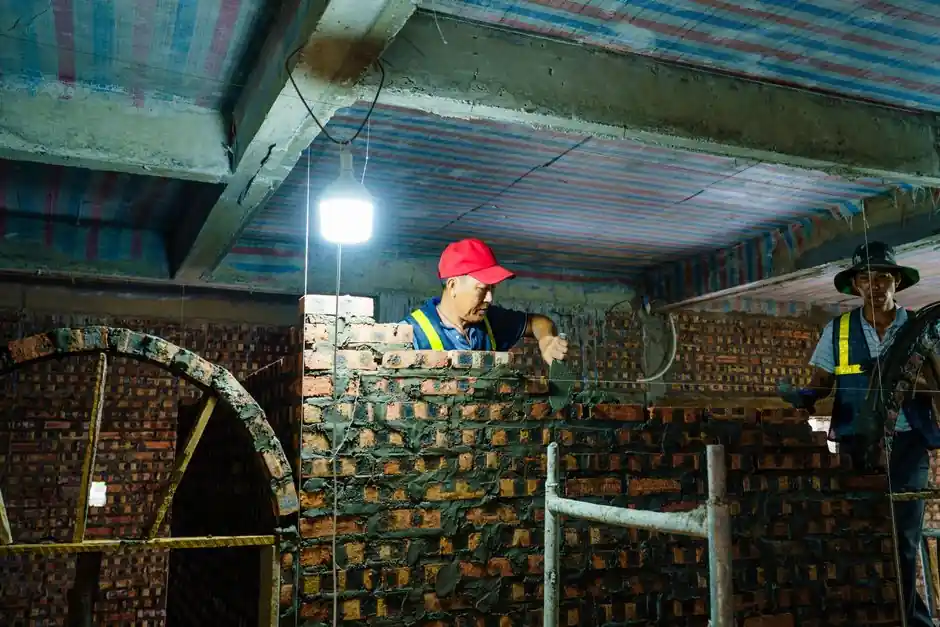
For interior slabs, walls, columns, and architectural panels, the working envelope of head diameter collapses to the 25-50 mm range, and the consolidation rule from ACI 309R is the binding constraint: head diameter must clear the minimum rebar spacing by a safe margin on insertion, with a target radius of action of roughly 0.3-0.6 m per insertion point [S1].
Interior finishing carries a tighter tolerance than mass-pour work because the finished surface is visible, frequently ground or polished, and exposed to scrutiny against architectural specs, so the consolidation tool choice directly drives surface defect rates, not just structural strength [S2].
Why Interior Finishing Is a Distinct Selection Problem
Freshly placed concrete carries 5-20 percent entrapped air by volume, and vibration is the only practical field method to drive that air out before initial set, with the standard reference framework being ACI 309R-05, ACI 309.1R, and ISO 28927 vibration-emission test methods [S1]. The interior finishing environment compresses the selection problem: slab thicknesses are often 75-150 mm, rebar cover is shallow, congested rebar mats are common, and the visible surface has to be free of bugholes, honeycomb, and form lines.
For this reason, internal pokers dominate the interior scope, while vibrating screeds take over the slab-top pass, and external form vibrators enter the picture only for thin architectural walls and precast panels where a poker cannot physically reach the form face [S3][S5]. The tool choice is not interchangeable: a poker on a 100 mm slab tends to over-vibrate the coarse aggregate and segregate the mix, while a screed on a 300 mm wall will not consolidate the lift at all.
Head Diameter and Frequency: The Two Numbers That Decide
Head diameter and frequency are the two binding specifications on any internal vibrator spec sheet, and ACI 309R describes vibratory motion in exactly those terms, with effectiveness driven by head diameter, frequency, and amplitude [S1]. For interior work the workable range is tight: 25-35 mm heads for tight reinforcement, columns, and beam-column joints; 35-50 mm for general slabs, walls, and footings; 50-65 mm only for thick foundation pours, which are outside the interior finishing envelope [S2].
Frequency sits in the 12,000-18,000 VPM band for high-frequency electric internal vibrators, with high frequency suited to fluid, higher-slump mixes because it works the mortar fraction, while high amplitude is reserved for stiff, low-slump mixes because it moves the coarse aggregate [S1][S3]. The radius of action around a typical internal head is 1-2 ft (roughly 0.3-0.6 m), and overlapping insertions are the only way to guarantee full coverage of the pour [S5].
A useful rule for interior finishing: pick the smallest head that physically fits the rebar spacing, then verify the VPM rating matches the slump on the mix design sheet. A 28 mm head at 15,000 VPM is the workhorse choice for a 100 mm residential slab over rebar at 150 mm centres, while the same slab poured at 75 mm thickness with mesh reinforcement usually drops to a 25 mm head to clear the cover [S2].
Internal, External, and Surface Vibrators Compared for Interior Use

Internal pokers are the default interior tool because they are inserted directly into the mix, suit foundations, slabs, columns, beams, footings, and high-strength structural concrete, and remain the industry standard for deep, thorough consolidation [S3]. External form vibrators are clamped to the outside of the form and transmit vibration through the formwork, which makes them the correct choice for precast moulds, architectural panels, thin walls, and any situation where a poker cannot physically reach the form face or where the spec demands a defect-free surface without disturbing the reinforcement [S3][S5].
Surface vibrators, principally vibrating screeds, work the top layer of the slab and are the right tool for shallow pours and finishing operations, including driveways, parking lots, and large flat surfaces where surface density and uniformity before trowelling are the goal [S2][S3]. The decision matrix is short: internal poker for structural consolidation, external form vibrator for closed or thin forms with high surface spec, vibrating screed for slab-top pass and finishing.
Power Source and Shaft Match for an Interior Site
Drive technology on internal vibrators splits into electric flex-shaft, electric high-cycle, gas-powered flex-shaft, and gas-powered backpack modular units, with the choice driven by site power availability, ambient ventilation, and run-time demand [S4]. High-frequency electric internal vibrators are the typical interior pick because they sit in the 12,000-18,000 VPM band, run quietly enough for enclosed buildings, and produce no exhaust, which matters in occupied or partially enclosed interiors [S3].
Stick-style external-motor units accept 120 V or 240 V single-phase electric, and shaft length runs from 1 ft to 8 ft to match pour depth and access; motor-in-head units are an alternative where the shaft must stay as flexible as possible for rebar-dense work [S5]. For interior finishing where the slab is 100-150 mm thick, a 1-2 m shaft covers the typical pour depth without forcing the operator to work bent over, and the 25-35 mm head class keeps the radius of action within the 0.3-0.6 m band [S1][S5].
Battery-powered internal vibrators have joined the lineup and now offer longer run times and faster response, which removes the genset from small interior fit-out pours, while gasoline flex-shaft units remain the top choice for heavy construction where site power is not available [S3]. The trade-off is straightforward: electric or battery for indoor air quality and noise, gas for outdoor or well-ventilated structural pours.
Selection Criteria and Common Failure Modes
The minimum selection checklist for an interior finishing pour is short but specific: measure the minimum rebar spacing and the slab or wall thickness, pick a head diameter that clears both with margin, match the VPM rating to the mix slump, confirm the shaft length covers the deepest lift, and verify the power source against site ventilation and outlet availability [S1][S2].
Common failure modes line up against the rules: under-frequency or under-amplitude on a stiff mix leaves entrapped air and bugholes against the form face; oversized head in a tight rebar mat forces the operator to bend bars to insert the poker; over-vibration with a high-frequency head on a wet, high-slump mix segregates the coarse aggregate and drives paste to the surface, which then blisters under trowelling; insufficient overlapping of insertion points leaves unconsolidated cores between vibration zones [S1][S3][S5].
Spare heads should be held on site for any continuous pour because a worn bearing drops the effective amplitude and frequency before the operator notices the loss in consolidation quality, and the change is invisible on a vibrating head that still sounds like it is running [S2]. Specifying durable reinforced shafts, heavy-duty casings, and reliable couplings is the procurement-side guard against this failure mode, and it is the difference between a vibrator that holds frequency for the season and one that drifts after a week on site [S2].
Standards, Sourcing, and Trackable Signals
The reference standards cluster is ACI 309R-05 for consolidation, ACI 309.1R for fresh-concrete behaviour under vibration, ISO 28927 for vibration-emission test methods, and IEC 62841 for power-tool safety on the drive side [S1]. Equipment that carries a stated VPM, head diameter, amplitude, and shaft length on its data sheet is conforming to that cluster in the sense the specifier needs; data sheets that quote only watts or only RPM without VPM and amplitude usually do not map to ACI 309R selection and should be treated as non-compliant for interior finishing bids [S1][S3].
For a specifier tracking 2026 procurement signals, the watchpoints are: high-frequency electric internal vibrators in the 25-35 mm head class, vibrating screeds sized to the slab bay width, and external form vibrators for precast and architectural panels where surface spec dominates the acceptance criteria, with the option to cross-check against the spec-first breakdown in the broader concrete vibrator selection guide and to consult the concrete vibrator encyclopedia entry for the underlying head-diameter and frequency relationships [S1]. Material pairing on interior pours also benefits from the adjacent cement and concrete reference, because mix design sets the slump and aggregate size that the vibrator must be matched to.
Spec-level background on the components involved: finishing material.