
For general-purpose industrial drives in the 0.12-160 kW range, a jaw coupling usually accounts for 15-25% of 20-year total cost, with the elastomeric spider, alignment labor, and unplanned downtime driving the rest [S3].
Specifying engineers routinely compare jaw couplings against disc coupling and gear coupling architectures on torque density, misalignment tolerance, and service interval; TCO modelling shifts the decision once energy losses and mean time between repairs are added [S6].
What the TCO model actually captures for a flexible coupling
Total cost of ownership in rotating-equipment terms is the sum of acquisition cost, installation labor, scheduled maintenance (elastomer and fastener replacement), unscheduled downtime, and the cumulative energy lost to hysteresis and windage across the design life [S2]. Busch's 2025 TCO guidance for process equipment states that initial purchase price is "only a fraction" of lifetime expense, a framing that translates directly to jaw couplings where the elastomer is a consumable, not a one-time fitment [S6].
Cowan's Springer reference, drawing on the Gartner five-year PC cost model, places recurring operations and support at roughly 75% of lifetime spend; for a jaw coupling that maps to spider replacement cycles (typically 8,000-24,000 operating hours depending on torque loading, ambient temperature, and chemical exposure), shaft realignment after foundation settling, and the productivity loss of any stoppage the coupling cannot absorb without damage [S3].
A practical TCO worksheet for a single jaw-coupled driver therefore rows: (1) coupling unit cost, (2) bore finishing and keyway work, (3) mounting hardware and guard, (4) installation labor hours, (5) laser alignment on commissioning, (6) elastomer replacement frequency × unit cost, (7) kWh lost to hysteresis at operating speed, and (8) expected downtime hours × production value [S2][S6].
Cost driver ranking: what moves the 20-year number
Acquisition cost is the smallest line item in absolute spend but the most visible; engineers who spec on unit price alone routinely underestimate lifetime cost by a factor of 3-5 [S6]. On a kW-normalized basis, the dominant drivers for jaw couplings in standard NEMA / IEC foot-mounted service rank, in descending order, as: elastomer replacement, unplanned downtime events driven by spider failure, realignment labor after 12-24 months, and energy dissipation.
Elastomer hardness is the single largest TCO lever. A 92 Shore-A polyurethane "spider" carries roughly 3× the wear life of a 70 Shore-A natural-rubber element under the same torque, but transmits 25-40% more shock load back into the connected bearings; the right pick depends on whether the drive sees motor-start transients or steady pump duty [S3]. Material grade also drives the chemistry tolerance window: nitrile and Hytrel grades extend service in oil-mist environments typical of gearbox housings, while EPDM is required where the coupling sits near hydraulic fluid or wash-down chemicals.
Sizing tier matters more than brand. Undersizing a jaw coupling by one frame (e.g., selecting an L-100 where the application torque and service factor demand an L-110) accelerates spider fatigue and can cut service life by 40-60%; oversizing, conversely, raises inertia and adds 2-5% to no-load motor current depending on the connected equipment.
Jaw vs disc vs gear vs fluid: a TCO-based comparison
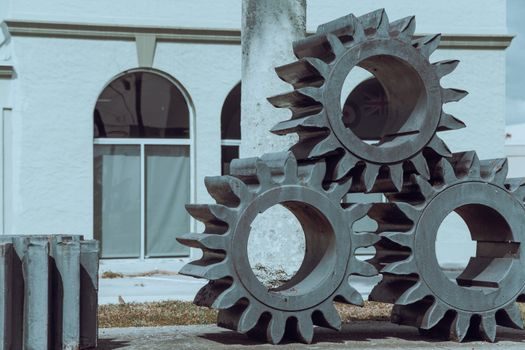
On four decision criteria relevant to a 50 kW, 1,750 rpm pump or fan drive, the four common flexible shaft coupling architectures line up as follows [S6]:
Acquisition cost (lowest first): jaw, gear, disc, fluid. Maintenance frequency: jaw spider replacement every 8,000-24,000 h; gear coupling lubrication and re-bedding on similar cycles; disc coupling is essentially zero-maintenance until bearing or seal replacement on the connected machine; fluid coupling requires annual oil change and coupon inspection.
Energy loss at full load: fluid coupling 3-7% slip loss, jaw coupling 0.5-2% hysteresis loss, gear coupling 0.3-1% windage and tooth friction, disc coupling <0.2% (purely mechanical, no elastomer damping). On a 50 kW motor running 6,000 h/year, a fluid coupling's slip loss can cost more in electricity over five years than the coupling's purchase price.
Misalignment tolerance: jaw ±0.2-0.5 mm offset, ±1° angular; disc ±0.5-1.5 mm, ±0.5-1°; gear ±0.1-0.3 mm, up to 2°; fluid coupling tolerant of significant parallel offset but intolerant of angular.
Failure mode cost: jaw coupling fails benignly (spider shears, driver coasts, no collateral damage); disc coupling failure can throw fragments; gear coupling failure typically forces shaft removal; fluid coupling failure modes include seal leaks and overheating. This single factor - whether a coupling fails safe or fails destructively - is often the largest TCO line on a high-consequence service.
Who benefits from a TCO-driven jaw coupling spec, and who should spec something else
Jaw couplings are the right call for cost-driven, moderate-duty applications: fan, pump, conveyor, and gearbox service under 200 kW where the connected driver and driven equipment are both replaceable and where some elastomer maintenance is acceptable. The economics collapse when (a) the drive is on a critical-path process with high downtime cost, (b) ambient temperature routinely exceeds 80 °C, (c) the elastomer sits in continuous contact with petroleum oil or aggressive solvents without a chemical-grade spider, or (d) the application needs torsional damping beyond what a 95-98 Shore-A element provides. [S7]
For variable-speed, high-inertia, or torque-converter service, a fluid coupling or disc coupling will usually beat jaw on 20-year TCO despite higher acquisition cost, because energy losses and service intervals dominate the spend profile. For high-torque, low-speed mill or crane service above the jaw coupling envelope, gear couplings remain standard.
For related spec-driven cost analysis on adjacent coupling types, the disc coupling TCO breakdown in this catalog follows the same 20-year framework with different driver weights - see Disc Coupling TCO: Spec-Driven Cost Breakdown for 20-Year Service.
Failure modes and constraints that erode the 15-25% purchase-price share
The Gartner-style ratio - capital hardware and software costs ~25% of five-year TCO, with 75% in operations and support - holds directionally for jaw couplings once service life exceeds five years [S3].
The most common failure-driven cost events on jaw couplings are: spider shear from momentary torque overload, premature hardening and cracking of the elastomer from sustained high ambient temperature, chemical attack from oil or solvent exposure on incompatible polymer grades, hub bore elongation from keyway fretting, and fastener loosening on vertically mounted shafts. Each of these maps to a specific TCO line; the mitigation is overspec'ing the spider material, adding a guarding/containment provision, and including alignment verification at the 12-month commissioning follow-up.
For total-cost comparisons on adjacent equipment classes - including laser-based alignment tooling selection, which directly drives the "realignment labor" line of the jaw-coupling TCO - see Laser Displacement Sensor Selection: Principle, Range, and Accuracy Map.
Sourcing, standards, and what to ask the supplier
Jaw couplings used in general industrial service are typically specified against AGMA 9006, ISO 9001 manufacturing, and DIN / ANSI bore-and-keyway conventions; ATEX 2014/34/EU and IECEx certification becomes mandatory for couplings installed in Zone 1/Zone 2 hazardous areas in chemical, pharmaceutical, and refinery service. When a coupling sits in an ATEX-classified zone, the elastomer must also carry a documented electrostatic-dissipative rating to prevent static discharge as a spark source. [S3]
A practical sourcing shortlist for a TCO-driven spec: (1) confirm published torque rating at the rated service factor, not the peak rating; (2) request the elastomer's full chemical compatibility table including oil mist, ozone, and water/glycol exposure; (3) ask for documented MTBF or field-failure data at the actual torque and speed envelope; (4) require the supplier to publish a recommended spider replacement interval at the design operating point, not a generic hours rating; (5) confirm the unit is repairable in the field (spider-only replacement) versus requiring full hub replacement. Couplings that require hub replacement at every spider change carry a hidden labor and shaft-damage premium not visible in the parts price.
Watch two signals in 2026: the shift from 70-80 Shore-A standard rubber to 92-98 Shore-A polyurethane spiders in the aftermarket, and the increasing availability of laser-aligned, factory-pre-assembled coupling units that compress the installation-labor line of the TCO. Either of these moving against the application is grounds to re-bid the 20-year number.