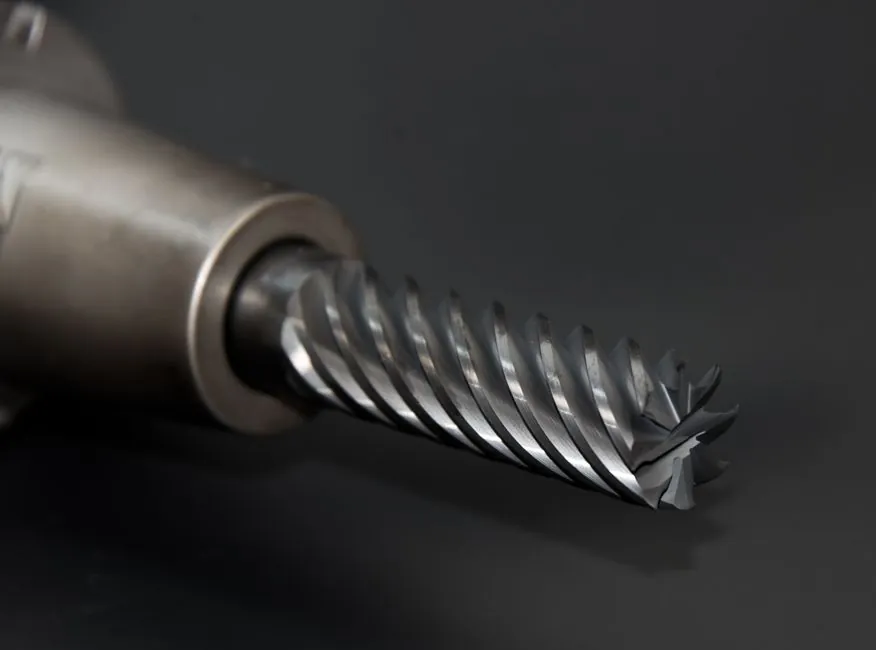
A kammprofile gasket is a solid metal core, typically 304/316 stainless steel, carbon steel, Hastelloy, or Inconel, with concentric serrations machined into both faces and soft facing material (graphite, PTFE, mica) bonded into those grooves [S3][S4]. A spiral wound gasket is built by winding alternating strips of metal and soft filler (graphite, PTFE, vermiculite, ceramic) under controlled tension to form a self-supporting spiral, optionally fitted with an inner ring, an outer centering ring, or both [S2][S5].
Dimensional scope for both types on ASME B16.5 flanges (up to NPS 24) and ASME B16.47 flanges (NPS 26 and larger) is governed by ASME B16.20 ("Metallic Gaskets for Pipe Flanges") [S2]. Selection between the two is therefore not arbitrary: the difference in core construction drives every downstream decision on torque, flange surface prep, reusability, and total cost of ownership. Engineers comparing these two for refinery, petrochemical, and power-plant service should treat the construction difference as the root cause of nearly every performance and handling trade-off that follows.
Core Construction and Material Stack-up
Spiral wound gaskets rely on a layered laminate: a metal winding strip (commonly SS 316, SS 304, Inconel, or Monel) is wound together with a soft filler (graphite, PTFE, vermiculite, or ceramic) so that each metal-filler pair forms a concentric seal path [S5]. This is why spiral wound gaskets are flexible and resilient under thermal cycling, but also why the windings can "spring back" if the gasket is dropped, bumped, or stored incorrectly [S2].
Kammprofile (also called camprofile or grooved metal) gaskets use a single solid metal core with both faces machined into a pattern of concentric serrations; the soft facing layer is then pressed or bonded into those grooves [S3][S4]. Because the core is one solid piece, kammprofile gaskets are dimensionally stable, easy to handle at large diameters, and resistant to radial shear and buckling [S2][S3]. The trade-off is a higher unit cost driven by the precision machining of the serrated faces.
Sealing Mechanism and Load Path
In a spiral wound gasket, sealing is created by compressing both the metal windings and the filler simultaneously, then letting the filler extrude between flange face and windings to fill surface imperfections [S1][S2]. Multiple concentric seal lines form along the winding, and the outer ring acts as a compression limiter that protects the windings from over-compression [S2].
In a kammprofile gasket, all compressive force is concentrated on the soft facing material seated in the serrations; the solid core does not compress [S1][S2]. This produces tighter, more concentric seal lines and lower required seating stress, but it also means the soft facing layer is the only deformable element. Damaged or contaminated facing is the dominant failure mode, whereas on spiral wound gaskets, the more common failure modes are winding buckling, pop-out on large diameters, and spring-back after loading [S2][S3].
Pressure, Temperature, and Flange Surface Sensitivity

Both types are used in refineries, petrochemical plants, and power plants for high-pressure, high-temperature service, with metallic construction outperforming soft sheet gaskets under aggressive process conditions [S5]. Kammprofile gaskets, however, are markedly more sensitive to flange face flatness and surface finish; reference is typically made to PCC-1 Appendix D flatness tolerances for critical flanged joints [S3].
Spiral wound gaskets are more forgiving on imperfect flange faces because the soft filler extrudes into scratches, minor dents, and small radial grooves, and they recover better after thermal cycling [S1][S5]. The downside appears at large diameters: spiral wound gaskets above NPS 24 / ASME B16.47 Series A and B "want to buckle and pop out," whereas kammprofile gaskets of the same size remain stable because the solid core resists radial deformation [S2][S3]. On heat exchanger channel flanges and similar machined-groove joints, kammprofile gaskets can be used without outer or inner rings, which spiral wound gaskets cannot [S2].
Installation, Torque, and Reusability
Kammprofile gaskets require less torque to achieve a seal because the load is concentrated on the soft facing rather than spread across a layered wind, and they tolerate uneven bolt loads better than spiral wound gaskets [S1][S2]. Installation is therefore quicker and less operator-sensitive. The metal core can be re-faced and reused if undamaged, but the soft facing is typically single-use after disassembly [S1].
Spiral wound gaskets demand careful centering and controlled, multi-pass bolt tightening to avoid crushing the filler and to keep the windings square in the flange; they are generally treated as single-use, especially if the gasket is damaged or marked during removal [S1][S2]. Inner rings, where fitted, serve as both a compression limiter and a corrosion/erosion barrier between the process fluid and the windings, and are normally specified from the same alloy as the winding strip [S2]. For plants still refining their torque procedures, a structured comparison of related bolted-joint hardware such as DPDT vs SPDT pressure switch contacts for dual circuits shows how contact geometry and load path influence reliability in a similar way.
Cost, Lifecycle, and Application Fit
Unit price is consistently the discriminator in the other direction: spiral wound gaskets are the cheaper buy, and kammprofile gaskets are "significantly more expensive" because of the solid core, the precision groove machining, and the facing process [S1][S2]. Lifecycle math usually flips that conclusion: a higher first-cost kammprofile avoids unplanned downtime, leak remediation, and production loss in critical service, while spiral wound remains the economic default for standard raised-face piping where flange faces are well maintained and operating conditions are moderate [S2][S5].
The decision matrix therefore reduces to four criteria. On flange-face tolerance, kammprofile requires near-perfect flatness (PCC-1 Appendix D), spiral wound forgives minor damage. On diameter, kammprofile is preferred above NPS 24 / B16.47; spiral wound remains the default for NPS 24 and below on standard raised-face flanges. On torque and operator sensitivity, kammprofile wins with lower required seating stress and tolerance to uneven bolt load. On purchase cost, spiral wound wins outright. For process-critical heat exchanger channel covers, hydrogen service, and high-pressure refinery headers, kammprofile is the default specification; for general-purpose piping, steam, and hydrocarbon flanges with machined faces, spiral wound remains the workhorse. Plants standardising on kammprofile for exchangers should also review their broader sealing and assembly process, including how flow meter impulse lines and other small-bore fittings are torqued, since the same disciplined bolt-up logic applies. A wider background on gasket types and selection, including where each style sits in a refinery's overall sealing strategy, is covered in the gasket reference page.
Track two signals over the next quarter: any revision activity in ASME B16.20 affecting kammprofile facing thickness and density limits, and any change in the relative unit pricing of SS 316L kammprofile cores versus 316/graphite spiral wound windings, since the cost gap is what currently keeps spiral wound specified in non-critical service [S2][S5].
For the relevant spec sheets and selection criteria, see spiral duct.