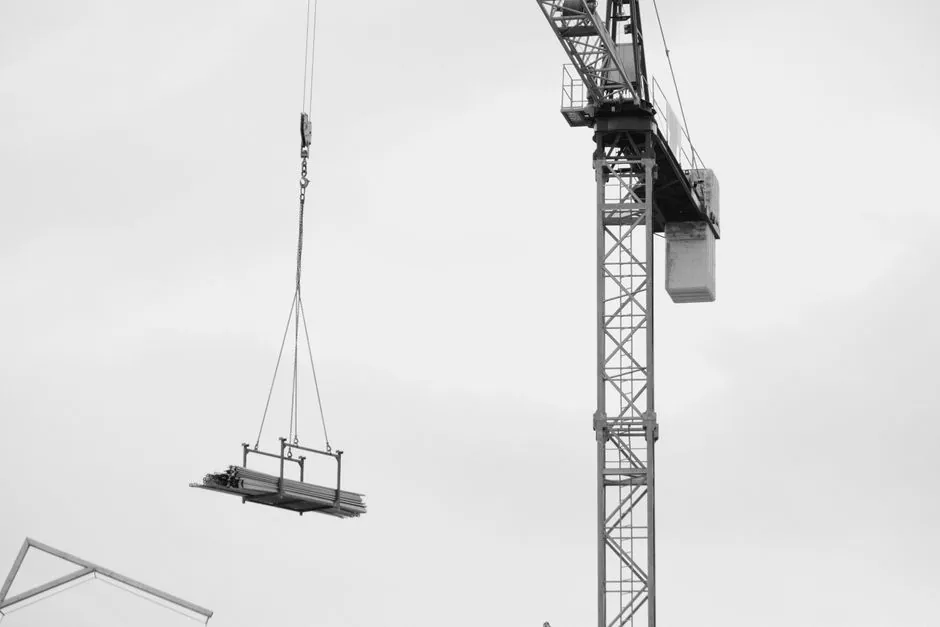
On a modern truck crane, fully retracted boom length, fully extended reach, lift chart capacity at radius, and axle weight all hinge on one structural variable: how many telescoping sections the boom carries, and how each is nested [S1][S5].
Section count drives a near-linear gain in maximum tip height, but at a non-linear cost in stowed length, cylinder count, and pin-and-latch complexity. Engineers who spec a truck-mounted crane for fleet deployment usually start the conversation at the section count, not at the tonnage rating.
What "section count" means in a telescopic boom
A telescopic boom is a set of nested steel boxes that slide inside one another; the base section is bolted to the turret, and each additional "fly" section rides on wear pads inside the next larger section [S5]. A single double-acting hydraulic telescoping cylinder, or a pair of cylinders in larger machines, drives the inner-most section out, which in turn pulls each successive section with sequential pin-and-latch or cam-style locking [S6].
Pin-and-latch designs restrict each section to a small set of fixed telescoped lengths, because the spring-loaded pins must find drilled holes in the next outer section. Full-power free-telescoping designs (used on most European and Japanese 50 t+ machines) use a detent plate and cam that allow any intermediate length, but at the cost of a longer cylinder and more plumbing. The "Boom Length" line on a spec sheet is therefore the fully extended tip distance, not a continuously variable value on every model [S5][S6].
3-section booms: the boomtruck sweet spot (10-18 t class)
Three-section booms dominate the 10-18 t (20,000-36,000 lb) boomtruck segment because they retract short enough to keep the carrier within standard 40 ft bridge laws and DOT axle limits [S4]. Elliott's 10-18 t line shows the pattern: a 3-section 1047F reaches 47 ft (14.3 m) of boom, a 1560F or 1860F hits 60 ft (18.3 m), and the 1881TM tops the line at 81 ft (24.7 m) of boom, 91 ft (27.7 m) tip height, with a 36,000 lb (16,329 kg) rating [S4].
Two practical limits define the 3-section envelope. First, adding a 4th section on a Class 8 carrier pushes the retracted boom past the legal rear overhang, so most North American boomtruck buyers stop at 3 sections. Second, three-section booms can still be specified with a 1- or 2-section telescopic jib, side-stowed on the boom, that adds 20-30 ft of reach without touching the main section count [S4]. For mechanics and sign installers running a service body, a 3-section 60-81 ft boom with an optional jib covers roughly 80% of daily lifts, which is why this segment is the volume leader for fleet buyers.
4-section booms: the workhorse range, 30-80 t
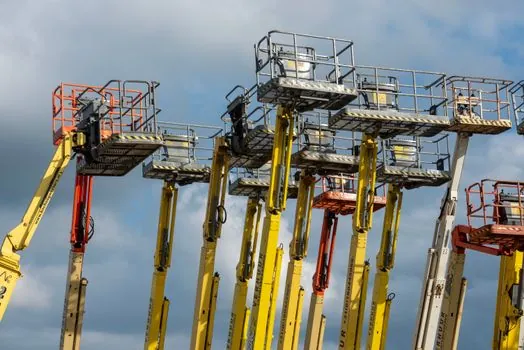
Step up to a 4-section boom and the tip-height window opens from roughly 90 ft to 127 ft, the band where most carrier-mounted boom trucks, rough-terrain cranes, and many all-terrain units sit. Stand-up operator models in this class typically max out around 33 t with boom lengths up to 127 ft (38.7 m); swing-seat (cab-behind-engine) cranes on the same section count push higher capacity at the cost of a longer wheelbase [S2].
Mechanically, the 4th section is where single-cylinder free-telescoping starts to feel strained. Most 30-50 t machines use a twin-cylinder or single long-stroke cylinder with a 2-stage cable-pulley assist; beyond 60 t, designers move to a 5th section or a boom-power-pin system. The trade-off is weight: every additional section adds 350-700 kg of high-strength steel, plus a parallel set of wear pads and a longer synchronizing cable or chain. For fleet owners comparing a 4-section 50 t to a 5-section 60 t, the deciding factor is usually a single lift on the chart (e.g. 4 t at 40 m radius) rather than raw tip height.
5- to 7-section booms: 100 t+ reach machines
Beyond 100 t, telescopic booms carry 5, 6, or 7 sections and routinely extend past 200 ft (61 m) of main boom, with a lattice or telescopic jib pushing total tip height to 350 ft+ on flagship all-terrain models [S2][S3]. Sany's industry overview notes that telescopic boom crane "reach can be extended from 36 ft to over 200 ft" across the commercial product line, which lines up with the 4-section 127 ft / 5-7 section 200+ ft bracket seen in spec sheets [S3].
At this scale, the telescoping mechanism itself changes. A 5th section usually forces a dual-cylinder or 2-stage telescoping system with an inner-mid-outer sequencing valve; 6- and 7-section booms on Liebherr, Tadano, and Grove flagships use a single long-stroke cylinder with rope-pull sequencing across all sections. Each added section typically increases maximum tip height by 30-45 ft but cuts retracted boom length efficiency: a 7-section boom needs roughly 12-13 m of nested steel to deliver 90+ m of extended reach, a 1:7 extension ratio that compresses section wall thickness and forces 900-1100 MPa quenched-and-tempered steel in the lower sections [S1].
For buyers, the practical question is not "how many sections" but "what radius vs capacity do I need for my worst-case lift." The 2019 IEEE similarity study by Cao Xuyang and co-authors showed that custom-designed 4-section models can match the strength, stiffness, and stability of larger 5-section production cranes when the section moment of inertia is held equivalent, which is why some rental fleets now run a 4-section 50 t in place of a 5-section 60 t for standard building-erection work [S1].
Selection criteria: matching section count to the lift
Three decision criteria usually settle the section count: stowed length vs road law, retracted-to-extended ratio, and synchronization complexity.
For North American boomtruck buyers running a single-axle or tandem-axle day cab, 3 sections with an optional jib cover 47-91 ft of tip height at the lowest chassis cost [S4]. For European mobile-crane fleets chasing long-distance roadability, an LTF (truck-mounted loader crane) covers around 15,000 km per year and stays more economical than a conventional mobile crane over those routes, which is why 4-5 section LTF and truck-crane hybrids are the volume segment in the EU [S2]. For tower-installation, wind-energy, or high-rise steel erection, 5-7 sections become mandatory, and the operator usually adds a 30-50 ft swing-away jib to push tip height past 300 ft [S3].
Across the three options, the comparison is concrete:
3-section / 10-18 t / 47-81 ft boom / 20,000-36,000 lb capacity / 2-section telescopic jib option: lowest cost, shortest setup, fits standard bridge laws, dominant in sign-installation and HVAC fleets [S4].
4-section / 30-80 t / 90-127 ft boom / up to 33 t stand-up or higher swing-seat: best lift-to-section-cost ratio, covers most commercial and light-industrial lifts, single or twin tele cylinder, the segment most rental yards stock [S2].
5-7 section / 100 t+ / 200+ ft boom / lattice or telescopic jib to 350 ft: required for wind, tower, and high-rise work, uses 900-1100 MPa high-strength steel, sequencing cylinder complexity rises sharply, and section moment of inertia must be derived from similarity theory rather than past practice [S1][S3].
Limits, failure modes, and what the research flags
Section count has a hard upper bound, set by retracted-length efficiency, cylinder sequencing, and structural stability under compression. Cao Xuyang et al. point out that the design of telescopic booms still "relies on experience and lacks the theory and method of custom design," and they derive a similarity-criterion method to size custom section moments of inertia for non-standard configurations [S1].
Pin-and-latch booms, the dominant type in the 10-30 t segment, are restricted to a discrete set of telescoped lengths because the pins must engage drilled holes, which complicates lift planning at intermediate radii [S6]. Free-telescoping designs solve that problem with a cam and detent plate, but at the cost of more hydraulic plumbing and a slightly heavier cylinder, which in turn shifts the boom's mass distribution and can require re-checking the load chart at every 5 ft of partial extension. For a related cross-industry comparison of how stacker-crane mast section materials trade off, see the stacker crane mast steel vs aluminum decision.
Operators should also note that published tip heights assume full 360° slewing with outriggers fully extended on level ground; on partial outriggers, or with the boom over the front of the carrier, capacity at tip can drop 40-60% even when the section count is unchanged.
Trackable signals to watch in 2026
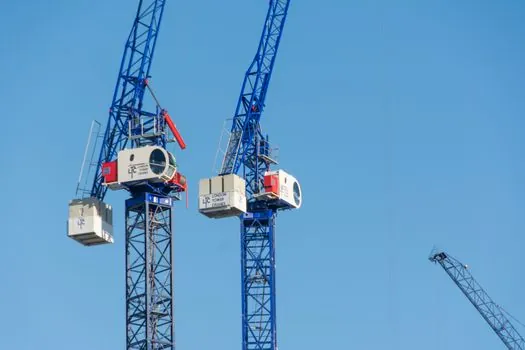
Two product signals are worth tracking into late 2026. First, OEM 50-60 t segment launches in Europe and North America are consolidating around 4-section booms with a 2-section swing-away jib, replacing older 5-section-only configurations, which is the direction the Cao Xuyang similarity study anticipated [S1]. Second, the 100 t+ segment is pushing section count higher (6-7 section booms on new all-terrain models) to clear 90 m of main boom without a jib, while keeping retracted length inside 4-axle road limits. Buyers comparing a truck-mounted crane against a concrete mixer truck for fleet spec should look at section count as a primary line item, not a footnote.
Detailed specification references: dump truck.