The Kroll process remains the only industrial route to titanium sponge, and it works in two coupled stages: magnesiothermic reduction of TiCl4 by liquid Mg near 900 °C under an inert argon cover, followed by vacuum distillation to strip residual Mg and MgCl2 from the porous Ti matrix [S1][S4].
Feeds are high-titanium slag chlorinated to crude TiCl4, refined, then dripped into a reactor holding molten Mg; the exotherm drives sponge growth while byproduct MgCl2 accumulates and is periodically tapped [S1]. Pangang Group's 7.5 t "I"-style distillation furnace is representative of large-batch Chinese capacity, with documented runs that exposed the dominant process pain points: distillation channel blockage, slow Mg evaporation, high residual Cl, and hard sponge [S2].
Reduction chemistry and the 900 °C argon envelope
The reduction half of the Kroll cycle is a heterogeneous gas-liquid-solid reaction, and the governing equations in Table 1 of the Pangang study all converge on Ti(s) + MgCl2(l) [S2]. Reaction paths differ in whether TiCl4 enters as gas or liquid and whether Mg is liquid or vapor, but the stoichiometric demand is fixed: roughly 1.04–1.06 kg of Mg per kg of TiCl4 fed, with MgCl2 tapped to keep the bath active [S2].
Operating temperature sits around 900 °C under an argon or helium blanket to keep oxygen and nitrogen pickup below the few-hundred-ppm ceiling that defines higher sponge grades [S1][S4]. A documented failure mode is local hot spots above the magnesium boiling point (1091 °C), which partially sinter the dendritic Ti and produce hard "lumps" that resist later crushing and leaching [S2].
Why soft sponge is hard to make
"Soft" titanium sponge — the grade preferred for ingot melting — requires the Ti dendrites to stay un-sintered, which means the reduction must reject heat fast enough that the local temperature never crosses the titanium self-diffusion threshold [S2]. The Pangang optimization work showed that lowering TiCl4 feed rate, i.e. spreading the same mass of TiCl4 over a longer window, raised the share of soft product and lifted the overall product-grade rate, because lower instantaneous heat flux kept the dendritic Ti from necking into lumps [S2].
Residual chlorine is the second gate. Excess MgCl2 trapped inside the sponge reacts with moisture in downstream handling and pushes Cl into the melt; that is why vacuum distillation temperature, system pressure, and hold time are tuned as a coupled set rather than independently [S2].
Vacuum distillation: the coupled control loops
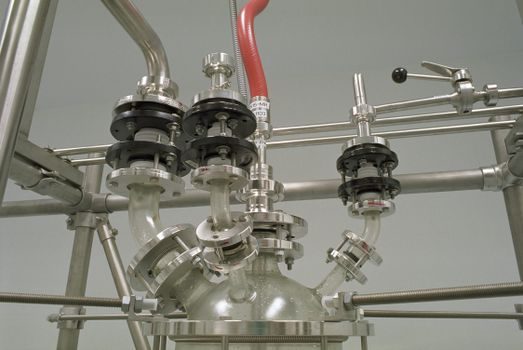
Distillation separates the spent Mg and MgCl2 from the Ti matrix by vaporizing Mg (bp 1091 °C) and MgCl2 (bp 1412 °C) under sub-atmospheric pressure, then condensing them in a cold trap for recycle [S2][S4]. Lowering absolute pressure drops both boiling points in parallel, so a given furnace temperature evacuates more impurity per hour — but only if the off-take channels stay open.
Channel blockage is the recurring failure: if reduction left sintered lumps, the vacuum path through the sponge bed collapses, the system pressure rises, the Mg evaporation rate collapses, and chlorine content in the finished sponge stays above the ~0.06–0.10 wt% window most melters want [S2]. Holding the bed at target temperature for longer compensates partially, but it also pushes Ti grain growth and worsens hardness, so the practical lever is prevention during reduction, not cure during distillation [S2].
Feed, energy and mass balance at industrial scale
For every tonne of titanium sponge produced, the Kroll route consumes roughly 4.0–4.2 t of TiCl4, ~1.05 t of Mg makeup (after MgCl2 electrolysis recycle), and 10–15 MWh of electrical and thermal energy, with argon losses on the order of 50–150 Nm3 depending on leak-tightness and number of batch cycles [S4]. Indian aerospace-grade scale-up work has focused on these three knobs — chloride feed purity, Mg recycle loop, and energy integration — to compress unit cost, which historically runs several times the cost of the titanium content alone [S4].
Process options to displace Kroll — the FFC Cambridge electrolytic route, the Armstrong ilmenite electrolysis, and the MER (magnesium-hydrogen) hybrid — have all been piloted, but none has reached the multi-thousand-tonne/year continuous operation that sponge buyers require [S4]. For procurement purposes that means every commercial titanium mill ingot, titanium alloy billet and most additive-manufacturing powder feedstocks still trace back through this exact reduction-plus-distillation sequence [S4][S6].
Product grade windows and downstream consequence

Sponge grade is set by the Brinell-equivalent hardness on the crushed sponge and the residual Cl, Fe, N, O and C assays, with the softest, lowest-impurity fractions (typically < 90 HBW, Cl < 0.06 wt%) reserved for rotating-equipment and aerospace ingot [S2][S4]. Harder, higher-Cl fractions are routed to ferrotitanium, master-alloy production, or to powder manufacture via the hydride-dehydride (HDH) route [S2].
The Pangang data explicitly credits the lower TiCl4 feed-rate regime with a measurable lift in soft-sponge share and overall product grade rate [S2].
Linked process map: from TiCl4 to alloy billet
Titanium sponge exits the Kroll line as a porous, gray-metallic chunk product that is crushed, screened, and blended into electrode compacts for VAR (vacuum arc remelting) or, for higher-purity rotating-equipment stock, into hearth melts for the cold-hearth plasma or electron-beam route [S4][S6]. Titanium alloy billet and bar then feed either forging stock for aerospace structural parts or atomization stock for additive-manufacturing powder, including the bioimplant powder paths reviewed in current literature [S6].
The Kroll process is also the upstream of every titanium investment-casting flow: as of 2026-07-11, TriTech Titanium Parts LLC's Detroit facility has been closed and its assets and titanium casting technology have been acquired by two successor firms, one of which — Barron — specializes in complex aluminum, steel, stainless steel and increasingly titanium investment castings for aerospace and defense [S5]. That plant transition is downstream of the sponge line but a useful signal: finished titanium part demand is consolidating, while the sponge process behind it stays the same [S5].
What an engineer spec'ing a sponge source should check
For a buyer evaluating sponge supply, the decision criteria collapse to four measured numbers plus one process fact: (1) Brinell hardness of the soft fraction, (2) residual Cl, (3) residual Fe, N, O, C — and confirmation that the producer actually runs a two-stage Kroll with separate vacuum distillation, not a single-vessel "in-situ" variant that struggles to hit the low-Cl window [S2][S4]. Producers that publish reduction temperature, TiCl4 feed-rate curves and distillation pressure profiles are typically the ones that have done the optimization work that lifts the soft-sponge yield [S2].
For comparison, sodium reduction (the historic Hunter route) operates at lower temperature and gives a finer-grained sponge, but it is rarely used for prime aerospace grades because of higher residual Na and Cl, and it is essentially absent from current large-tonnage Western and Chinese supply [S4]. The Kroll route, with the two control levers above, is what almost every prime titanium ingot in service today was made from [S4].
Open constraints and watch-items
The two structural constraints on titanium sponge supply are unchanged as of 2026-07-14: it is a batch, multi-day, energy-intensive route, and the MgCl2 byproduct must be recycled through electrolysis or sold into the chlor-alkali chain to keep unit cost viable [S2][S4]. Watch for two signals over the next 6–12 months: published disclosures of FFC Cambridge or MER semi-continuous lines reaching sustained 1,000 t/y output, and any disclosure of new "I"-style or larger vacuum-distillation furnace capacity additions from major Chinese producers, which would compress the spot sponge premium.
No specific CAPEX figure or commissioning date for either signal is in the public record as of 2026-07-14, so they remain trackable, not confirmable, on the data available today.
For component-level specifications, see multifunction process calibrator.
For related coverage, see Battery Separator Upstream and Downstream Industry Map: Materials, Process and.