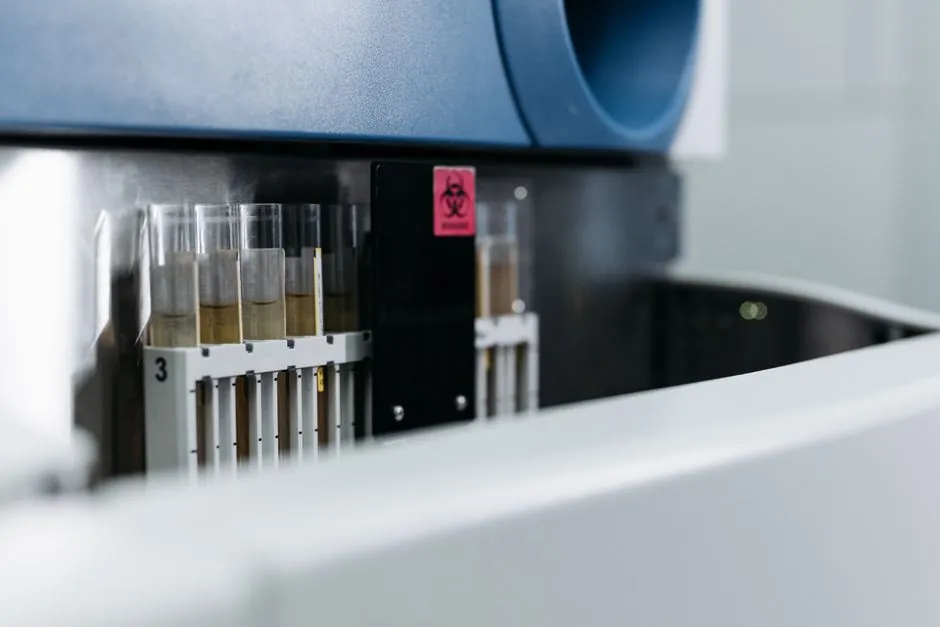
Specifying safety interlock switches for laboratories in 2026 starts with EN ISO 14119 switch type and a target performance level of PL e / Cat 4 / SIL 3 on the safety outputs that gate any mixer, centrifuge, autoclave, or robotic cell [S7][S8].
Lab hazards split into two camps: routine access (sample doors, fume hood sashes, cabinet guards) where coded tongue or RFID switches with 1,000 N to 2,500 N holding force are typical, and high-energy equipment (high-speed mixers, reactor chambers, hydrogen handling cells) where power-to-lock guard locking with 3,000 N+ holding and OSSD outputs is the 2026 norm [S5][S8].
Switch Types and Where Each Fits in a Lab
EN ISO 14119 classifies interlocks by construction type and coding level: Type 1 are mechanical limit-style switches, Type 2 are tongue-keyed, Type 3 are non-contact magnetic, and Type 4 are coded electronic (RFID) units [S7][S10]. A 2026 lab specification typically reads Type 4, high-level coded RFID, power-to-release, ≥ 1,000 N holding force, dual-OSSD outputs, PL e / Cat 4 / SIL 3, with the safety outputs landing on a Cat 4 / PL e safety controller that monitors the door state along with the equipment safe-stop inputs [S8].
Type 2 tongue-keyed stainless steel switches, such as the IDEM Kobra series in 316 stainless with IP67/IP69K sealing, still cover a large share of washdown lab and pharmaceutical cells, delivering positive-break contacts to IEC 60947-5-1 and up to PLe Cat 4 / SIL 3 when paired with a dual-channel safety monitor [S4]. Non-contact magnetic types suit lightweight cabinet and drawer interlocks where low force and tolerance to misalignment matter more than holding force [S3].
Selection Criteria Engineers Should Walk Through
RS Components' lab-facing selection guidance and Eaton's variable checklist converge on six decision points: hazard assessment, machine type (force and holding torque required for guard locking), applicable safety standards, body size and mounting, key or actuator position and orientation, and connection interface [S3][S5][S6]. The hazard assessment must identify the energy state behind the guard (residual kinetic energy in a mixer blade, residual pressure in an autoclave, residual heat in a furnace) because that determines whether a holding-force spec of 1,000 N, 2,500 N, or higher is justified [S5][S6].
Operating environment drives the enclosure decision: indoor analytical labs can use IP65 plastic-bodied switches at -20 °C to +60 °C, while washdown pharmaceutical or biosafety labs need 316 stainless, IP67 minimum, and often IP69K resistance to high-temperature detergent and CIP/SIP processes, exactly the envelope the Kobra K-SS and KM-SS housings target at 58 × 98 × 34 mm and 41.6 × 118 × 44 mm respectively with M20 conduit entries [S4]. Standards compliance on the spec sheet should at minimum list EN ISO 13849-1, EN/IEC 62061, EN ISO 14119, EN/IEC 60947-5-1, and where lab equipment is exported, UL 508 and EN 60204-1 [S4][S9].
Standards Map and Performance Numbers to Write Into the Spec

EN ISO 14119 (the standard for interlocking devices) defines the four construction types and the low, medium, and high coding levels, and it is the document that the safety controller calculation ultimately traces back to [S7][S10]. EN ISO 13849-1 supplies the Performance Level (PL a through PL e) and Category (1 through 4) framework used on the switch's safety data sheet, while EN/IEC 62061 carries the SIL 1 through SIL 3 equivalent and is mandatory where the higher-level machine safety standard EN/IEC 62061 is invoked [S4][S9].
Mechanical positive-opening switches are credited with 2,000,000 operations under EN 60947-5-1 Annex K, while electronic and RFID devices instead publish a PFHd, the probability of a dangerous failure per hour, often in the range of approximately 1×10⁻⁹ to 5×10⁻⁹ for PL e-rated sensors, together with a mission time commonly 20 years; these numbers, not the marketing tier label, are what the engineer enters into the SISTEMA or PAScalc calculation [S10]. The advanced-function variants on 2026 OEM lines add an EDM/reset input around 5 mA and an OSSD operation-switching input around 2.5 mA, and these inputs are what let a single safety controller supervise both the interlock and the downstream contactor feedback in one PL e loop [S8].
Who This Is For and Who Should Pick a Simpler Switch
Type 4 RFID OSSD interlocks are for lab equipment builders and integrators who need to hit PL e / SIL 3, want a single safety controller to monitor the door and the safe-stop inputs, and need the highest tamper resistance for a public-access or semi-skilled operator environment [S7][S8]. They are also the right call for guard-locking applications where residual energy behind the door could injure a person who pushes past a closed guard, because the power-to-release or power-to-lock logic only lets the door open after the safety controller confirms a safe state [S3][S8].
For low-risk sample cabinets, drawer interlocks on instrument bays, and non-routine maintenance access, a Type 2 tongue switch or a Type 3 magnetic non-contact switch at PL d / Cat 3 is usually the right economic and engineering answer, and over-specifying to PL e wastes money on safety controller channels and dual-OSSD wiring that the risk assessment does not demand [S3][S7]. Pharmaceutical cleanrooms that need to maintain room pressure and limit door cycling are a strong fit for non-contact coded magnetic units, where the absence of mechanical contact also limits particle generation [S6].
Comparison of the Main Switch Types for Lab Service
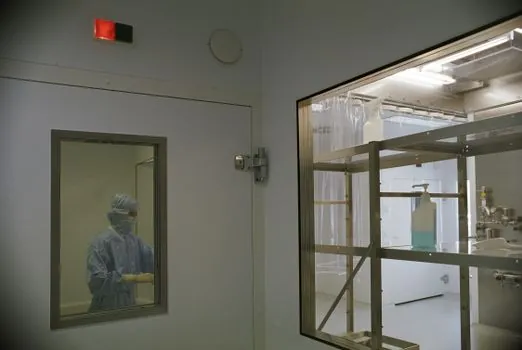
Against four decision criteria (tamper resistance, hygiene/washdown suitability, holding force, PL/SIL ceiling): Type 1 mechanical limit switches score low on tamper resistance but reach PL d / Cat 3 with low cost; Type 2 tongue-keyed switches (e.g. IDEM Kobra 316 SS) score high on hygiene and tamper resistance, deliver up to PL e / Cat 4 / SIL 3 with a dual-channel monitor, and typical holding force in the 2,500 N class with power-to-lock options [S4][S7]. Type 3 non-contact magnetic units are best on hygiene and tolerance to misalignment but are easiest to defeat with a spare magnet unless high-level coded, and they generally ceiling at PL d / Cat 3 [S3][S7].
Type 4 coded RFID OSSD units are the clear leader on tamper resistance, offer no contact wear, publish PFHd in the 1×10⁻⁹ to 5×10⁻⁹ band for PL e, and support 1,000 N+ holding in their power-to-lock variants, but they are the most expensive and require a safety controller that can read OSSD pulses and EDM feedback [S8][S10]. A practical 2026 rule of thumb: Type 2 stainless tongue switches for washdown and pharma cells, Type 3 magnetic for cleanroom cabinet access, and Type 4 RFID OSSD for robotic, autoclave, and high-energy reactor cells where PL e and high tamper resistance are non-negotiable [S4][S6][S8].
Failure Modes, Limits, and Common Mistakes
The most common spec error is selecting a switch on housing material alone and missing the PL/SIL rating on the safety data sheet; a stainless 316 body with IP69K is meaningless for functional safety if the contact block is only rated to PL c / Cat 1 [S4][S5]. A second error is mixing OSSD switches into a system whose safety controller only reads dry contacts: OSSD outputs need a pulsed sink/source-compatible input and the controller must tolerate the 1 kHz test pulse, otherwise the switch will trip the controller or be ignored entirely [S8][S10].
Third, holding force is the most over-claimed parameter on lab spec sheets; the 1,000 N or 2,500 N figure is a static lock rating, not a dynamic impact rating, and a guard that can be slammed by a person or by a robot cell's vibration will defeat a low-force lock in service, so the holding force must be derived from the risk assessment's severity and frequency-of-access numbers, not the switch brochure [S5][S8]. Fourth, mission time and proof-test interval need to match the PFHd calculation: an RFID switch rated for 20 years will fall out of its PL e claim if the lab's maintenance schedule replaces the actuator head without re-validating the SISTEMA file [S10]. For broader machine safety and safety certification context, the switch's data sheet should be cross-referenced against the higher-level machine PHA before the part is released to procurement, and the safety barrier layout should be drawn with the switch's response time and the controller's reaction time summed into a single stop-time value.
Sourcing, Compliance Trail, and a Verifiable Next Node
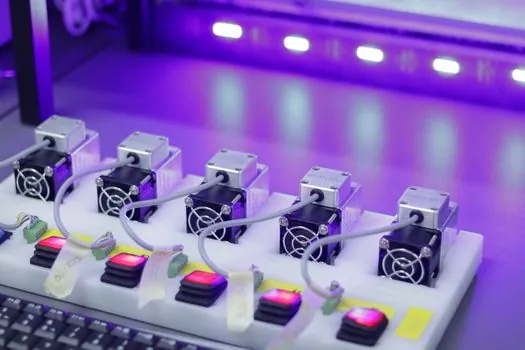
Procurement-side signals from 2026 lab-focused listings: RS Components' safety-rated interlock category and IDEM's Kobra K-SS / KM-SS data sheet, with 8 actuator entry positions on the mirror-polished KM-SS, IP69K maintained by a double-seal lid gasket, and compliance to EN 1088, IEC 60947-5-1, EN 60204-1, ISO 13849-1, EN 62061, EN 954-1, and UL 508 with CE / cULus / TÜV approvals, define the de facto shortlist for washdown lab service [S4][S5][S6]. For non-washdown lab builds, Eaton's LS-Titan miniature DIN IEC limit switch line gives a plastic- or metal-bodied, modular safety position switch with worldwide approvals at the entry-level PL d tier [S3].
Trackable signals for the next 90 days: confirm whether the safety controller in the candidate BOM accepts OSSD with EDM in a single PL e loop without an extra safety relay; verify the fire safety and safety fence integration of the chosen RFID switch with any existing perimeter guarding; and re-run the SISTEMA file for any new RFID switch against a 20-year mission time before issuing the purchase order [S8][S10]. The next step is a bench-level stop-time measurement on the actual guard plus a written rationale that maps the switch's PL e / SIL 3 claim to the lab cell's required performance level, a step that is consistently the gap between a spec sheet and a safety interlock switch that holds up under audit.
For related coverage, see Sand Mixer Selection for Energy Equipment: Spec Bands, Rotor Geometry, and Throughput Maps.