
E-commerce fulfillment centers running above 30 cartons/min consistently specify print-and-apply labeling systems rather than manual or semi-automatic dispensers, because the carrier-label, SSCC, and LPN workflow is the throughput bottleneck on the outbound dock [S1][S2].
Selection is driven by four hard constraints: label substrate, container geometry, label placement tolerance, and WMS/ERP data handshake speed. Operations handling variable-sized apparel, beauty, and small-electronics SKUs overwhelmingly choose pressure-sensitive systems with tamp-blow or wipe-on applicators [S2].
Where Labeling Fits in the E-commerce Outbound Workflow
A typical e-commerce pack-and-ship line stages the order at a pick wall, transfers the carton to a taper or carton-erector, runs it through inline weighing, then reaches the labeling machine before the carrier manifesting scan [S5]. At this point the carton needs at minimum a carrier label (carrier-compliant 4x6 or 100x150 mm), and for B2B or pooled-pallet flows a GS1 SSCC pallet label plus an internal License Plate Number (LPN) [S1][S2].
Print-and-apply systems are dominant in this role because the label is printed, verified, and applied in a single pass, eliminating the scan-and-apply error rate seen with separate print stations [S1]. For e-commerce operations fulfilling to Brazilian carriers, dual-format capability is now baseline, since the same machine must emit DANFE-style carrier labels plus SSCC pallet labels from the same print engine [S1].
Four Applicator Types, Mapped to Carton and Tote Use Cases
Pressurized-air tamp-blow units are the workhorse for shipping cartons because they bridge a 25-50 mm gap between the peel plate and the carton face, tolerating the dimensional variation common in recycled corrugated [S2]. Wipe-on applicators are the right answer for high-speed wraparound labeling on cylindrical or soft-pack SKUs, where the label is dragged onto the surface by the product itself.
For retailer-compliance top-labeling on trays or totes, the coding machine stage often runs upstream to inkjet a batch code, but where variable data is required, a print-and-apply top applicator is the cleaner integration [S5]. A practical comparison, derived from current industrial sourcing guidance:
Tamp-blow: 30-120 ppm, 25-50 mm stand-off, best for irregular cartons [S2]. Wipe-on: 60-250 ppm, contact application, best for stable cylindrical products [S2]. Air-blow: 60-300 ppm, requires flat, well-presented surfaces [S2]. Print-and-apply: 20-90 ppm integrated, adds inline data verification, dominating e-commerce carrier-label work [S1].
Selection Gates: Throughput, Substrate, Integration, Footprint

Throughput is the first gate. Semi-automatic dispensers top out near 15-20 labels/min and only make economic sense below ~5,000 parcels per month, while inline print-and-apply systems cover the 30-120 ppm window that most 3PL and direct-to-consumer operations run in [S2]. Below the 30 ppm threshold, the labor delta versus automation rarely justifies capex for a 3PL [S4].
Substrate drives print engine choice. Thermal-transfer print engines handle the matte paper, polypropylene, and voided-security substrates that carrier and SSCC labels use, while direct-thermal is reserved for short-life shipping labels where the print head is replaced annually [S1]. A related upstream/downstream concern is the cutting machine interface: when inline die-cut voids or tear-strip windows are specified, the label dispenser must accept pre-cut roll stock at the correct outer diameter.
Integration with the WMS is the third gate, and the most underestimated. Print-and-apply systems that read carton weight, dimension, and order ID from the WMS in under 200 ms avoid queueing at the applicator, and modern OEM guidance now treats this handshake as a binary go/no-go specification [S1].
Semi-automatic vs. Fully Automatic: the Break-even Line
Semi-automatic labeling requires an operator to place the product on a platform and trigger the cycle, then auto-dispenses, cuts, and applies; throughput is constrained by the operator, not the head [S2]. It is the right answer for startups, contract packagers running under ~3,000 SKUs/day, and 3PLs with high SKU-mix and low batch run-length [S2][S3].
Fully automatic inline systems move the carton on a conveyor with no operator in the cycle, and are the only answer for the 60+ ppm lanes of a regional fulfillment hub [S2][S3]. For the surrounding workflow, the upstream filling machine choice, bagging versus boxing, sets the cadence the labeler must match, and the downstream machine safety architecture guards the operator at the takeaway conveyor.
Failure Modes and What to Verify Before Purchase
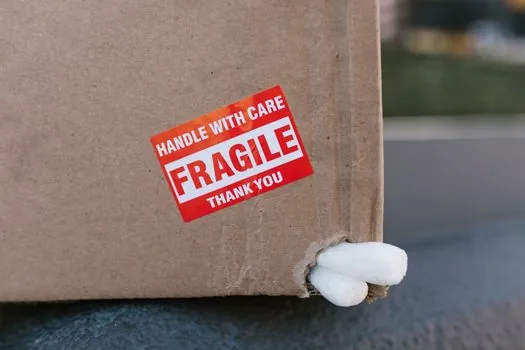
Three failure modes dominate e-commerce labeler downtime: label mis-registration on recycled corrugate, print-head burn-through on direct-thermal stock above 8 inches/sec, and WMS hand-shake stalls that starve the applicator head [S1][S5]. Buyers should request OEM mean-time-between-assistance (MTBA) data on the print engine, and require a documented field-replaceable print head rated for at least 50 km of thermal-transfer ribbon.
Pack Machinery Lab's 2026 maintenance guidance is explicit that labelers require scheduled print-head cleaning every 200 operating hours on direct-thermal stock, and every 500 hours on thermal-transfer, with operator machine safety lockout on the unwind and rewind spindles during changeover [S5].
Integrating Labeling with the Wider Packaging Line
Labeling does not stand alone; the upstream bagger, carton erector, and taper set the dimensional envelope the labeler must accept, while the downstream scale, manifest scanner, and palletizer set the cadence the labeler must sustain [S3][S5]. For a 3PL, the most common rework occurs when the labeler's signal I/O does not match the WMS event bus, and a planning step that maps the signal flow before purchase prevents this.
A useful reference for the upstream pack-side decision is the 3PL review of fulfillment services published in July 2026, which frames throughput, integrations, and scalability as the three buying criteria that mirror the labeler spec gates [S4]. Buyers specifying a new e-commerce line in 2026 should treat the print-and-apply head as a piece of the line, not a standalone purchase.
Track two signals over the next quarter: OEM releases of print-and-apply heads with native OPC UA over MQTT handshakes (replacing the older serial/TCPIIO patterns), and WMS vendors shipping built-in label template libraries for regional carriers, which removes the integrator fee that currently runs 15-25% of the print-and-apply hardware price [S1][S2].
See also our earlier report, Concrete Batching Plant Selection for Quarrying Sites.