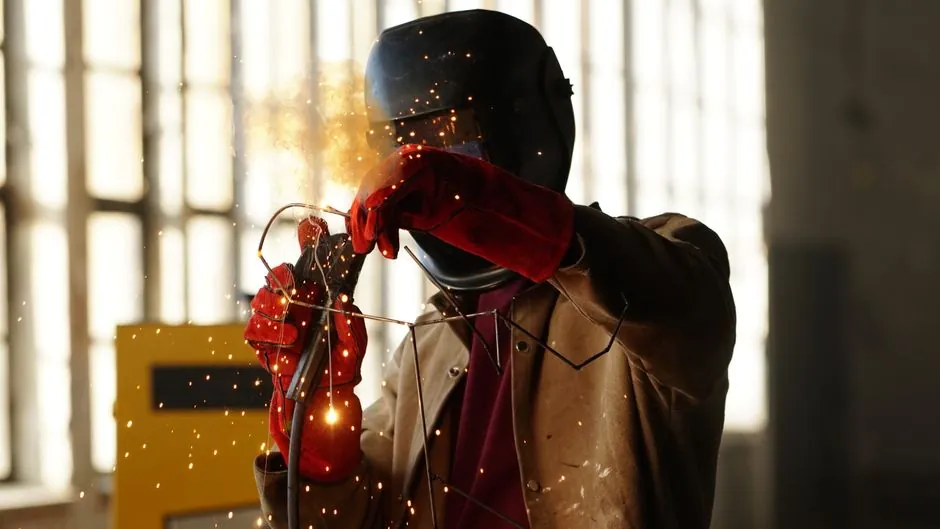
Landscape fabricators sit in a strange gap: thin decorative stainless on Monday, 3mm mild steel edging on Wednesday, 2mm aluminium planter boxes on Friday. The right TIG welder for this mix is an AC/DC inverter in the 160-200A class, 240V input, with HF start, pulse, and a foot pedal (or equivalent amperage control) so the operator can throttle heat on the thin stuff without burning through [S1][S2].
What landscaping TIG is NOT is a 110V hobby unit. A 110V/16A outlet caps continuous output around 130-140A on most inverters, which is borderline for 3mm steel and undersized for 1/8 inch aluminium in a single pass [S2]. A 240V supply, by contrast, drives 200A at 25-30A input, which is the amperage window where 3-4mm steel, 1/8 inch aluminium, and 1.5mm stainless all weld cleanly with margin to spare [S1][S3].
Material Gates: Steel, Stainless, Aluminium in the Same Week
DC TIG handles mild steel, stainless, chromoly, and copper cleanly with a stable, directional arc; AC TIG is non-negotiable for aluminium and magnesium because the alternating wave breaks the surface oxide layer that DC alone cannot penetrate [S2][S6]. For a landscaping shop that touches all three, the AC/DC inverter is the only rational purchase, and the price premium over a DC-only unit is smaller than the cost of replacing a DC machine the day an aluminium trough job lands on the bench [S2].
Worked examples for landscape thicknesses: 5-20A covers 22-24 gauge stainless banding; 80-130A covers 1/16 inch to 1/8 inch mild steel edging; 160-200A covers 1/4 inch steel and 1/8 to 3/16 inch aluminium in a single pass [S5]. A 200A ceiling is the practical sweet spot for a single-operator landscape fab shop: enough headroom for 3-4mm plate without paying for 300A industrial three-phase gear [S5].
Output Range and the 1A per 0.001 inch Rule
For steel, plan on roughly 1 amp of output per 0.001 inch of material thickness as a starting baseline, then adjust for joint geometry and travel speed [S2]. At 3mm (roughly 0.118 inch) mild steel, that puts you in the 110-130A range with DC and a 1.6-2.4mm tungsten; a 160-200A machine gives you the headroom to run the upper end of that band without tripping thermal cut-out on a long bead [S1][S2].
Aluminium behaves differently because of its thermal conductivity: 2mm aluminium needs around 90-110A AC, while 3mm wants 130-160A AC, often with pulse to keep the puddle from sagging on a horizontal-vertical joint [S4]. The same 160-200A AC/DC inverter covers both, which is why landscapers regularly spec a single AC/DC box rather than two dedicated machines.
Duty Cycle: 60% at 160A Is the Working Floor
Duty cycle is the metric landscapers underestimate, because a single planter box is one weld, but a run of twenty troughs is a continuous test of the thermal envelope. A 60% duty cycle at 160A means 6 minutes of arc time in a 10-minute window before the machine forces a cool-down; a 100% at 110A rating lets the welder run flat out on small aluminium work without pause [S3].
For a comparison, line three realistic landscape-shop machines against each other on output and duty: a Sealey TIG160 delivers 60% at 160A at 6.5kg, suited to light stainless banding and 1.6mm mild steel; a Sealey TIGACDC200 delivers 30% at 200A AC, 60% at 141A AC, and 100% at 110A AC, plus 100% at 93A DC, at 8.5kg, which is the realistic workhorse for mixed steel and aluminium landscaping; a 200A 415V three-phase industrial unit is overkill and forces running gear for the bottle and water cooler [S1][S3]. The 240V single-phase AC/DC inverter is the practical middle.
Arc Starting: HF, Lift Arc, and Foot Pedal
High-frequency (HF) start is the cleanest arc initiation and is essential on stainless and aluminium where tungsten contamination from scratch-start ruins the finish; lift arc is the lower-wear alternative for thin sheet and indoor work where HF noise is a problem; scratch start is the cheapest, but it tends to contaminate the tungsten tip and leave a rough start bead [S1][S4]. For a landscape shop doing visible stainless and aluminium, HF start is the right default.
A foot pedal (or a fingertip amperage control on the torch) is the second control that matters: it lets the operator drop 30-40A on the puddle the moment the puddle starts to sag on a thin-gauge corner, which is the single biggest difference between a clean stainless planter and a melted-through reject. The reference set in [S1] lists foot switch control alongside HF and pulse as core features, not optional extras, and the broader landscape-spec map in road-maintenance TIG welder specs confirms the same output and duty discipline applies to outdoor fab work in general.
Pulse TIG: Why It Matters on Decorative Work
Pulse TIG alternates between a peak current and a background current at a settable frequency, and the practical effect on landscaping work is threefold: reduced heat input on thin stainless banding, better puddle control when welding vertically up the side of a 600mm tall planter, and up to 45% faster travel speeds on thin-gauge sheet at high pulse rates [S1].
For aluminium specifically, pulse also tightens the arc cone, which helps when laying a bead along a tight corner of a folded planter or along the root of a T-joint on a trellis frame. A landscaping-shop machine without pulse is workable but forces the operator to rely entirely on foot-pedal dexterity; with pulse, the same operator produces cleaner, more consistent beads at higher travel speed [S1][S4].
Power Input and Portability on a Site Van
Landscape welders often work out of a van or trailer on site, so weight and input voltage matter. A 6.5-8.5kg IGBT inverter on 240V single-phase is genuinely portable: it can run off a 32A site outlet or a 6kVA generator, and it does not require three-phase or water cooling for the volumes typical of landscaping work [S1][S3].
Beyond 5mm material thickness, however, a 240V inverter runs out of headroom and a 415V three-phase machine becomes necessary, but 5mm plate is rare in landscaping: most structural edging, planter walls, and irrigation brackets live in the 1.5-3mm band where 240V single-phase is sufficient [S1]. A typical IGBT portable unit weighs 6.5-8.5kg and includes hot start, anti-stick, forced air cooling, and thermal cut-out as standard protections on the current generation of 160-200A inverters [S3].
Gas, Tungsten, and Consumables: The Hidden Cost Line
Argon shielding gas flow for landscape TIG typically sits in the 8-15 l/min window, with 10-12 l/min being a safe default for most outdoor work where any breeze will disturb the shield [S3]. For decorative stainless and aluminium where appearance matters, an argon-helium mix improves bead profile on aluminium but adds cost; for production work, pure argon is the practical choice.
Tungsten selection matters because the same electrode that runs 80A DC on steel is wrong for 150A AC on aluminium. A 1.6mm zirconiated or 2% lanthanated tungsten covers most landscape DC work; for AC aluminium, a 2.4mm pure or zirconiated tungsten balled to roughly 2.5x its diameter handles the higher heat load [S4]. For shops also doing close-tolerance work on architectural trim, the TIG welder spec map for interior finishing applies the same tungsten-preparation logic to thinner gauge cosmetic welds.
Selection Criteria: What to Specify Before You Buy
For a landscaping fabrication context, the working specification should read: 160-200A AC/DC inverter; 240V single-phase input, 32A plug; 60% duty cycle at 160A minimum, 100% at 100-110A for continuous light work; HF start, lift arc fallback, pulse TIG; foot pedal or torch-mounted amperage control; IGBT inverter platform with thermal cut-out, hot start, anti-stick; 6-9kg weight for van-portability; air cooling sufficient for the duty cycle (water cooling only if regular 3mm-plus aluminium production is on the books) [S1][S3][S4].
Skip: 110V/16A hobby units, DC-only machines if any aluminium is on the books, three-phase 415V industrial units unless the shop is doing structural steel, and any welder without HF start if visible stainless or aluminium is part of the workload. Beyond the welder itself, a TIG welder entry in the equipment reference and the related welding cutting tool category cover the consumable and accessory stack that sits behind the machine itself.
Sourcing, Standards, and What to Verify on the Datasheet
TIG welders for landscape fab should carry a published duty cycle curve at the relevant amperage, a declared IEC 60974-1 rating, and a warranty from a brand with consumable and spare-part support in your region [S2][S3]. For mixed-material shops, an established brand (Miller, Lincoln, Fronius, ESAB, or GYS at the value end) offers better long-term parts availability than unbranded imports, even when the headline price is higher [S2].
Two trackable signals before purchase: ask the seller for the duty cycle curve at 160A and 200A specifically (not just the headline number), and confirm the input plug is 32A Commando or equivalent for full output, because a 16A plug silently caps the machine at roughly 140A regardless of what the front panel says [S1][S2]. A final cross-check, comparing the chosen AC/DC inverter against the broader landscape TIG discipline in TIG welder selection for interior finishing, confirms the same output band and HF/pulse logic holds for any mixed steel-stainless-aluminium workload.
Component reference pages worth checking: coding machine.