Road-maintenance welding covers a narrow but punishing material matrix: mild-steel patching plates, galvanized and stainless drainage hardware, aluminum signpost bases, and the occasional chrome-moly or stainless structural repair on a gantry or bridge component. That mix is exactly the envelope where an AC/DC TIG inverter with high-frequency start earns its keep over a DC-only unit, because the DC-only chassis cannot clean the aluminum-oxide layer on signpost or light-bracket repairs [S1][S4].
Sizing starts with the joint, not the brand. For 1–6 mm aluminum sheet and thin-wall stainless tube, an AC-balanced 200 A class inverter is the practical floor; for 6–10 mm steel plate typical of in-situ crack repair on structural members, a 250–350 A class AC/DC unit with 40–60% duty at peak current is the realistic minimum, because 25–35% duty on hobby-class 200 A inverters is the most common spec mismatch flagged on municipal purchase orders [S4]. The four-gate logic (current type, maximum amperage, duty cycle at that amperage, arc-starting method) applies identically to road work as to any other GTAW application, and a TIG welder reference page lays out the same selection sequence for process engineers.
Why AC/DC Beats DC-Only for Mixed-Base-Metal Road Crews
DC TIG delivers a negatively-charged electrode arc that is ideal for steel, stainless steel, titanium and copper, and is the cost-effective baseline whenever the truck rolls out the door knowing the day will be 100% steel plate [S1][S6]. The moment an aluminum signpost base, a magnesium light-fixture bracket, or a cast-aluminum drainage grate is in the truck's repair queue, a DC-only machine forces a workaround (MIG with spool gun, or send the part back to the shop) and the AC-balanced alternative is the correct tool [S4].
AC output breaks through the refractory aluminum-oxide layer that forms instantly on aluminum and magnesium, alternating polarity between cleaning and penetration half-cycles [S1]. Modern AC frequency control (adjustable up to roughly 250 Hz on production-class units) tightens the arc cone, narrows the cleaning band, and concentrates heat, which matters when a crew is doing a cosmetic pass on a roadside handrail or a signpost cap that will be visible to the public [S7]. For purely structural steel work below 6 mm, the DC baseline is still the cheaper chassis and the right call.
Output, Duty Cycle, and the On-Site Generator Problem
Three-phase industrial multi-process units in the 350–550 A class are commonly listed with duty cycles in the 40–60% envelope at their peak current, positioning them for shop-floor rather than intermittent-repair work, while single-phase 200–250 V inverters typically top out at 200 A with 25–35% duty [S4]. For a road crew that needs to drop a 250 mm long, 6 mm thick fillet on a cracked gusset and then idle for an hour driving to the next call, the 25% duty rating at 200 A is genuinely adequate. For a bridge-deck repair sequence that calls for back-to-back 4 mm stainless tube splices on a handrail, the same chassis will thermal-limit inside ten minutes.
Field power is a separate gate. Many municipal yards run the welder off a 5–8 kVA portable genset, which on a single-phase 200 A inverter with HF start can nuisance-trip the generator's inverter electronics; engine-driven welder/generators such as the Lincoln Ranger or Vantage class integrate the generator and arc source and run SMAW, GTAW and GMAW independently of grid power, which is the standard answer for remote-site pipeline and road work [S5]. When the work is strictly within reach of yard power and the repairs are steel-only, a TELWIN ELECTROMIG 550 SYNERGIC or comparable multi-process inverter covers MIG, TIG and stick on one chassis and eliminates the second welder in the truck [S4].
Arc Start, Torch Cooling, and Shielding Gas Choices
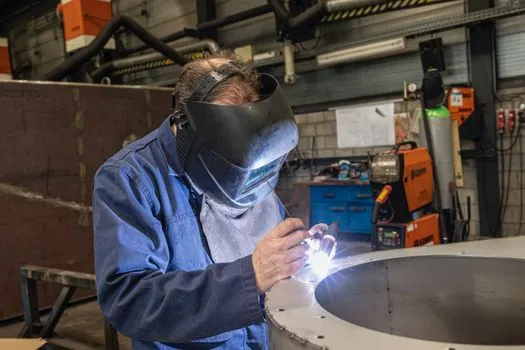
Arc-starting method is a safety and quality gate, not a convenience. High-frequency (HF) start delivers a non-contact arc strike that does not contaminate the tungsten or the workpiece, which is the right default for stainless and titanium work where contact strike pickup is unacceptable [S4]. Lift-TIG uses a low-amperage contact start that eliminates HF electrical noise, important near traffic-loop sensors, variable-message signs, or any roadside cabinet with sensitive controls, while scratch start is the legacy MMA-style strike rarely specified for new equipment [S4].
Torch cooling is the next gate. Air-cooled torches rated around 150 A at the 17 series and 200 A at the 26 series cover most manual work; above roughly 200 A sustained, or for any mechanized or long-duration pass, a water-cooled torch (250 A at the 20 series, 350 A at the 18 series, both at 100% duty) plus a recirculator is the correct call [S3]. For road crews this translates to a simple rule: if the day's repair list includes any pass longer than about 1.5 minutes continuous at above 180 A, spec the water-cooled torch and cooler, otherwise budget for torch handle failures inside the first year.
Shielding gas for road work is almost always pure argon (99.99%) carried in a single cylinder, which is the default for steel, stainless and aluminum [S4]. Argon-helium mixes (typically 75/25) raise arc energy for thick aluminum but are an unnecessary complication for the road-crew truck. Post-flow timers in the 5–30 s range after arc-off protect the tungsten and the cooling bead from oxidation, and any machine without an adjustable post-flow is automatically disqualified for stainless or titanium work [S4]. Road crews that only ever weld mild steel can tolerate a fixed post-flow; crews that also repair stainless handrails and aluminum signposts cannot.
Road-Maintenance Application Map: What to Spec for Each Repair
Crack repair on a steel gusset or beam (typical 4–10 mm): DC TIG, 150–250 A at the joint, 26-series air-cooled torch is generally adequate, 99.99% argon, 2% thoriated or 2% lanthanated tungsten, HF start. This is the bread-and-butter pass and a 200 A class single-phase inverter will cover it with the right technique [S1][S3].
Stainless handrail splice or balustrade repair (1–3 mm tube): pulsed AC/DC, 30–90 A peak, water-cooled micro-torch above 200 A is rarely needed but post-flow must be adjustable; pure argon backing gas on the tube interior prevents sugaring [S4]. This is the application that punishes a DC-only machine, because DC TIG on stainless tube without pulse control burns through on the thinnest sections.
Aluminum signpost base, drainage grate, or light bracket (2–6 mm): AC-balanced TIG, 100–180 A, adjustable AC frequency for cleaning, 2% lanthanated or pure tungsten ground to a balled tip, pure argon [S1][S7]. This is the second-strongest argument for AC/DC on the truck.
Galvanized-steel patching plate over an existing structural member: DC TIG with the zinc ground off the immediate weld zone, or DC stick (SMAW) with a low-hydrogen 7018 electrode when the prep is not practical. TIG over zinc fumes is a health hazard and most road crews should default to stick or grind clean before TIG [S5].
Comparison: Three Workhorse Configurations for a Road-Maintenance Truck
Configuration A, single-phase 200 A DC-only inverter (entry baseline): covers mild steel, stainless up to about 4 mm, copper, brass; 25–35% duty at 200 A; HF or lift-TIG start; 17- or 26-series air-cooled torch; budget-priced; fails on aluminum and on any sustained 200 A+ steel work. Use when the truck is dedicated to steel crack repair and stainless tube and never sees aluminum. [S3]
Configuration B, single-phase 200 A AC/DC inverter with pulse (most common road-crew spec): adds AC for aluminum and magnesium, adds pulse for stainless tube and thin-wall work, post-flow adjustable, 25–35% duty at 200 A; HF start with lift-TIG fallback for EMC-sensitive roadside cabinets; water-cooling optional but recommended for any work above 180 A sustained [S4][S7]. This is the default truck for mixed-base-metal municipal work.
Configuration C, three-phase 350 A AC/DC industrial inverter (heavy repair / bridge work): 40–60% duty at 350 A, water-cooled 18- or 20-series torch with recirculator, full pulse and waveform control, programmable sequences; right when the crew regularly repairs 6–10 mm steel plate and runs back-to-back passes; usually paired with a 10+ kVA three-phase genset on the truck [S3][S4]. Engine-driven welder/generators such as the Lincoln Ranger and Vantage series sit alongside this tier and are the answer when grid power is unavailable at the repair site [S5].
Failure Modes, Limits, and When Not to TIG On-Site
TIG is the wrong process when the base metal is contaminated beyond grinding (heavy rust, thick paint, oil-soaked steel), the joint is in a wind-exposed position that will disperse shielding gas faster than post-flow can compensate, or the operator is not GTAW-qualified. AWS D17.1 governs aerospace TIG and ASME BPE covers hygienic stainless tube, but neither standard applies to a roadside gusset repair; the relevant qualification for the operator is typically ISO 9606-1 or AWS D1.1 for the structural code the asset is built to [S3].
Common on-site failure modes are tungsten contamination (caused by lift-TIG with the electrode touching the filler rod, producing green/white inclusion defects), porosity (caused by insufficient post-flow or wind, producing pinholes in the bead), and burn-through on thin stainless (caused by DC-only operation without pulse, fixable by switching to pulsed AC/DC) [S4]. The hard limitation is heat input: above a defined J/mm threshold, even pulsed AC/DC will distort a thin signpost cap, and the right call at that point is a mechanical clamp plus a stitch-weld sequence rather than a continuous bead.
Spec discipline is the cheapest insurance. Insist on IEC 60974-1 compliance on the power source nameplate, AWS A5.12 classification on the tungstens, ISO 14175 shielding-gas designations on the regulator, and ISO 9606-1 welder qualification for the operator [S3]. None of those markings will fix a wrong-amp decision in the field, but they will keep the chassis and the consumables inside the envelope the manufacturer actually tested. Related process coverage, including stick and MIG selection for the same road-crew environment, sits in this arc welder picks for demolition and field repair companion piece and in the broader arc welding machine selection for electrical installations guide.
Track these signals over the next buying cycle: whether road crews standardize on AC/DC 200 A class inverters or continue ordering mixed DC-only and stick; whether municipalities spec water-cooled torches above the 200 A sustained threshold or accept torch-handle replacement as a line item; and whether HF start is being replaced by lift-TIG on trucks that regularly work near traffic-control cabinets. Each is a verifiable signal of how seriously the spec is being read, not just priced.
Spec-level background on the components involved: road roller, and welding cutting tool.