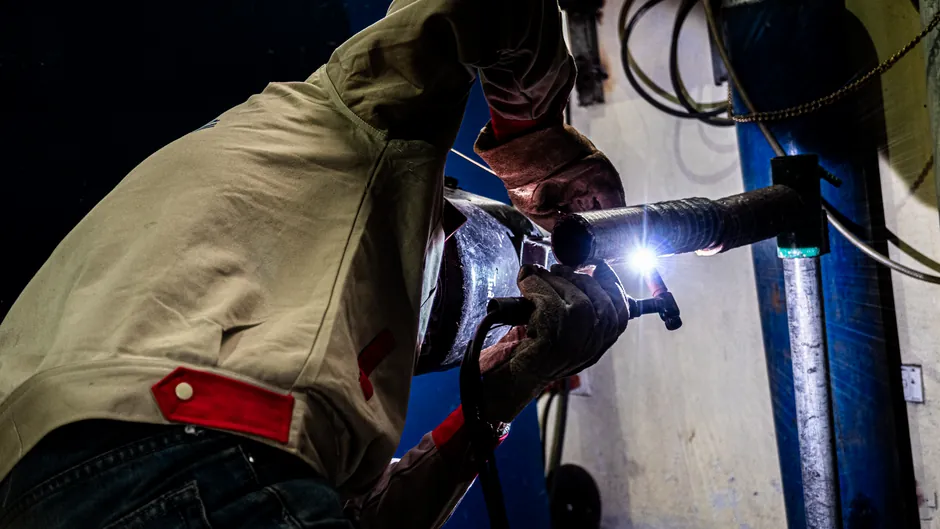
A 160-210 A DC TIG inverter with high-frequency start and 120/240 V dual-voltage input is the working envelope for most plumbing-installation welding, where the dominant base metals are carbon steel, stainless steel, and copper, not aluminum [S2]. For plumbing rigs that run exclusively on steel and stainless tube, AC capability can be dropped to save roughly 50 A of output headroom and a meaningful slice of unit cost [S2]. Field-portable mass matters: anything above ~50 lbs stops being carryable up a riser, into a mechanical room, or across pipe racks, and the procurement decision tilts away from console machines [S2].
Plumbing-installation welding sits at the low-current, position-heavy end of the GTAW spectrum: thin-wall tube (often under 2 mm stainless), all-position joints, and short beads around fittings. That profile is fundamentally different from pipeline-cross-country work, where machines run 200-700 A and 0.25 in (6.35 mm) wall thickness is the typical floor [S4]. Treat plumbing as a precision-bench task that occasionally happens on a ladder, and the spec line writes itself: DC TIG, HF start, pulse for thin-wall distortion control, fingertip torch control, dual-voltage input.
Process envelope: DC TIG, 5-200 A, dual-voltage input
A plumbing-grade TIG machine must hold a stable arc from roughly 5 A up to at least 160 A on 120 V, and to 200-210 A on 240 V, so the same unit can do 0.035 in stainless trim work and 1/8 in schedule-10 carbon-steel socket welds [S1][S2]. HF (high-frequency) start is preferred over lift-arc on critical work because scratch starts contaminate the tungsten and put inclusions into the first half-inch of bead [S1]. The 2026 commercial envelope for manual TIG inverters runs from an 8 kW DC-only class (TELWIN SUPERIOR TIG 421 DC ACC at 400 V three-phase) up to 12.9 kW / 17.3 kW AC/DC pulse units such as the 422 WAVE AC/DC AQUA, which adds aluminum and copper coverage at the cost of size and price [S5]. For plumbing-only fleets, the lower-power DC-only class is the spec sweet spot; for mixed shops that also braze or weld aluminum transitions, the AC/DC pulse class earns its premium.
Minimum capabilities the spec must call out, regardless of brand: AC/DC switch (DC is acceptable, AC only if aluminum is in scope), HF start, foot-pedal compatibility, post-flow control, and a 5-pin or 8-pin Dinse-style remote receptacle for fingertip amps [S1][S2]. Pulse TIG (typically 0.5-2 Hz on thin stainless) is the single most useful feature for plumbing because it controls heat input on thin-wall tube and reduces the warping that ruins a flared or compression joint downstream [S1].
Portability and field power: 50 lb ceiling, auto-line preferred
Plumbing welders carry the machine up scaffolding, across pipe racks, and into mechanical rooms, and mass above ~50 lb self-eliminates a unit from field plumbing work [S2]. The reference benchmark is the Miller Dynasty 210 at 46 lb with 120-480 V auto-line input, which the field-install community treats as the upper-mass limit for a hand-carried unit [S2]. The Miller Maxstar 161 at 120/240 V and up to 160 A in a toolbox-class footprint is the lighter-tier alternative for service trucks where AC and pulse are not required [S2].
Power-source flexibility matters as much as weight. Jobsites deliver unpredictable receptacles: a 120 V/20 A wall outlet in a tenant space, a 240 V/30 A drop in a mechanical room, or a generator with wandering voltage. Auto-line input (120-480 V, single or three-phase, no manual switching) is the field-friendly choice because it removes the adapter-plug error mode that burns receptacles and trips breakers [S2]. Where auto-line is unavailable, dual-voltage 120/240 V switching is the minimum acceptable substitute; fixed 240 V-only machines are a shop-only spec for plumbing crews that work on ladders.
Position welding and fingertip amperage control
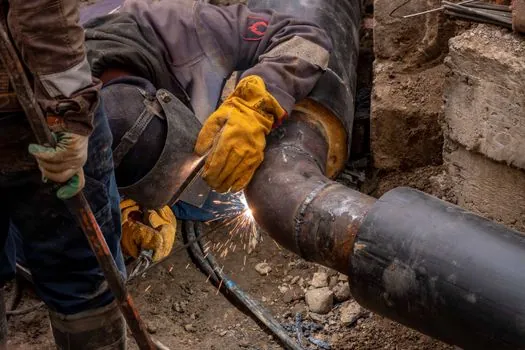
Plumbing welds run all-position: vertical up on risers, overhead in ceiling chases, vertical down on drains, and flat on floor mains, often in a single pass around a socket-weld fitting. A foot pedal does not work for this because the operator cannot reach it, so fingertip amperage control on the torch is mandatory [S2]. Three control styles are in commercial use, and each has a different feel in the hand: Amptrac (slidable collar, push for more amps, requires practice), thumbwheel (rotary dial, precise, one-handed operation), and variable-pressure trigger (squeeze harder for more amps, least precise but most intuitive) [S2]. The machine side of this interface is a 5-pin or 8-pin Dinse-style remote receptacle, and it must be confirmed against the chosen torch before procurement, not at the jobsite [S2].
Arc stability across positions is the second field requirement. Premium machines hold consistent arc character from flat through overhead; budget machines sometimes show a different arc shape overhead versus flat, which forces the operator to retune technique mid-bead [S2]. A stable low-amp end (under 10 A) is equally important because plumbing often lands on 0.035-0.049 in wall stainless, where the puddle needs to stay alive without blowing through. AC balance and frequency controls are unnecessary for plumbing unless aluminum is in scope; on DC they add no value, and the controls on the front panel should be minimized for plumbing-only operators [S1].
Comparison: three machine classes lined up against plumbing criteria
The procurement decision reduces to a four-criterion comparison: output range, mass, input flexibility, and process coverage. The three candidate classes in the 2026 market are: (a) DC-only portable inverters in the 160-200 A bracket at roughly 46-50 lb and 120/240 V input, exemplified by the Miller Maxstar 161 at up to 160 A and the Primeweld TIG225X with pulse and CK torch in the mid-40-lb range; (b) AC/DC pulse mid-size inverters in the 200-250 A bracket at higher mass, exemplified by the Miller Dynasty 210 at 46 lb, 3-210 A, 120-480 V auto-line, and a price band of $3,200-3,500; and (c) high-power shop multiprocess inverters at 11-17.3 kW on 230 V single-phase / 400 V three-phase dual input, exemplified by the TELWIN SUPERIOR TIG 422 WAVE AC/DC AQUA and the INVERPULSE 40.40 WAVE, which are trolley-mounted and water-cooled [S2][S5]. For plumbing-only fleets, class (a) hits the cost-versus-capability floor; for mixed shops that also weld aluminum, class (b) is the correct single-machine answer; class (c) is a fabrication-shop tool that is over-spec for service-truck plumbing.
On cost, the 2025-2026 price band runs from roughly $500-600 for a Primeweld TIG225X with pulse and a CK torch, through $1,200-1,500 for a Maxstar-class DC-only portable, up to $1,800-2,000 for a Lincoln Precision TIG 225, and $3,200-3,500 for a Miller Dynasty 210 [S2]. The marginal spend from class (a) to class (b) buys AC capability, pulse, and 50 A of output headroom that plumbing rarely uses; the marginal spend from class (b) to a multiprocess shop inverter buys MIG/MMA capability that is irrelevant to tube-installation work [S2][S5].
When TIG is the wrong process for plumbing
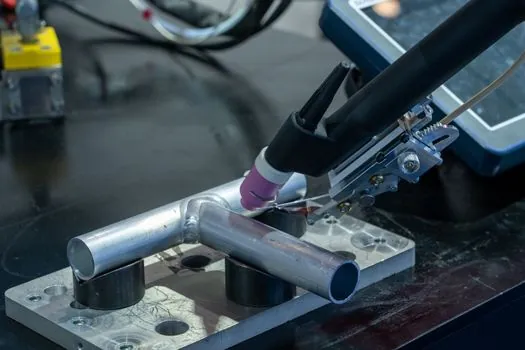
TIG is not always the right answer on a plumbing rig. For carbon-steel pipe 0.25 in (6.35 mm) wall and thicker, in outdoor or rough-position work, stick (SMAW) and MIG (GMAW) multiprocess machines in the 200-700 A bracket are the more productive spec, and the pipeline-welding literature treats them as the default for that wall-thickness range [S4]. For high-deposition, long-bead cross-country pipeline work, submerged-arc welding (SAW) is the correct process, not TIG, and the right machine is a Miller SubArc-class DC submerged-arc unit, not a handheld inverter [S4]. Plasma arc (Hypertherm Powermax-class) is reserved for cutting and precision keyhole work, not plumbing installation, and should not be specified for a plumbing rig [S4].
The auto-pipe-welding case is a separate procurement problem. Field data for the MWG-230 automatic pipe-welding head reports a measured project recovery of 99.2%, a 90% reduction in the first-pass RT rejection rate, and cleanup and repair work of zero [S6]. Plumbing-installation welds, which are short, varied, and fit-by-fit, are the wrong application for automatic orbital heads because the setup time per joint is longer than the weld time. Related 2026 procurement guidance for steel-construction TIG specification and architectural trim TIG spec follows the same process-and-dissimilar-metal logic and is worth cross-reading if the plumbing scope also touches structural or finish metalwork.
Duty cycle, gas, and acceptance criteria for plumbing welds
Spec the duty cycle at the heaviest joint, not the average. A 200 A class inverter at 40% duty cycle (200 A for 4 minutes in a 10-minute window) is the typical 2026 commercial rating, and a plumbing crew that runs more than four minutes of arc time on a single riser should drop amperage or step up to a 250-350 A class machine to avoid thermal cutout [S1]. Air-cooled torches (WP-9, WP-17, WP-26) are adequate up to about 200 A with moderate duty; water-cooled torches (WP-20) are correct above 200 A and on extended aluminum runs, but they require a cooler, hoses, and a maintenance routine that a small plumbing shop will rarely want to own [S1].
Shielding gas is argon for steel, stainless, and copper; helium-blend argon (75/25) is used for thicker copper and aluminum but is uncommon on plumbing rigs. Post-flow control on the power source matters because plumbing welds on thin-wall stainless oxidize quickly without trailing shielding. Acceptance criteria for a plumbing weld are visual: full penetration, no porosity, no discoloration beyond light straw on stainless (which indicates correct heat input and gas coverage), and no undercut at the toe. The relevant reference for process behavior, not procurement, is the TIG welder encyclopedia entry and the welding cutting tool page for torch and consumable geometry; for general machine fit-up the cutting machine reference covers the related plasma-class equipment that is sometimes confused with high-amperage TIG in plumbing shops.
Track for the next quarter: any 2026 Q3/Q4 release notes from TELWIN, Miller, Lincoln, and Schnelldorfer on auto-line plumbing-class inverters under 40 lb, and any revision to the AWS D1.1 / ASME Section IX procedure-qualification coupling that affects small-diameter thin-wall stainless tube. Also watch for the next round of field-failure data on the Maxstar 161-class machines in service-truck duty, where warranty claims tend to surface first.