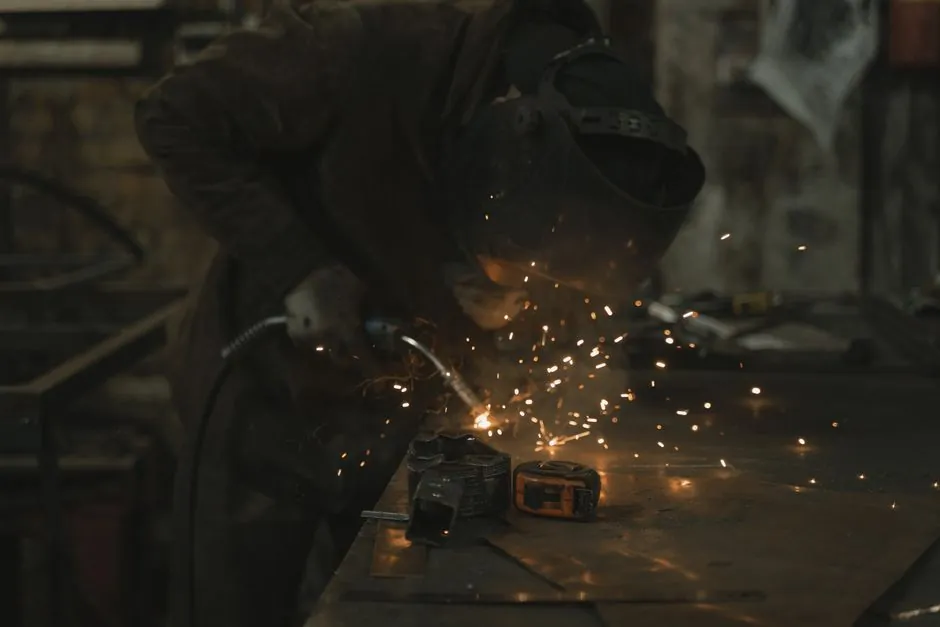
A TIG (GTAW) welding machine is sized by output current, duty cycle, current type, and arc-start method, while masonry is a non-conductive substrate that the process cannot join directly, so the welder is selected for the steel, stainless, or aluminum components mounted to or embedded in the masonry, not the masonry itself.
Masons, bricklayers, and stone-facade contractors who need a TIG set are typically welding embedded plates, rebar couplers, anchor straps, structural steel lintels, or thin stainless flashings that tie into CMU, brick, or stone. The TIG power source is specified to the metal, with masonry acting as a thermal mass and restraint, not as a workpiece.
Why TIG Is Specified for the Metal, Not the Block
TIG is the precision arc process under the AWS term GTAW, using a non-consumable tungsten electrode and inert shielding gas, typically argon, to produce clean, spatter-free welds on thin sections and non-ferrous alloys [S1][S4]. It is not an adhesive or fastening process, so it cannot bond to concrete, brick, mortar, or stone; it welds the steel or aluminum components that interface with the masonry, such as 1/8 inch (3.2 mm) anchor straps, 1/16 inch (1.6 mm) stainless flashing, or 1/4 inch (6.4 mm) aluminum trim.
For masonry-adjacent work, the governing selection rules still come from the four interacting parameters: current type (DC, AC/DC, or pulsed), maximum output in amperes, duty cycle at that output, and arc-start method (HF, lift-TIG, or scratch start) [S7]. Each parameter gates which base metal and joint geometry the unit can weld, independent of whether the surrounding structure is CMU, brick, or stone.
Amperage and Material Gates
Output current sets the thinnest and thickest material a TIG machine can weld, with a general rule of thumb of about 1 amp for every 0.001 inch of material thickness; aluminum requires more current than steel for the same thickness because it dissipates heat so well [S6]. Reference amperage windows in published guides: 1/16 inch (1.6 mm) steel at 60-80 A, 1/8 inch (3.2 mm) steel at 110-130 A, 1/8 inch (3.2 mm) aluminum at 140-160 A, and 1/4 inch (6.4 mm) aluminum at 200-225+ A [S6].
A wide low-end range, ideally single-digit amps, is what lets a TIG weld foil-thin stainless flashing or shim stock common in masonry detailing, while a 200-250 A ceiling covers 1/4 inch (6.4 mm) aluminum plate and thick steel embeds [S4][S8]. A 10-200 A range suits most mixed masonry-construction work; below 5 A minimum, HF start behaviour on thin gauge becomes inconsistent in real shop conditions.
AC/DC, Pulse, and Arc-Start Selection
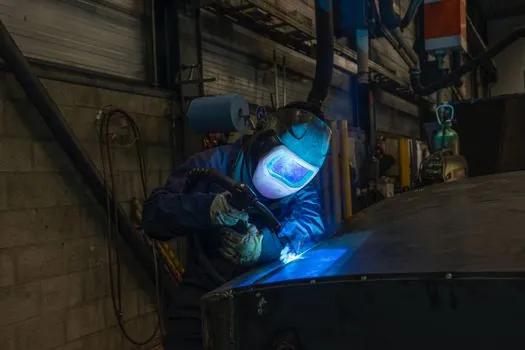
AC capability is non-negotiable for any aluminum or magnesium work, including aluminum coping, trim, and composite panels on masonry facades; DC handles steel, stainless, titanium, and nickel alloys [S2][S3]. A dedicated DC machine is the lower-cost route for steel-only anchor and strap work, while an AC/DC unit is mandatory if the same crew welds stainless flashing one day and aluminum soffit panels the next.
Pulsed TIG, defined as a modulated peak-and-background current waveform, is useful on thin stainless flashing because it limits heat input and reduces distortion on the visible side of the trim. High-frequency (HF) start is the standard for clean arc initiation without touching the tungsten to the workpiece, which protects the electrode geometry on cosmetic welds; lift-TIG and scratch start are contact methods that save cost but can contaminate the tungsten on production work [S3][S7].
Duty Cycle, Power Input, and Portability
Duty cycle, the percentage of a 10-minute period the machine can deliver rated output at a given temperature, is governed by the IEC 60974-1 welding power source standard; a 60% duty cycle at 200 A is the typical industrial baseline, with cheaper inverter units dropping to 30-35% at the same output [S4]. Anchor-strap and flashing work rarely stresses a machine, but stainless architectural welding and aluminum panel welding run longer arcs and expose underspec'd inverters to thermal cutout.
Input power choices are 110-120 V single-phase, 220-240 V single-phase, or 400 V three-phase; dual-voltage 110/220 V inverters are the most flexible for site work where a 220 V outlet is not guaranteed, while 400 V three-phase is standard in fixed fabrication shops [S3][S9]. Compact inverter TIG machines are far lighter than transformer-based units, and the trade-off is shorter duty cycle at peak output.
Shielding Gas, Tungsten, and Consumables
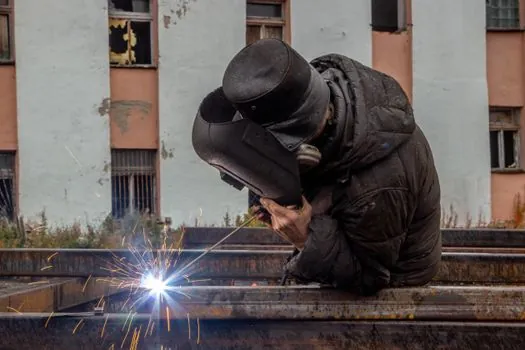
Argon is the default shielding gas for steel, stainless, and most aluminum; the AWS / ISO 14175 designation carries the gas code, with pure argon (ISO 14175 - I1) the common shop choice [S4]. Helium-argon mixes are used for thicker aluminum where higher heat input is needed, but they cost more and are rarely justified for masonry-adjacent trim work under 1/4 inch (6.4 mm).
Tungsten electrode selection follows the AWS A5.12 classification: 2% lanthanated (AWS A5.12 EWLa-2, color code blue) and 2% ceriated (EWCe-2, grey) are the modern replacements for thoriated (red) electrodes, with EWLa-2 widely used as a non-radioactive general-purpose choice for both DC and AC [S4]. A common shop rule is 1/16 inch (1.6 mm) tungsten for 5-70 A work, 3/32 inch (2.4 mm) for 70-150 A, and 1/8 inch (3.2 mm) for 150-250 A.
Comparison: Machine Class vs Masonry-Adjacent Use
Entry-level DC-only inverter (110/220 V, 10-160 A, 30-40% duty at max): suits steel-only anchor and rebar-strap work on CMU and brick, where 1/8 inch (3.2 mm) steel at 110-130 A is the upper end. Mid-range AC/DC inverter (220 V, 5-200 A, 40-60% duty at 200 A): the general-purpose choice for mixed steel, stainless flashing, and aluminum coping on masonry facades. Production AC/DC water-cooled (400 V 3-phase, 10-400 A, 60% duty at 300+ A): reserved for shop fabrication of stainless and aluminum architectural assemblies that bolt to masonry, not for site tie-in work. [S4]
Selection criteria lined up: (1) material range, AC/DC covers both steel and aluminum while DC-only excludes aluminum; (2) duty cycle, 60% at rated output is the floor for production, 30-40% is acceptable for occasional site work; (3) input power, dual-voltage 110/220 V is the site-friendly default, 400 V 3-phase is shop-only; (4) arc start, HF is required for clean cosmetic welds on visible flashing and trim, lift-TIG is acceptable only on non-cosmetic structural welds.
Limits, Failure Modes, and What TIG Will Not Do
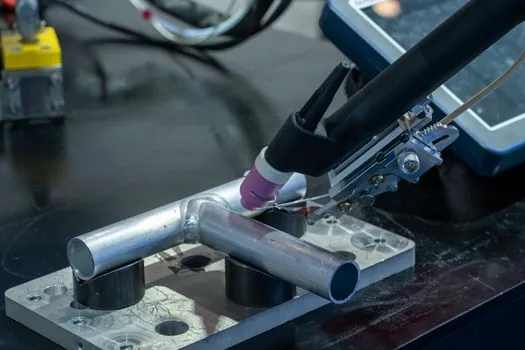
TIG cannot weld masonry, concrete, brick, block, or stone directly because these are non-conductive substrates that do not form the electrical circuit an arc needs; attempts to strike an arc on CMU will simply spall the surface and damage the tungsten [S4][S7]. The process is also slower than MIG/GMAW (Gas Metal Arc Welding) and requires higher operator skill, so on thick steel embeds above 1/4 inch (6.4 mm) a MIG or stick process is more cost-effective, with TIG reserved for the visible or code-critical welds.
Common failure modes in masonry-adjacent TIG work: tungsten contamination from accidental contact start on rusty anchor plates, porosity from drafts on outdoor flashing work (wind breaks the shielding gas envelope), and cracking on aluminum trim welded without adequate cleaning (oxide layer reform within minutes of abrasion) [S1][S3]. A 5-10 second post-flow of shielding gas after arc extinction protects the tungsten and weld from oxidation as it cools, and is non-negotiable on production work.
Specification Standards and Sourcing
The governing standard for the TIG power source itself is IEC 60974-1, which defines duty cycle, input voltage, and rated output; welder qualification falls under ISO 9606-1, tungsten classification under AWS A5.12, and shielding gas designation under ISO 14175 [S4]. For masonry-side anchoring that interacts with the welded components, the relevant fastener and embed standards are separate (e.g. ACI 318 Appendix D for concrete anchors in the U.S.), and the TIG selection does not change those rules.
Trackable signals for a 2026 spec refresh: any revision of IEC 60974-1's duty cycle test method, the ongoing industrial shift from thoriated (red) to lanthanated (blue) tungsten for non-radioactive compliance, and the spread of pulse-capable mid-range AC/DC inverters into the under-USD 1500 price band. For the broader process-vs-material decision across a building site, an HVAC-side comparison of arc processes is mapped in this arc welding machine selection spec gate guide, and the underlying TIG reference parameters sit in the TIG welder encyclopedia entry.
Spec-level background on the components involved: masonry insulation, and welding cutting tool.