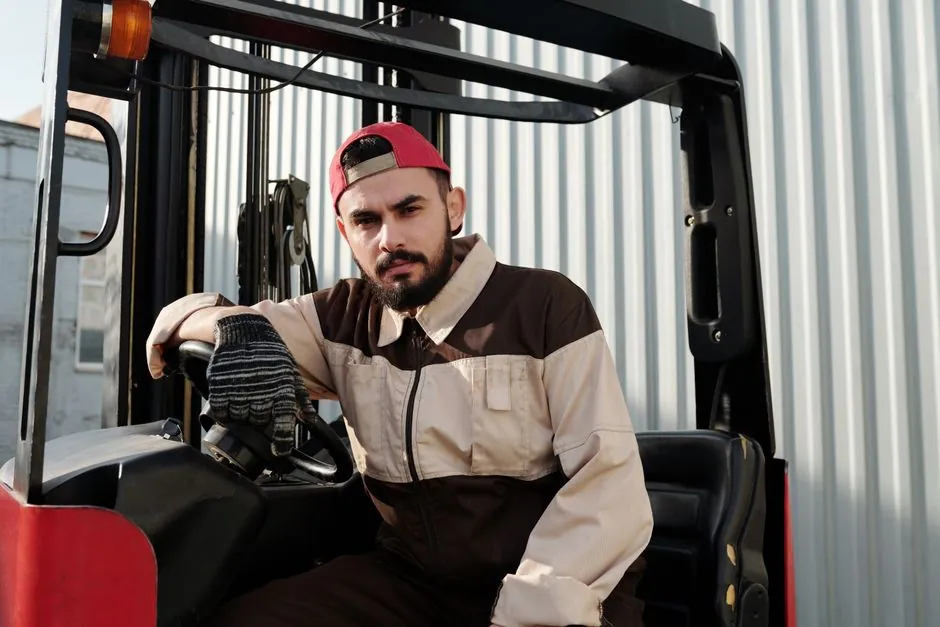
A 4WD diesel rough terrain forklift in the 3.5-5.0 t class with 250-300 mm minimum ground clearance and 23.5-70-16 herringbone pneumatic tires is the practical baseline for municipal solid waste (MSW) landfill cell work, where the substrate is a mix of compacted clay, daily cover soil, and demolition debris [S1][S2].
Landfills differ from construction sites or farms in three ways: the ground is often a moving cover (6-12 inches of new soil per day), leachate seeps across the working face, and the payload is rarely a uniform pallet, often being bales, drums, or containerized waste. The selection must reflect those three conditions, not the smoother assumptions used in forklift catalogs written for warehouse aisles.
Capacity Bands: 1.8-3.5 t, 5.0 t, and 10.0 t
Rated load, load center, and operating weight define three distinct classes available from current OEM lineups, and the choice is dictated by bale weight and trailer size rather than by raw lift height [S1][S2][S4][S5].
The 3.5 t class (CPCD35T-A) delivers 3500 kg at a 500 mm load center, with 30/33 km/h travel, 400/500 mm/s lift, an 8 deg forward / 11 deg rear mast tilt, 250 mm ground clearance, and an 80 L diesel plus 80 L hydraulic tank; operation weight without counterweights is 3565 kg plus 1200 kg of counterweight [S1]. The 5.0 t class (CPCD5.0T-Y) lifts 5000 kg at 500 mm load center, 300 mm ground clearance, 85 L tanks, and a 5750 kg operating weight plus 800 kg counterweight [S2]. The 10.0 t class (CPCD10T-A) lifts 10000 kg at 500 mm load center, 370 mm ground clearance, 150 L fuel / 80 L hydraulic tanks, with a 9800 kg operating weight plus 4500 kg counterweight, powered by a DongFangHong 6105 at 103 kW [S4].
For bale handling at transfer stations, 3.5 t is typically sufficient. For moving roll-off containers or stacked drum pallets on a working face, 5.0 t is the engineering default. 10.0 t units are reserved for heavy debris cells, scrap metal staging, or large soil-screen feed hoppers, and their 5350 mm overall length and 3750 mm turning radius make them problematic on narrow access roads above the liner [S4].
Drivetrain and Tire Choices for Leachate and Cover Soil
Hydraulic 4-wheel drive, 23.5-70-16 herringbone pneumatic tires, and a two-speed split gearbox (Model 278) are the current OEM spec on the 3.5 t and 5.0 t classes [S1][S2]. Compact 4WD models (FD18T, FD25T, FD35T) add a 4WD system to a 2WD chassis and are available in 1.8-3.5 t capacities with 12-16.5-12PR front and 10.0/75-15.3 rear tires, but the unladen ground clearance drops to 215-230 mm and the max drawbar pull is 38 kN on a 45-80% gradeability curve [S5].
On a working face with 6 inches of fresh daily cover plus intermittent standing water, the 250-300 mm ground clearance of the 3.5-5.0 t classes becomes the decisive spec, not the lift speed. A rough terrain forklift running on herringbone pneumatic tires at 0.62/0.55 MPa inflation will outperform a solid-tire compact 4WD on mud, because the herringbone pattern clears itself, but the trade-off is puncture risk from demolition debris and scrap metal, which is why most landfill operators spec the optional semi-pneumatic or solid tire as a retrofit [S1][S2][S5].
Steering Geometry: Articulated vs. Compact 4WD
The 3.5 t class uses front-articulated steering with a 2950 mm minimum inside turning radius, while the 5.0 t class is built around integrated rear-wheel steering with a tighter 2500 mm inside turning radius, and the 10.0 t uses front-wheel steering with a 3750 mm inside turning radius [S1][S2][S4].
On a lined cell with 40-50 ft working-face width, the 2500 mm inside radius of the 5.0 t class is the practical minimum for a single-pass turn with a load; the 2950 mm radius of the 3.5 t front-articulated unit demands slightly more swing room, but its 1840 mm wheelbase and 3800 mm overall length keep it inside the lane width of a standard transfer trailer. The 10.0 t unit, at 5350 mm overall length and 3750 mm inside turning radius, should be restricted to the soil-screen area and main haul road, not deployed on the active cell [S1][S2][S4].
Mast, Lift Height, and Free-Lift Constraints
Standard mast on all three classes is a 2-stage 3000 mm unit, with options from 3500-7000 mm (3.5 t) and 4000-7000 mm (5.0 t and 10.0 t), and free-lift height of 100-165 mm depending on class [S1][S2][S4][S5].
Landfill work is rarely a high-mast application: most loads are pickup-height, not container-stacking-height. A 3-4 m lift covers transfer trailers and most roll-off boxes; selecting 6-7 m masts for landfill duty adds cost, raises the load center, and reduces residual capacity. The fork dimensions matter more: 1220x120x45 mm forks on the 3.5 t class and 1520x120x45 mm forks on the 5.0 t class are sized for standard pallets, while 1520x150x45 mm forks on the 10.0 t class are needed for drum pallets and heavy debris boxes [S1][S2][S4].
Brakes, Engine, and Maintenance Windows
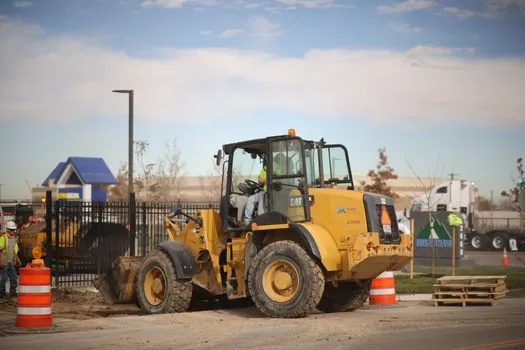
Air disc brakes are standard across the 3.5-10.0 t classes, and the 3.5 t and 5.0 t both use a QuanChai 493 CN-4 diesel at 36.8 kW, while the 10.0 t uses a DongFangHong 6105 at 103 kW [S1][S2][S4]. Compact 4WD models run a China-built FSDT35I transmission with 2 forward / 1 reverse stages, 16.5-20 MPa operating pressure, and 12 V / 90 Ah battery [S5].
For a landfill fleet, the 36.8 kW engine on the 3.5-5.0 t classes is the right power density: enough for sustained 30/33 km/h roading between the cell and the transfer station, but not so oversized that DEF consumption and diesel particulate filter (DPF) regen cycles create a maintenance liability. The 103 kW engine on the 10.0 t class is justified only when the unit is also feeding a soil screen or moving scrap metal containers. Air disc brakes are a meaningful upgrade over hydraulic drum for landfill duty because they tolerate the wet, clay-coated environment at the cell face without the fade seen on long downgrades from perched fill platforms [S1][S2][S4][S5].
Selection Matrix for Landfill Service
The decision is a 2-axis problem: payload weight on one axis, and ground-condition severity on the other. Below is a working matrix drawn from the OEM spec sheets [S1][S2][S4][S5].
Class 1.8-2.5 t compact 4WD: suited to transfer stations, baling areas, and short-haul pavement work; ground clearance 215-230 mm rules it out on active wet cells. Class 3.5 t articulated: the default for daily cover handling, bale loading, and roll-off box work; 250 mm clearance and 1200 kg of counterweight handle the typical 2.5-3.0 t bale plus fork weight. Class 5.0 t rear-steer: the default for drum pallet handling, containerized waste, and soil-screen feed; 300 mm clearance and 5000 kg at 500 mm load center cover the 4-4.5 t drum cluster. Class 10.0 t: reserved for scrap metal staging, heavy debris cells, and high-volume soil-screen feed; the 5350 mm length and 3750 mm turning radius restrict it to the main haul road. Across all classes, 23.5-70-16 herringbone pneumatic tires are the default, with optional solid or semi-pneumatic retrofits for puncture-prone debris cells [S1][S2][S4][S5].
Common Failure Modes and Rejection Triggers
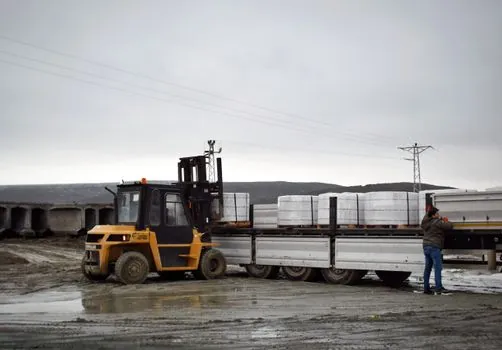
Three failure modes show up repeatedly in landfill rough-terrain forklift service: (1) hydraulic contamination from airborne dust at the soil screen, which mandates 80-85 L hydraulic reservoirs and strict 250-hour filter discipline; (2) tire punctures from demolition debris, which forces the solid-tire retrofit on debris cells; (3) brake fade on long downgrades from perched fill, which is why air disc brakes are a must above 3.5 t [S1][S2][S4][S5].
Reject any compact 4WD unit (FD18T / FD25T) specified for active wet-cell duty on the ground clearance alone: 215-230 mm unladen is below the 250 mm threshold most landfill safety plans require. Reject any 10.0 t unit on a working face with less than 50 ft of swing room. And reject any spec that omits the tire-pressure spec at the operating pressure, because under-inflation by 0.1 MPa is the single most common cause of sidewall failure on herringbone pneumatic tires in this service [S1][S2][S4][S5]. For comparison with adjacent specs, see the spec path for demolition-project rough terrain forklifts and the tunneling low-headroom forklift spec path.
Spec-level background on the components involved: pressure transmitter.