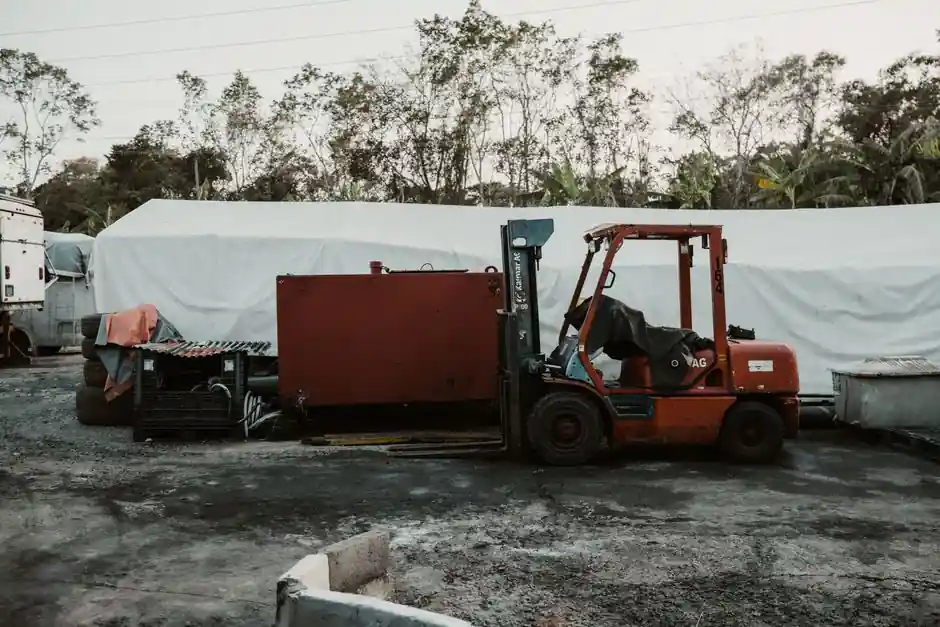
Demolition yards need a rough terrain forklift with rated load 3.0 to 10.0 tons, full-time 4WD (4x4) driveline, articulated frame, and 250 mm or more of ground clearance to cross broken slab, rebar mat, and soft backfill without high-centering [S5]. The current production sweet spot for structural demolition work is the 3.5 t class with 500 mm load center, 3.0 to 6.0 m duplex or triplex mast, and a Weichai or Cummins diesel rated 36.8 to 110 kW that already meets EPA Tier 4 final or Euro V emission tiers [S3][S5].
Demolition is not a warehouse: a standard 2WD cushion-tire lift truck will bottom out on the first rut and lose traction on mixed rubble, so the rough terrain forklift class is the baseline spec, not an upgrade. A correctly sized unit replaces one excavator, one skid-steer, and one telehandler on small-to-medium structural tear-downs, with attachments (bucket, grapple, jib, rotator) that turn the same chassis into a sorter, loader, and hoist.
Demolition Workload: What the Chassis Has to Survive
A demolition site is a moving hazard map, so the spec must cover three failure modes before capacity: surface, debris, and gradient. On broken concrete, compacted soil, and rebar-strewn mud, 12-ply 405 mm flotation tires inflated to a maximum 350 kPa keep the contact patch wide enough to avoid cuts while carrying the rated load [S9].
Ground clearance has to clear rebar chairs, slab edges, and trench lips, and 250 mm is the common OEM minimum for the 3.5 t class, with overall height held near 2,700 mm so the unit can pass under standard site hoarding and through 3 m gates [S2]. Travel speed matters less than tractive effort, but a 30 to 40 km/h loaded/unloaded maximum lets the operator reposition between drop zones without a low-bed trailer [S3].
Capacity, Mast Height, and Load-Center Math
Rated capacity is stated at a 500 mm load center, which is the ASTM/ISO convention for forklift nameplates, and the JAC CPCD35J publishes 3,500 kg at 500 mm LC with a 3,000 mm two-stage mast as the baseline configuration [S1][S10]. For demolition, add a 3-stage full-free-lift mast so the operator can unload inside low clearances (basements, containerized sorting bays) without tilting the load into the overhead guard.
For sorting mixed C&D debris, a 3.5 t unit with forks sized 50 x 125 x 1,070 mm (or the heavier 1,220 x 120 x 45 mm pattern on articulated 4x4 chassis) handles a standard masonry pallet, while 5.0 to 10.0 t chassis (CPC-50, CPC-60) are reserved for steel beam lifts, concrete panel extraction, and bulk aggregate reloads [S2][S3][S10]. Mast tilting of 10 degrees forward and 10 degrees rear on the JAC platform, or 8 degrees forward and 11 degrees rear on the Luken articulated chassis, lets the operator self-level loads on a 5 to 8 percent cross-slope without a second banksman.
Driveline, Engine, and Emission Tier
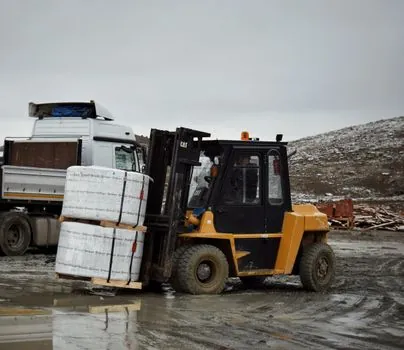
Full-time 4WD with a split two-speed gearbox (model 278 on the Luken CPCD35T-A) and an automatic differential lock is the standard pattern, and the 3.5 t class uses a YunNei 490 CN-4 diesel at 42 kW, while the 6.0 t class climbs to 110 kW with a Weichai or Cummins option [S2][S3][S5]. For urban demolition near occupied buildings, EPA Tier 4 final and Euro V are the documented compliance tiers, and they are met by the current Weichai and Cummins calibrations offered as OEM options.
Hydraulic capacity drives attachment performance, and 80 L hydraulic tank paired with an 80 L diesel tank on the 3.5 t articulated unit is typical, enough to run a hydraulic breaker, grapple, or auger continuously through a demolition shift without thermal cut-out [S2]. Air-over-hydraulic disc service brakes are now standard on the articulated 4x4 class, which matters when the unit is fully loaded downhill on a rubble ramp.
Attachments: Matching Tool to Debris Stream
The 3.5 t articulated chassis typically lists side shifter, 3-stage mast, tilting device, bucket, wood grab, snow plough, corn bale clamp, crane jib, fork extension, rotator, and air conditioner as factory options, and the demolition subset is bucket, grapple, jib, and rotator [S2]. A hydraulic rotator on a grapple turns the forklift into a single-operator sorter for mixed C&D, separating rebar, masonry, and timber in the drop zone without a second machine.
For brick and stone yard work, a bucket attachment on the same mast lets the same chassis reload 1.0 to 1.5 t of rubble per pass, replacing a small wheel loader. Fork extensions are the cheapest upgrade and let the operator pick long timber, steel rail, or formwork panels that exceed the standard 1,070 to 1,220 mm fork length, but they derate capacity, so the spec must call out the reduced load at the extended load center.
Selection Comparison: Three Common Demolition Chassis
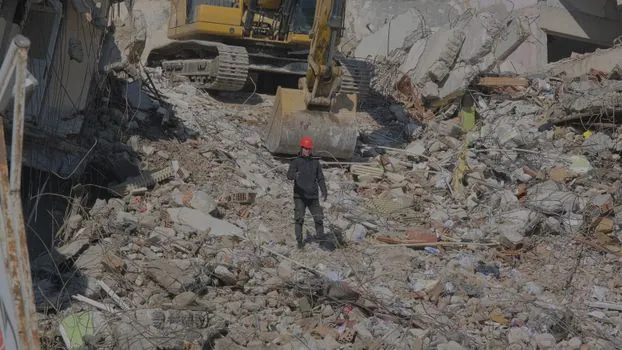
For a structural demolition contractor, three chassis patterns cover 90 percent of jobs. The JAC CPCD35J is a straight-mast 2WD-derived 4WD rough terrain unit at 5,140 kg service weight, 2,985 mm length, and 1,610 mm width, ideal for tight urban infill sites where an articulated joint would reduce maneuverability [S1][S10]. The Luken CPCD35T-A articulated 4x4 trades turning radius (2,950 mm inside) for chassis oscillation over broken ground, at 3,565 kg operating weight plus 1,200 kg counterweight option [S2].
The STLTG CPC-60 at 7,500 kg vehicle mass, 4,720 mm length, 110 kW power, and 12R22.5 tires is the heavy demolition pattern for steel erection, panel extraction, and quarry-face work [S3]. Tires scale with chassis: 20.5/70-16 on the 3.5 t, 16/70-20 on the 4.0 t, 16/70-24 on the 5.0 t, and 12R22.5 on the 6.0 t, and the wrong tire on a demolition site cuts service life by half. Minimum turning radius tracks the same curve: 3,200 mm on the CPC-35C, 3,900 mm on the CPC-40, 4,000 mm on the CPC-50, and 4,050 mm on the CPC-60 [S3].
Site Safety Gates: Tires, Brakes, Cab, and Visibility
Four gates must close before a unit is accepted onto a demolition site. First, tires: 405 mm flotation, 12-ply, 350 kPa max cold inflation, with a spare on the truck because demolition punctures a tire every 200 to 400 hours on average [S9]. Second, service brakes: air-over-hydraulic disc on at least the front axle, with a park brake that holds on the maximum site gradient.
Third, overhead guard: 2,285 mm cabin height on the JAC platform clears a seated operator with a hard hat, and a FOPS (Falling Object Protective Structure) rated roof is the de facto requirement when the mast is working under a partially demolished slab [S10]. Fourth, visibility: a wide-view mast with the hydraulic hoses routed inside the mast channels, plus a rear-view camera and amber beacon, are the minimum kit for a shared drop zone where the forklift works within 5 m of an excavator.
Cost, Lead Time, and the 2026 Market Signal
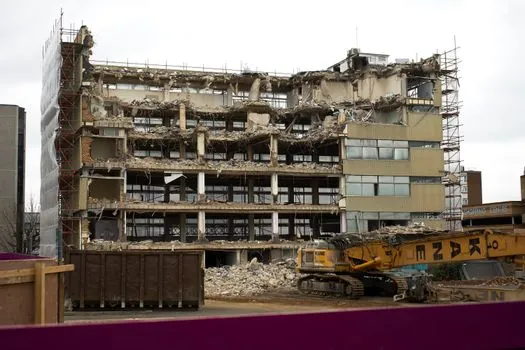
List price for a 3.0 to 10.0 t rough terrain forklift in 2026 ranges from USD 4,500 to USD 15,000 FOB for Chinese OEM builds, against USD 6,000 to USD 20,000 for European and Japanese equivalent chassis, with the 3.5 t articulated 4x4 sitting at the lower third of that band [S3]. Lead time is 15 to 30 days for stock configurations and 45 to 60 days for non-standard mast height, engine tier, or attachment packages [S3].
The 2026 to 2030 market signal is the rental channel: equipment rental fleets are refreshing toward Tier 4 final / Euro V diesel and full-time 4WD with articulated frame, because one chassis now serves construction, mining, and event-industry customers and that utilization is what pays the lease [S5]. For a demolition contractor, the implication is that late-model used articulated 4x4 stock is available from rental fleet refresh, typically with 2,000 to 4,000 hours, at 40 to 55 percent of new list. For crews who also pour, finish, and service equipment on the same site, the spec should also include a demolition hammer pairing for concrete slab work, since the same hydraulic flow and operator skill set transfer directly from the forklift chassis to a compact breaker.
Track these three signals before the next purchase decision: rental fleet refresh auctions in Q4 2026, the next Euro VII proposal cycle for off-road diesel (expected to tighten NOx further on the >75 kW class), and the rollout of factory-installed telematics that log load weight, cycle count, and impact events, which is how insurers are now pricing demolition fleet policies. Crews who also handle industrial valve change-out on process plant tear-downs will find the same articulated 4x4 chassis doubles as a pipe rack handler with a 1,500 kg jib attachment.
For related coverage, see Sand Cooler Selection for Telecom Enclosures: Sizing Rules and Closed-Loop Picks.