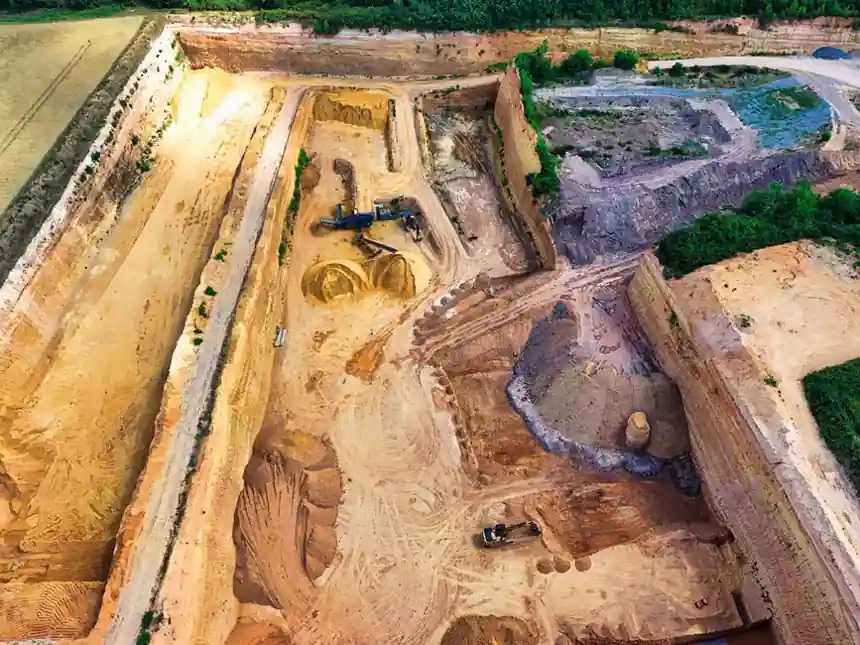
Quarry buyers in 2026 are converging on 4WD articulated diesel rough terrain forklifts in the 5-15 t class, with 30 degree slope rating, off-road tyres sized for boulder fields, and reinforced masts for stone-block cycles [S4][S5].
Selection hinges on three measurable gates: lift capacity at the mast tilt and height the block cycle actually uses, ground clearance and tyre size for the quarry floor, and engine cooling plus dust sealing for continuous abrasive-air duty. Each gate is checked against the manufacturer's load chart, not the marketing nameplate [S5].
What a quarry-spec rough terrain forklift must deliver
A quarry-class rough terrain forklift is a purpose-built off-road lift truck, not a padded warehouse unit: 4-wheel drive, articulated steering, large-diameter traction tyres, a heavy-duty mast, and a diesel powertrain sized for continuous low-speed load handling on grades up to 30 degrees [S4][S5].
Capacities cluster in three working bands that map to quarry duty: 3-5 t compact units for small sites and yard feeding, 6-10 t mid-range machines for block and slab handling, and 10-16+ t heavy-duty chassis for granite slabs up to 8 t, quarry blocks around 10 t, and bulk-bag cycles [S3][S5]. The articulated chassis lets a single machine pivot inside loading bays where a rigid-frame telehandler or standard counterbalanced forklift would have to multi-point turn, which matters on narrow quarry benches [S1][S2].
Compared with a standard forklift on smooth concrete, a quarry rough terrain unit trades top travel speed and lift height for axle articulation, high ground clearance, and chassis strength, the trade is deliberate and should be priced in [S1][S2].
Selection criteria, ranked by what breaks a quarry cycle
Selection criteria, ranked by what actually breaks a quarry cycle, should run in this order: load capacity at the working lift height and mast tilt, drivetrain and tyres for the floor, mast and attachment match, engine and filtration for dust and heat, then total cost of ownership across the hire-versus-buy decision [S4][S5].
Capacity is governed by the load chart, not the nameplate: a 10 t nameplate can drop materially at full lift with mast tilted forward, so write the required capacity at the worst-case combination of height plus reach into the specification [S4]. The 5-15 t band dominates quarry and mining procurement because it covers the stone-block, slab, and equipment-handling envelope most quarries actually cycle [S5].
Drivetrain and tyres set the floor: 4WD with differential lock, heavy-duty off-road tyres sized to clear loose rock without bridging on ruts, and ground clearance that lets the chassis straddle a boulder line without high-centering [S4][S5]. For a baseline rough terrain forklift spec sheet, the on-paper minimums for a working quarry are 4WD, articulated frame, diesel engine, heavy-duty mast, and operator cabin with ROPS/FOPS protection, with a slope rating of 30 degrees as a working reference [S4][S5].
Quarry use cases by class
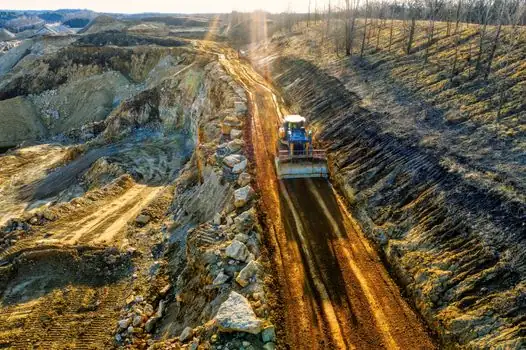
Quarry use cases by class break down cleanly: 3-5 t machines feed crushing lines and move palletised consumables, 6-10 t units handle dressed blocks and pipe/rack loads on uneven yards, and 10-16+ t chassis move raw blocks, heavy slabs, and large crates of spare crusher wear parts [S3][S5].
HAMAC's published quarry-application guidance lines up with this split, and includes a 6 t articulated all-terrain unit deployed for heavy-duty outdoor material handling plus a 3.5 t rough terrain unit shipped to Africa for construction and agricultural projects, evidence that the 3-10 t band is where most multi-site buyers actually procure [S4]. NOELIFT's quarry reference case describes heavy-duty mining forklifts handling 10 t stone blocks on uneven quarry terrain, with the working envelope sized around 5-15 t for bulk material in quarries and mines [S5].
Attachment choice moves with the product: stone and slab yards pair the chassis with slab clamps and block forks sized for slabs up to 8 t, while crushing and screening lines usually run standard forks plus a side-shifter, occasionally a rotating clamp for pipe and ring loads [S5]. For dust-heavy faces, sealed electrical connectors and heavy-duty hydraulic filtration are non-negotiable, not an upgrade [S5].
Diesel articulated versus standard models, on the criteria that matter
Diesel articulated rough terrain forklifts outperform standard models on the criteria quarry sites actually score on: 4WD traction, 30 degree slope capability, large off-road tyres, higher ground clearance, and a heavier chassis that resists torsional fatigue on uneven ground [S2][S5].
The trade-off is real and should be written into the spec: diesel articulated units are heavier, cost more upfront, and burn more fuel per hour than an electric or LPG warehouse forklift, so they lose on indoor logistics and on light-duty pallet cycles where a compact electric sit-down counterbalanced unit is the right tool [S2].
The operational envelope is the differentiator. Articulated steering lets the chassis pivot within its own length, which on a tight quarry bench or a stone-yard gantry removes the multi-point shuffle a rigid forklift would need, and that single change is often the productivity case for the price premium [S1][S2].
Operating environment and its constraints

Operating environment and its constraints set the spec floor: dust, water, ambient swings from roughly -20 degrees C to 50 degrees C, continuous vibration, and abrasive-particle ingestion into the engine intake and hydraulic return [S5].
Cooling packages and air filtration are the parts that fail first on a quarry unit, not the mast, so the spec should require heavy-duty cyclonic pre-cleaners, oversized coolers, and sealed electrical connectors as standard rather than as options [S5]. Slope rating is the other constraint that gets ignored at procurement: 30 degrees is the published working ceiling on current rough terrain models, and any cycle that crosses a steeper face should be redesigned or handed to a purpose-built slope machine, not the forklift [S5].
Stone-yard dust is a control-room hazard as well as a maintenance issue, so ROPS/FOPS cabins with filtered pressurisation are increasingly the difference between a usable shift and an unusable one in regulated jurisdictions [S4][S5].
Total cost: hire band, buy threshold, and lifecycle
Total cost: hire band, buy threshold, and lifecycle. Nairobi published hire rates in mid-2026 cluster at KES 12,000-20,000 per day for 3-5 t units, KES 20,000-35,000 per day for 6-10 t, and KES 35,000-60,000+ per day for 10-16+ t heavy-duty chassis, a useful benchmark for short-term quarry campaigns [S3].
Cross that against engine-hour targets. A 10-16+ t diesel articulated unit that is going to log more than roughly 1,200-1,500 hours a year, the typical break-even band published by rental operators, is usually cheaper to own with a full maintenance contract than to keep hiring, while anything below 800 hours a year almost always stays on hire [S3]. Spare-parts lead time, especially for hydraulic pumps and mast rollers, should be written into the purchase contract as a maximum days figure, because quarry downtime is paid in production tonnage, not in calendar days [S5].
For broader guidance on matching chassis class to material flow, the spec path used for linear guide selection for material handling follows the same load-versus-environment reasoning and is a useful parallel read for the engineering side of the choice.
Decision matrix: which class to specify
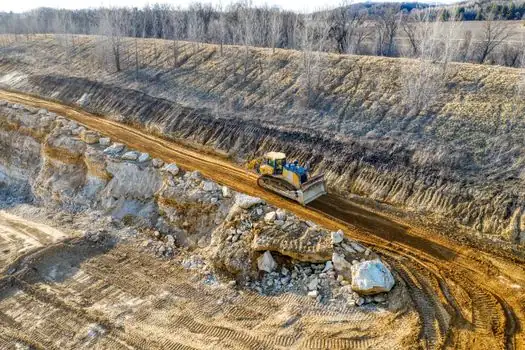
Decision matrix: which class to specify, on the four gates that actually break a quarry selection. Read across capacity, drivetrain, attachment, and hire-versus-buy. [S5]
3-5 t class: capacity 3-5 t, typically 4WD diesel, standard forks plus optional side-shifter, hire for short campaigns or sub-800 hr/yr duty, buy only for multi-site service fleets [S3][S5]. 6-10 t class: capacity 6-10 t, 4WD articulated diesel, slab clamps and block forks for dressed stone, the most common quarry buy because it covers both block and consumable cycles, the hire-versus-buy crossover sits near 1,200 hr/yr [S3][S4][S5]. 10-16+ t class: capacity 10-16+ t, 4WD articulated diesel with reinforced mast and heavy-duty hydraulics, dedicated slab or block fleet, buy is usually justified above 1,500 hr/yr, hire is the default for one-off block moves [S3][S5].
Cross-check every class against the published load chart at the working mast height and tilt, and against the 30 degree slope rating, before signing [S4][S5].
Common failure modes and what to do about them
Common failure modes and what to do about them, in order of frequency on quarry fleets: dust ingestion into the air filter and hydraulic return, mast roller and chain wear from side-loading on uneven ground, tyre cuts and sidewall failures on sharp rock, and chassis flex cracks around the articulation joint [S5].
Each has a specific prevention step. Air and hydraulic filtration: enforce filter-change intervals by hour meter, not by calendar, because dust load varies more than time [S5]. Mast and chain: train operators to approach square to the load and to use the leveler rather than the tilt to correct on uneven ground [S4]. Tyres: spec off-road tread patterns with reinforced sidewalls and carry a documented rotation and pressure schedule [S4][S5]. Chassis: include annual NDT on the articulation joint welds for any unit over 5,000 hours, and budget for it.
For procurement teams also fitting out crusher lines and conveyor supports, a related industrial coating selection for general fabrication spec path can be run in parallel, since the same abrasive-air and wash-down environment that chews forklift filtration also chews the chassis paint and the structural steel around it.
Sourcing and standards to pin in the enquiry
Sourcing and standards to pin in the enquiry: ROPS/FOPS for the operator cabin, diesel emission class for the destination market, and a written load chart at the worst-case lift height plus mast tilt the cycle actually uses [S4][S5].
List the supplier's published quarry or mining reference list with hours and product handled, ask for the service intervals in engine hours, and ask for the hydraulic and filtration consumables priced for a five-year horizon, not just the first service [S5]. For a buyer also standing up dust-heavy processing, dust-suppression planning runs alongside, and the same logic that drives sand cooler selection for hardware manufacturing foundries on heat-and-abrasion duty shows up in forklift cooling-package sizing [S5].
Track the next two signals before the next procurement review: OEM publication of load charts at 30 degree slope for the 6-10 t and 10-16+ t classes, and any regional diesel-emission rule change that retires older chassis from quarry sites, both will reset the buy-versus-hire crossover for 2027.
Spec-level background on the components involved: pressure transmitter.