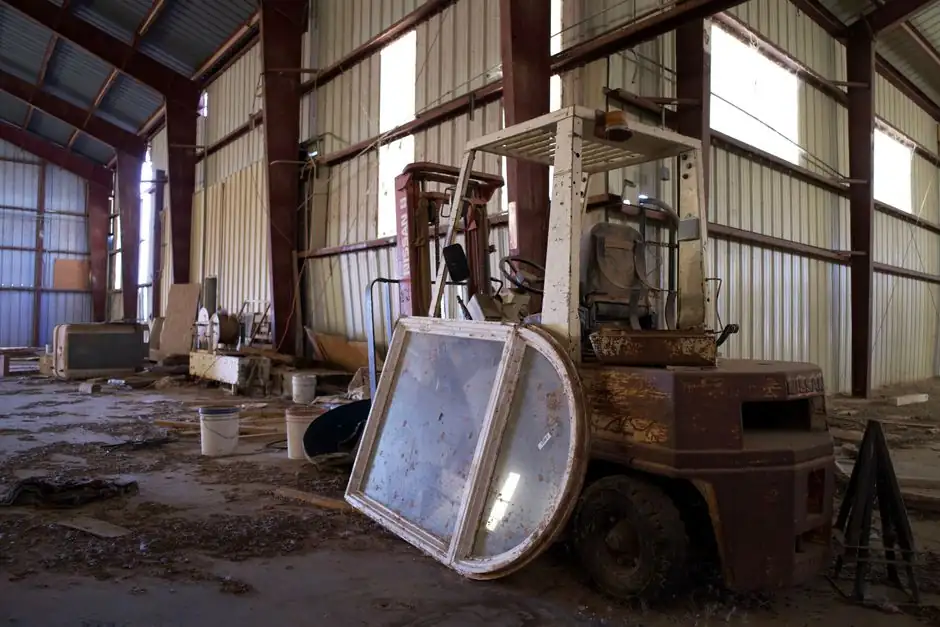
Underground construction sites punish standard forklifts: low headroom, rock-fall debris, water seepage, and gradients of 25–30% in access ramps force the specification toward a dedicated rough terrain forklift rather than a converted warehouse unit. The dominant Class VII machines in 2025/2026 OEM literature cluster around 2.5–4.0 t lift capacity, 55–78 kW diesel power, and 4WD with locking differentials [S2][S3][S4].
Tunneling adds three constraints not present on open construction sites: fixed cross-section height (often 4–6 m finished, less during rough excavation), diesel-emission restrictions tied to ventilation capacity, and continuous abrasive dust. These constraints reshape the decision matrix that the forklift selection guide otherwise uses for general outdoor work [S6][S7].
Ground clearance and ramp gradient: the two non-negotiable numbers
Tunneling sites routinely deliver 30–45% climb capability to off-road forklifts, with 25% side-slope tolerance in published rough-terrain specs [S5]. OEM data from Maximal shows 250 mm ground clearance on the 2.5 t 2WD rough terrain variant and 284.5 mm on the 3.5 t unit; the larger EIRMON RT50 (5,000 kg) reaches 330 mm at 5,700 kg operating weight [S4][S2]. For a tunnel invert with 200 mm muck, water, and stray rail, 250 mm should be treated as a floor, not a target.
Selection logic from a 2025 scenario-based guide treats clearance as the critical metric for obstacle handling, with the 300–500 mm band reserved for stone-yard and mining-class work [S7][S5]. Inside a finished tunnel bore, however, overall machine height matters more than clearance: the JCB 926 ships at 5,780 kg with up to 6.7 m mast, and closed-height must clear ventilation ducting and overhead conveyor supports [S3].
Diesel stage, emissions, and tunnel ventilation: the hidden cost driver
Stage V JCB DIESELMAX at 55 kW (74 hp) is the current benchmark for European-bound Class VII forklifts, with 440 Nm torque and a documented 8% fuel reduction versus the outgoing model [S3]. A 100% jaw self-locking differential design, as on Maximal 2WD rough terrain, is now standard for self-recovery in mud and rock-fall [S4]. For tunnel work, the practical question is ventilation air: each litre of diesel burned consumes roughly 10 m³ of air per minute to dilute fumes to safe working levels, which quickly dwarfs engine efficiency gains.
Luken Machinery's 2025 function summary quantifies the diesel envelope at 3.0–6.0 L, 80–150 hp, Euro VI / EPA Tier 4 compliant, with electric alternatives at 60–100 kW and 100–150 kWh battery packs giving 5–7 hours runtime [S5]. On a long tunnel with limited ventilation, the electric Class VII variant starts to make economic sense despite the higher unit cost, especially for short-shift material restock near the face.
Mast versus telehandler: which Class VII geometry fits the bore
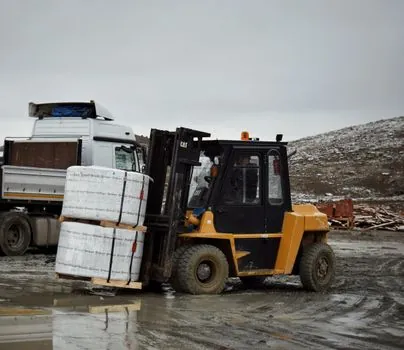
OSHA's Class VII definition (cited in OEM buying guides) splits into two configurations: vertical-mast rough terrain forklifts, which resemble counterbalance trucks, and variable-reach telehandlers, which add a boom pivot [S10]. The decision hinges on reach geometry: in a tunnel face, the operator typically works within 3 m of the machine, so a vertical mast is usually sufficient and cheaper, but forepole support and shotcrete-sprayed sections often require the forward reach of a telehandler variant.
A practical RFQ comparison matrix for the procurement engineer:
1. Capacity at 600 mm load center: rough terrain mast 2.5–3.5 t (JCB 926 at 2.6 t, JCB 930 at 3.0 t, Maximal 3.5 t); telehandler 3.0–4.0 t for the same envelope [S3][S4].
2. Maximum lift height: mast 3.0 m (EIRMON RT15–RT100 all 3,000 mm); JCB mast 6.7 m duplex/triplex; telehandler typically 6–8 m forward reach [S2][S3].
3. Turning radius: JAC CPCD35J at 2,850 mm turning radius with 1,610 mm overall width is the tightest in published spec sheets, useful in narrow tunnel side-drains [S8].
4. Ground clearance at rated load: 230 mm (1.5 t), 250 mm (2.5 t), 284.5 mm (3.5 t), 330 mm (5 t) across the EIRMON/Maximal range [S2][S4].
Attachments, tires, and undercarriage for rock and shotcrete
Pallet fork attachments are the central load-handling device for in-tunnel transport of consumables, mesh-box pallets of rock bolts, and palletized hydraulic power packs; matching the rated capacity of the fork to the residual capacity of the carrier at the actual load center is the safety-critical step [S1]. Industrial-grade off-road tires with deep tread and reinforced sidewalls, 18–24 inch, are the published norm for stone and shotcrete yards, with 405 mm flotation 12-ply at 350 kPa max cited in straight-mast rough terrain RFQ templates [S5][S6].
Mining-class sealing matters underground: IP65-sealed electrical components and ROPS/FOPS cab structures with 360° visibility are now baseline on Luken-spec machines, alongside -25°C cold-start and 45°C high-heat capability for portal work in winter and deep-bore summer ventilation failures [S5]. Operator presence sensing, seat-belt interlock, handbrake-engaged start, and neutral-only cranking are listed as standard start-interlock logic on Maximal 2WD rough terrain, which translates directly to conveyor-fed tunnel environments [S4].
Scenario-based selection: which tonnage for which tunnel
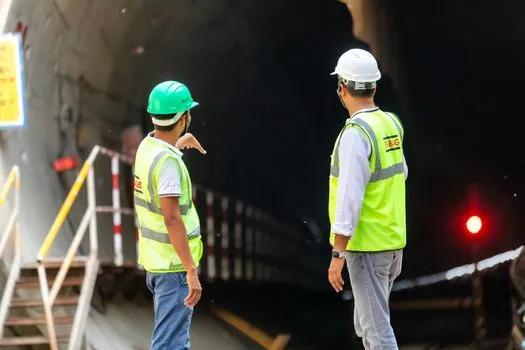
The 2025 LTMG scenario guide organizes selection around five pillars: terrain adaptability, ground clearance, traction, stability, and maintenance access; muddy sites and gravel slopes are explicitly called the graveyard of standard forklifts [S7]. For a 4 m finished-diameter utility tunnel with rail-mounted muck cars, the 2.6 t JCB 926 or a 2.5 t Maximal 2WD fits the envelope and keeps tire scrub inside the gauge. For a 6 m road tunnel with segmental lining and gantry cranes, stepping up to a 3.0 t JCB 930 or 3.5 t EIRMON RT35 (4,400 kg, 240 mm clearance) is the conservative pick [S3][S2].
For stone yards and portal laydown areas feeding the tunnel, the 7 t / 4WD class (Blanc-ele RT70 series) and 10 t EIRMON RT100 (8,500 kg, 350 mm clearance) handle block-stone and rebar bundles, but neither is dimensionally compatible with a live tunnel bore. The procurement rule: keep one size class above the maximum load you expect to lift, because published capacities are at 600 mm load center, and tunneling consumables (water-stop rolls, geotextile, lattice girder segments) often stack at 700–800 mm [S9][S2].
Failure modes and what to refuse at delivery
Common rough terrain forklift failure modes in tunneling are not the engine or the hydraulics; they are tire sidewall cuts from rebar stubs, brake fade on long downgrade ramps, and mast chain stretch from sustained rock-bolt loading above the rated center [S5][S7]. Acceptance inspection should confirm 4WD engagement under load (not just on level ground), 72° internal steering angle clearance in the bore, and a documented 500-hour engine oil service interval, as published for the JCB RTFL family [S3][S4].
For procurement teams comparing Class VII candidates for underground use, the rough terrain forklifts for demolition projects spec path covers the 3–10 t 4WD selection in adjacent demolition work, while a related demolition spec sheet on aluminum ladder duty rating and access rules covers the access equipment that operators will mount to and from the forklift cab. Both are useful cross-references when the same contractor handles tunnel support and surface demolition in the same bid package.
Trackable signals for the next procurement cycle: Stage VI emissions regulation taking effect for non-road mobile machinery in the EU, the gradual arrival of 60–100 kW electric Class VII units with 5–7 h runtime, and the slow displacement of 2WD rough terrain in tunneling by 4WD-only configurations to meet the 30–45% gradient capability that portal ramps demand [S5][S7].
Spec-level background on the components involved: pressure transmitter.