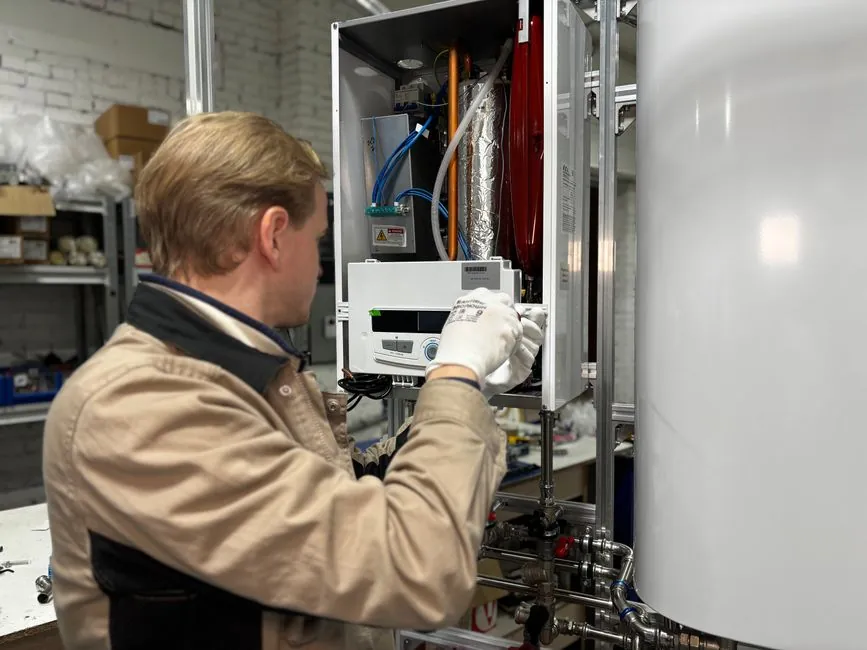
For drain slope, fixture rough-in, and vertical pipe transfer on plumbing jobs, the working spec is a self-leveling line or point-to-line laser with ±1/8 in accuracy at 30 ft, dual plumb points perpendicular to a horizontal line, and IP54 or better sealing against job-site moisture [S5][S7].
Beam color matters more than most spec sheets admit: green beams stay visible to roughly 30–50 ft in lit interiors where red beams wash out at half that distance, while red still wins on battery life and cost for crawl-space and residential service work [S5]. Rotary lasers enter the picture only when sewer or site-drainage runs exceed roughly 150 ft and a detector-equipped receiver is part of the kit [S1][S3].
Accuracy, Range, and the 1/4-Inch-Per-Foot Drain Rule
Code requires a 1/4 in per foot slope for residential drains, with a 1/8 in per foot fallback on larger-diameter building sewer lines; a laser accurate to ±1/8 in at 30 ft holds that slope across a typical 20–40 ft rough-in without re-shooting [S5]. Professional-grade rotary units tighten to roughly ±1–1.5 mm per 10 m (about ±1/16 in at 33 ft), which is more resolution than drain work needs but matters when you are setting elevations across a full slab [S7].
Working range splits into three bands the plumbing trade actually uses: 15–50 ft for fixture rough-in and single-bath layout, 50–100 ft for whole-house interior work, and 100–300 ft with a receiver for commercial multi-floor and exterior sewer runs [S3][S1].
Plumb Points vs Cross Lines: Pick by Job, Not by Catalog
A 3-beam point (plumb) laser plus two horizontal beams at a perfect 90° is the most versatile configuration for residential and light commercial plumbing, because it covers floor-to-ceiling pipe transfer, level transfers, and squaring shower corners in a single setup [S2][S4]. Cross-line units project a level plane and a plumb line on the wall, which is faster for repetitive horizontal runs (chair-rail-height supply lines, sink brackets, tub rails) but weaker for vertical drop shots into ceilings [S4].
A direct field comparison: 3-beam plumb lasers (PLS 3R class) transfer points between floor and ceiling with one setup, cross-line units (PLS 180R / 6R class) lay out long horizontal runs with one setup, and combo units merge both, trading battery life and price for fewer tool swaps on multi-trade days [S4]. Rotary lasers only beat both on runs over 150 ft where a point or line is too dim to read without a detector [S1].
Beam Color, Self-Leveling, and Mounting
Green-beam diodes (520 nm class) read at roughly 4× the visual distance of red (635 nm) under typical interior lighting, which is why green dominates new plumbing-spec purchases despite 20–30% higher cost and faster battery drain [S5]. A pendulum self-leveling mechanism with an out-of-level indicator (flashing beam or audible alert) is standard on every professional unit; the lock switch that protects the pendulum during transit is not optional on commercial jobs where a tool gets moved 20 times a day [S5].
Mounting drives daily speed: magnetic pivot bases stick to steel studs, HVAC duct, and torpedo levels, a 1/4-20 tripod thread fits every layout tripod, and a jamb-pole or wall mount replaces a tripod in finished rooms where a tripod tip would mark a floor [S5][S1]. For broader layout context, see the encyclopedia entry on laser levels and the related encyclopedia entry on laser markers for beam-source trade-offs.
Durability, IP Rating, and Power
IP54 (dust-protected + splashing water) is the floor for any plumbing laser that will see crawl spaces, tub boxes, or an open slab; IP65 (dust-tight + low-pressure jets) is the right call for crews that drop tools off ladders onto concrete, which is most of them [S5]. Drop ratings are vendor-specific and not interchangeable, so ask for the test height in feet, not the marketing claim. Rechargeable Li-ion packs delivering 8–12 hours on green beam and 25+ hours on red are the 2026 norm; AA-cell models still exist for service vans where charging discipline is unreliable [S5].
For high-precision alignment work in industrial piping, the principles overlap with laser tracker metrology, where accuracy is stated in mm at distance and beam stability is the gating spec.
Selection Criteria: A Side-by-Side
Three configurations cover roughly 90% of plumbing work, and the decision pivots on range, color, and run length: (1) Point/plumb laser, 30–50 ft, red, ±1/8 in at 30 ft, IP54, sub-$300, suits single-fixture rough-in and apprentices; (2) Cross-line or combo, 50–100 ft, green, ±1/8 in at 30 ft, IP65, $300–$700, the workhorse for residential and light commercial; (3) Rotary with receiver, 200–300+ ft, red or green, ±1–1.5 mm at 10 m, IP54–IP66, $600–$1,500, mandatory for site drainage, sewer laterals, and commercial slab work [S1][S3][S5][S7].
Field rule of thumb: if the longest single shot is under 50 ft and the floor is finished, skip the rotary entirely; if the run crosses a foundation or a parking lot, start with the rotary [S1]. For comparison with related layout tools, laser screed systems use the same rotary-laser receivers for concrete flatness, and laser displacement sensors cover non-contact distance measurement where a beam would be lost. Maintenance habits for these optics are covered in automatic level maintenance practices in electrical installation, which transfers directly to laser-level calibration discipline.
Failure Modes and When to Repair vs Replace
Out-of-level flashes that ignore a known-flat surface, or a beam that splits into a double line, mean diode or collimator failure and warrant replacement rather than repair, because calibration cannot recover a damaged emitter. Verify any post-repair accuracy against a 30 ft chalk reference before returning the tool to a truck.
Trackable signals to watch over the next two quarters: green-beam pricing compression as Chinese OEM diodes (520 nm, 5–30 mW class) reach the under-$200 tier, and IP66 ratings migrating from rotary-only models down into cross-line combos priced under $500, which would shift the durability baseline for plumbing crews.